The IRISH BY ANCESTRY community turned out for the first Ancestor Story Flash Memoir Contest this September. After much consideration by our special guest judge, Irish author Shauna Lawless, the winner is NICOLA DEVENISH. She has won an Irish by Ancestry prize pack, a signed set of Shauna’s Gael Song trilogy, and will help choose the theme for October’s contest. Congratulations, Nicola! Here is her story, based on the theme FAMILY SECRETS AND MYSTERIES.
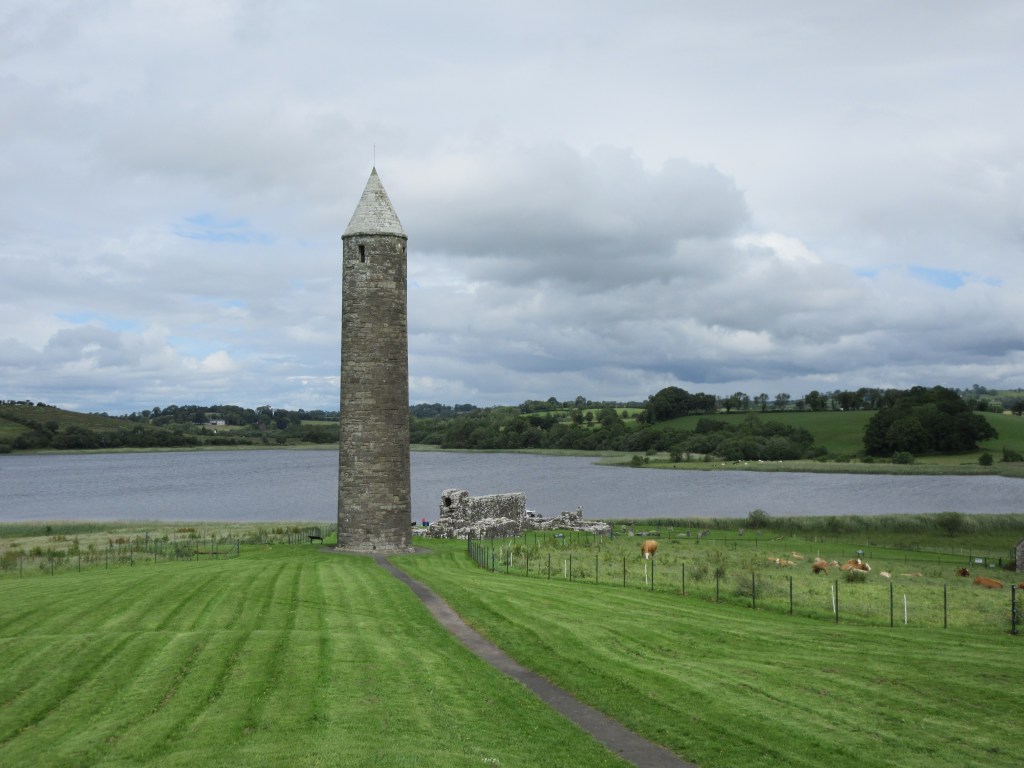
Echoes from the Round Tower
By NICOLA DEVENISH
Irish by Ancestry Member
In the heart of Athlone, Co. Fermanagh, a tower rises silently against the sky—its stones weathered by centuries, its purpose long whispered about in secret. This is the Devenish Round Tower, built by my ancestor, Sir Edmund Devenish, in the 17th century. On the surface, it was a monument to the family’s presence in the town, a symbol of strength and permanence.
But beneath the stones, it held a secret that would haunt generations.
During construction, Sir Edmund uncovered a concealed chamber beneath the foundation. Inside lay manuscripts and artefacts that spoke of a settlement far older than anyone imagined—pre-Christian, cloaked in symbols no one could decipher. Some said the knowledge was dangerous, others that it was cursed. Sir Edmund sealed the chamber, leaving behind cryptic warnings in journals and letters, but he spoke of it to no one. The secret became a shadow that followed our family quietly, whispered in corridors of memory, dismissed as legend.
Generations passed, and the Devenish name flourished in Athlone. Yet I always sensed the tower watched, holding its secrets in silence. One rainy afternoon in 2025, I stumbled across a faded letter in the family archives, written in my ancestor’s hand, pointing to the hidden chamber. It was a map, almost too faint to read, with an instruction that felt like a dare: “Those who seek must be prepared to face what lies beneath.”
With permission from local authorities, I returned to the tower. As the stones gave way to the chamber beneath, a chill ran through me. The manuscripts lay in perfect order, preserved as if time had paused just for them. Maps, genealogies, and cryptic notes revealed a history of Athlone I never knew existed—a story of alliances, betrayals, and a lineage intertwined with secrets the world had long forgotten.
Standing there, in the hush of the hidden chamber, I felt the weight of centuries pressing down, the echo of my ancestor’s choices reverberating through time. The tower, once merely stone, now seemed alive, a sentinel guarding not just history, but the truths families sometimes hide from themselves. I understood then that mystery is not just in what is lost, but in what is deliberately concealed—and that some secrets are meant to wait for the right eyes to find them.
The Devenish Round Tower still stands in Athlone, silent yet speaking, daring the curious to uncover the truths it has held for centuries. And now, as a descendant, I carry the story forward, the secret finally shared, yet still humming with the mysteries that time refuses to reveal.
Nicola’s story wasn’t the only entry that caught our judge’s eye. Kevin Kelly’s story was a second-place winner! She said this one was especially well-researched, high praise from Shauna. Here it is:
My Family and other Secrets
By KEVIN KELLY
Irish by Ancestry Member
Like many people, I suppose I secretly hoped for a brush with greatness in my family tree—perhaps Brian Boru, Daniel O’Connell, or Oscar Wilde were waiting to be claimed as a distant cousin. What I found instead was a story far stranger, far more human, and far closer to home.
I wasn’t a Kelly by birth; I was adopted when I was a few months old and had never been really interested in my family tree. At least not until there weren’t many people left alive who remembered the stories. My Auntie Maureen had survived several bouts of leukaemia, and she was the last person on both sides of my adoptive family who was still living. She was my Dad’s younger sister; Dad and his brother George had already died, as had Maureen’s Mum and Dad, my Granny and Grandad.
We went to see her shortly before she died. By then I had started doing some research into the Kelly family history but kept running into dead ends.
“My name isn’t really Maureen,” she told us, “I was baptised Mary.” One mystery solved, several dozen others to go.
“And I’m sure you know the story about how your Dad almost died in a fire, and Grandad had to pass him up through the skylight onto the roof where Granny was waiting, and they escaped across the roofs—it was in all the papers!”

They were staying in the Fianna Fáil Headquarters when it was firebombed in July 1930 – Dad was just 3 months old. “Grandad had been De Valera’s chauffeur, and he gave them the upstairs flat to live in after they were married.” De Valera’s chauffeur? No one had ever told me that. Maureen hinted that he may have been something more than just a chauffeur – a bodyguard perhaps, but she wouldn’t be drawn on that.
I knew that Grandad had fought the Black-and-Tans in the War of Independence and had been on the anti-treaty side and been imprisoned. “Grandad was born in Manchester in 1899.” I had always known that Granny was born in England, and her maiden name was Woods. She had come to Ireland as a young girl, but it was a surprise to discover that Grandad, who was fiercely anti-British, was himself British by birth.
It seemed that every answer Maureen gave me only cracked open another hidden door:
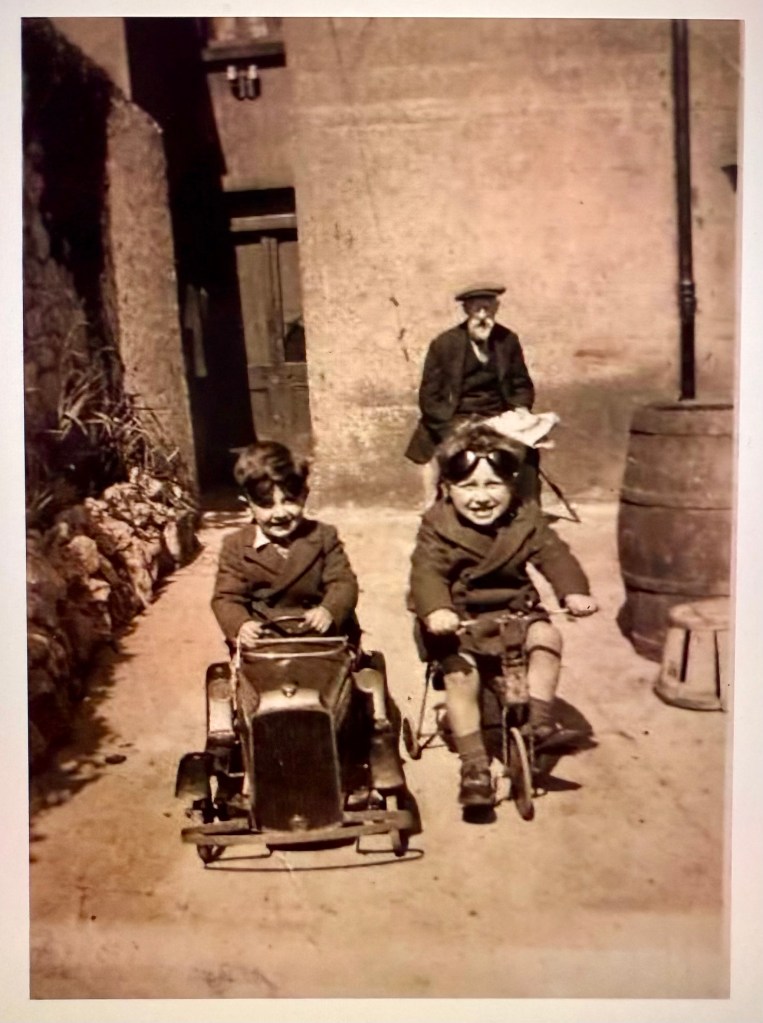
“You know, of course, that Granny was adopted?” No! “Her father and mother died, and she was adopted by a family friend. I’m not sure what happened to her Mum and Dad but she was told when she was 16.” Granny never spoke about her biological family, but there was a picture of an old man watching my Dad and his younger brother George driving pedal cars. Granny had said that it was her father, Richard Woods. He had lived in Dun Laoghaire, and when he died, she had inherited the house.
I went digging in the archives, and after many false starts, I discovered that Granny had been born Mary Hanlon. Her father, Edward, had been a soldier in the British Army, a Lance Corporal in the 5th Battalion of Lancers who had fought in the Second Boer War and had been invalided out after contracting a kidney infection from bad water.
He had died when Granny was 2, and her mother, Margaret Dwyer, took the baby back to Dun Laoghaire but she died soon afterward. There was no formal adoption, but Richard Woods and Esther Dunkling gave her a home and raised her as their own.
There was another surprise to come.
Maureen added, “Before I was born, Granny had another baby, a girl, but she died soon after being born.” I wonder whether Granny ever had anyone to talk to about the pain of losing a child. It was probably taken away from her immediately after the birth, and she never saw the baby again.
I didn’t find Brian Boru or Daniel O’Connell in my family tree, but sometimes it is the discovery of an unknown relation that is more striking. There is no record of the birth or the death of Patricia Kelly, but she hasn’t been lost to the shifting sands of history. Her name lives on in the Kelly family tree.
And finally, Shauna could not resist the heartwarming story submitted by Eric Cronin, about his endearing relative and his relationship with her. Here is that tale:
Aunt May
By ERIC CRONIN
Irish by Ancestry Member
Today, I’m writing about a photo of a letter from my father’s aunt. Aunt May—I do remember that this spirited aunt played an important role in my father’s life. He considered her his second mother and sometimes even a little more, I think. Aunt May was often discussed at home; she moved to London, just like my grandmother and my father. I never knew how she was related to our family; we never thought about this.
For us, she was simply Aunt May.
Aunt May became a widow at a very young age (she had the urn on her mantelpiece, which was strange to me; it was forbidden in Belgium), and my father knew his uncle Dick well. He was more than a role model to him. When my father spoke about his uncle, his words were always filled with deep admiration and intense respect. I had the privilege of meeting his Aunt May twice; she is (besides Jerry Clifford) the only member of our family I have ever seen and spoken to.
After all these years, I can still vividly remember both meetings. The first time was during a school field trip to London. We managed to arrange for me to visit my great-aunt for half a day, a visit I’ll never forget. She was waiting for me at the agreed-upon time and place, and she immediately called me over. She’d never seen or heard me, but recognized me instantly. “No problem,” she said, “you’re as ugly as your father,” followed by a burst of laughter. She took me away in her tiny car and drove through London as if she were alone on the road. She honked and drove in a way that made the experience feel very similar to riding a rollercoaster at an amusement park. Aunt May was small in stature, but oh so grand in both action and presence.
She made me feel as if she’d known me for years, and she kept talking all afternoon. I remained silent and enjoyed myself, feeling a strong connection with her, and still do. I immediately understood why Father loved his aunt so much. She still spoke Irish—not Gaelic, but Irish the way Irish sounds.
At the end of that blissful afternoon, she took me back to the place in London where we were staying. A little later, I realized I’d forgotten my backpack in her car, which was a disaster. My father’s passport was in it, and I needed it at the border. My father needed it when he traveled. I was the only one in the group with an EEC passport and Irish citizenship, and I had to have it with me. So, panic set in, and what next? Suddenly, Aunt May appeared in the hotel and sternly addressed me, saying, “Your father will kill you for this, and if not, I will.” Of course, she wasn’t serious, and she had a smile on her face that spoke volumes. My father never knew this; I remained silent, and so did Aunt May.
The second time I visited Aunt May was with my father. We were in London and stayed for one night in her incredibly cozy and warm basement flat. That evening, there was no need for TV or radio; we had Aunt May’s company, and no TV or radio program could match that. Both reminisced, laughed with and at each other, and you felt a deep and intimate friendship between them, a bond forged for life and much more.
After a much-too-late night, Aunt May had provided a breakfast as Irish as Irish can be; everything was there. After this breakfast, we were ready for another week. We weren’t allowed to leave without a packed lunch, which also lasted us a few days.
And then came the farewell, a deep, warm, and intense hug, a blessing from above, and we were on our way. I could tell that this visit was a moment to hold on to and cherish for Dad, Aunt May, and me.
Both Dad and Aunt May kept in close contact. Facebook and email didn’t exist in those days (I’m sure our great-aunt would refuse to know about any of these things). A simple phone call, with the necessary quips during the conversation, was enough. All I have left from this brave aunt is half a letter. In it, she indicates that she has remarried and moved back to her native Ireland. In Belgium, we say “home is where your heart is,” and for her, that was Ireland. It’s only half a letter, but for me, it’’ enough. I still have something from her from years gone by, and reading it evokes memories and feelings as if it were today. That’s why I’d like to share the letter with you, though not in its entirety. I can’t read the address on the letter.
I don’t know Aunt May’s last name, nor can I find any birth records or other information, but I have the letter and my memories. That’s how Aunt May came into our lives, and knowing that is a comforting feeling. Even though I never heard from her again, an “unknown, yet well-known lady.”
Aunt May passed away at an old age in her homeland. I’m sure she’s up there with my parents and brothers, and the conversations between them are endless. Hopefully, there are no cars or roads there, because Aunt May and driving don’t mix well, or maybe they do …
This letter is an ode to the only sweet and kind Aunt May, a lady to be proud of. Aunt May, my father’s aunt, and so much more.
THANKS TO EVERYONE WHO PARTICIPATED! We will announce this month’s contest on Irish by Ancestry by Oct. 3, so there will be plenty of time to get YOUR Ancestor Story Flash Memoir submitted. And a special thank you to author Shauna Lawless, our special guest judge this month. Don’t miss our full interview with her or our review of her first novel, Children of Gods and Fighting Men, as we read that for this month’s Brigid’s Library book club selection. Join us!
 RELATED ☘️