Author Shauna Lawless brings historical twists to Irish myth
By SHELAGH BRALEY STARR
RELATED ☘️ Staff
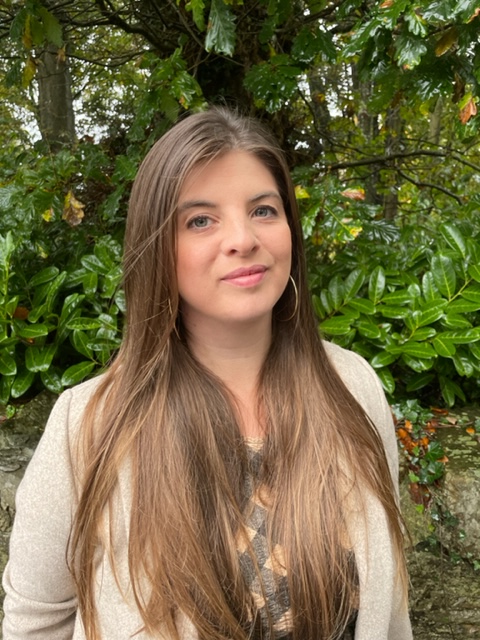
Shauna Lawless had no expectation of being a published author. Yet here she is.
“I love writing,” she said from her home library in County Down one recent afternoon, “but being published is another thing altogether.”
The steady mother of three now has published four historical fantasy novels and three novellas set in the same world. (The first, CHILDREN OF GODS AND FIGHTING MEN, was chosen as the book of the month for Brigid’s Library Book Club—see REVIEW for details.) She took up writing in her thirties.
“I started to get serious about it then. This is what happens when you start to talk about your writing: People always say, ‘Oh, you want to be the next JK Rowling,’ or ‘When will your book be published?’ ” She laughed. “When you take up jogging in your thirties, and you tell people, ‘I joined a jogging club,’ they don’t say to you, “So when am I going to see you in the Olympics then?’ ”
The trilogy draws on the mythology of two supernatural tribes of Ireland, the golden gods of the Tuatha de Danann and the Fomorians, a race of evil creatures from beneath the sea. These characters born of myth are caught in time, 10th to 11th century Ireland, between the Vikings and King Brian Boru. Boru, who turns out to be less saint and more warrior than colloquial history would characterize him, illustrates a point especially important to Lawless, to keep history straight, even in fiction.
“It’s the research. I knew a lot of history already, of course, but when you’re writing, even if you know history, you have to dig and look, because you have things that you will have picked up wrong or even out of sequence,” she said. “I read very long textbooks about history in this time and visited locations—that’s always helpful so you get a feel for the place, even though obviously modern Ireland is very different.”
She recalled visiting Rathlin Island, a wild spot in the sea between Ballycastle, Co. Antrim, and Scotland, a location that features in the series, to refresh herself on the landscape and finer sensory specifics. “I asked as I looked, ‘Now, how big are the cliffs, and which one is the tallest?’ That’s always fantastic to feed that into the story.” As Lawless shopped the manuscript to agents, her precise attention to historical detail led one agent to suggest she strip the story of its Irish names so it could be marketed more widely.
“He said, ‘It’s really good—would it be better if you took away all the Irish names and just based it on the Irish myth? Or would you take all the Irish out?’ I could see the sense in it, but I couldn’t do it, no matter how logical it was. I just listened. It’s marketing. They say, ‘Oh, if you just called him King Tyrion the Third of Lannisterland instead of Brian Boru …’ The details of history would still be there, everything that happens is the same. But no, in saying that, I just couldn’t do it.” Her loyalty to the origin of the characters held strong. “You just have to write what’s in your heart.”
Retaining the Irishness of the stories was more than a personal decision. She actually hopes it eases the way for more of these stories, not just the myths of Ireland but the folklore and mythical retellings of other cultures as well.
“This is one thing that people should know: how hard it is to get these books out there. It (the Gael Song trilogy) was almost seen as something that wouldn’t make money,” she said. “There are the cultural retellings that go everywhere—Greek, Roman, Norse. But others, you don’t have the familiarity in the western world that they do. So, if you ever see another culture that is not those three things, those authors had to try so hard to get published.”
Championing other cultures’ mythologies and folklore is high on Lawless’ list. She quickly ticked off Shelly Parker Chan’s Drowned World Series, an Asian-Australian fantasy based on Chinese and Southeast Asian myths; Katherine Arden’s Russian- and Slavic-inspired The Bear & the Nightingale; R.F. Kuang’s Poppy Wars, which incorporated elements of Chinese mythology; and the Rage of the Dragons duology by Evan Winter, rooted in African myth.
She said myths from other cultures are not received on the same level as the known classics, and are often dismissed as uncool or worse—not commercial. “They (other cultural myths) are not seen as being academic, it doesn’t have that literary star above it. These authors had to try really hard, and that publisher had to be really impressed to make that happen.”
“These, to have been picked up and published, had to be really good,” she said.
Count Lawless’ storytelling among those “really good” works on which publishers have taken a chance, as the global wave of awareness for her Gael Song trilogy grows among fantasy, historical fiction, and Irish myth-loving readers.
There is a quiet pride in continuing the long history of literary excellence coming out of Ireland. She points to Maeve Binchy and Joseph O’Connor as her favorite Irish authors. “Light a Penny Candle and Star of the Sea are two of my favourite books. Also Milkman, which was a Booker prize winning novel by Anna Burns.”
“In Ireland, there’s so much (creativity). You go into any pub, any community center, restaurant, anywhere, and there’s people singing and telling stories. But they do not necessarily equate greatness in the arts with success or wealth. If you say, ‘I went to see Coldplay down at the big arena,’ someone will say, ‘Ah, your man down the road is playing tonight at the local pub, and he’s better.’ And they mean it.”
So, money and fame do not necessarily equate to success in everyone’s eyes. “The money side and success side are not maybe everything here as it is in other places,” she said.
Lawless lives in a small town where her celebrity is expanding. “When someone does make it big here, they love it,” she said. “They’re always stopping me, congratulating me, when they see interviews about me in the papers.” She said it creates conversation, “lovely interactions I have about my books. People say, ‘My parents told me about these myths, and I loved them.’ “

She credits her own father with what she calls the “research bug.”
“I was very lucky to get my research bug from my dad. He’s done a lot (of ancestry seeking) and gone a long way back. And there is a legend on my mother’s side that still needs tending. Hugenots had come in, and my great-grandad was Protestant and rich. Granny was Catholic and poor. So, he was shipped off to New York, but he came back for her.”
She spoke of the difficulty so many experience while tracing roots in Ireland. “So, we have this legend, but it’s really hard to find records because of the Troubles and because of the Irish War of Independence. But it’s something I would like to find out at some point.” She laughed.
“Isn’t that terrible? I’m in Ireland and I haven’t researched it, and we’ve got all these Americans and Australians (doing ancestry work) … It will inspire me to get digging on this.”
You can buy the first in Shauna’s Gael Song trilogy, Children of Gods and Fighting Men, with the code LAWLESS20 from Bloomsbury, and there’s still time to participate in October’s book club sessions! You can preorder the most recent of Shauna’s books, Daughter of the Otherworld, at a discount, too, with code OTHERWORLD30. Sign up at Brigid’s Library and then join the Brigid’s Library Facebook group for fun and community.
Shelagh Braley Starr is a serial media-tech founder who got her start in traditional journalism, working for The Boston Globe and the Boston Herald, before entering a career in tech. She co-founded MyLifeList, an award-winning social network focused on bucket list achievements. There, she discovered a love for relevant advertising that could actually help members achieve their goals. Since then, she has built multiple platforms, aligning eager advertisers with buyers who seek their goods and services across multiple sectors. Seeking her own Irish roots, she founded By Ancestry Media after uncovering a deep misunderstanding between Ireland’s citizens and those who are Irish by heritage. She is currently working on a novel based in Irish myth, from the perspective of Cu Chulainn’s wife.
 RELATED ☘️