MEMOIR CONTEST—FAMILY FEASTS AND RECIPES
We asked you, the Irish by Ancestry community, to share stories and memories of your FAMILY FEASTS AND RECIPES for November’s Flash Memoir Contest, and you did not let us down. The traditional meals shared, the special times, the delectable recipes! Everyone’s family has unique flavors.
Our winner this month, EMILY TRASK, shares a revealing moment in her family’s history over dinner, from Tubbercurry, Co. Sligo to New York City. The details in this story are as delicious as the meal described. Congratulations, Emily! Here is her story.
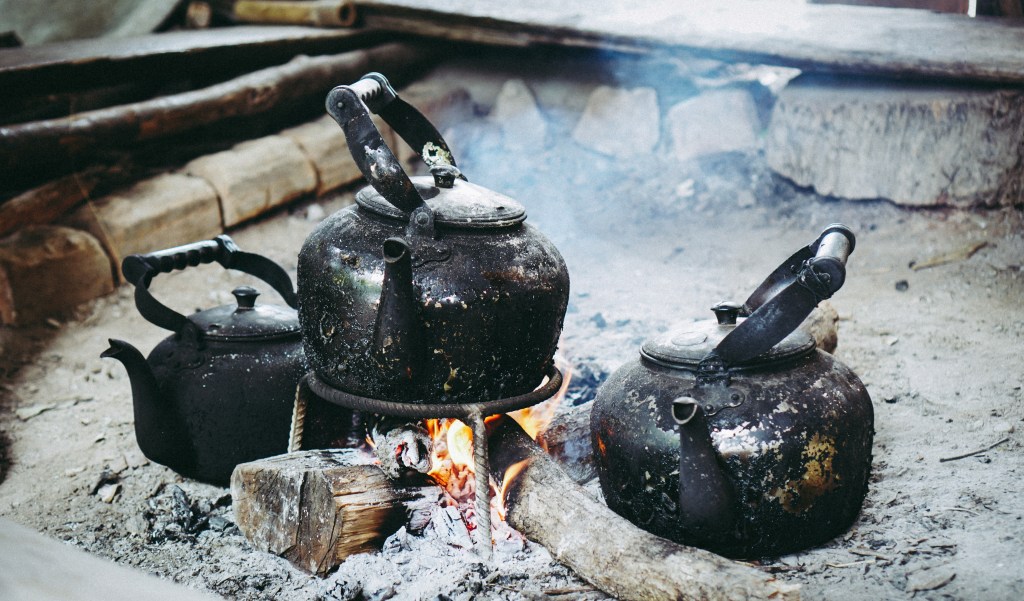
Turf
By EMILY TRASK
Irish by Ancestry Member
Smoked shoulder simmered on the enameled gas range, its sumptuous saltiness curling into every corner of her far-upper West Side apartment, along with over-boiling pots of potatoes and cabbage. A tinge of natural gas lingered in the air. And the windows were dripping with condensation.
Delia was well into her 80s at this point in 1990, but her giant farm-worn hands never
stopped—washing, ironing, folding, slicing, pouring, baking. And they moved as she spoke in a lilting way that matched the timbre of her still-distinct brogue.
She carefully stirred milk into the potatoes with a wooden spoon that was probably 40 years older than I was while she explained how to get them seasoned perfectly with no lumps. (Lumpy mashed potatoes were tantamount to blasphemy.)
“And the secret to cabbage is to add baking soda to the water. It keeps it green and not so anemic-looking.” She folded the drained cabbage into a well-seasoned cast-iron skillet, still slick with bacon fat she had fried earlier.
“You know,” she said, without looking up, “I’d have married a farmer with dung up to his waist if I’d stayed in Tubbercurry. That was the plan for me. Me! Can you imagine?”
She laughed. Sharp and defiant.
“I was only six when my mother died from consumption. My three sisters were sent off. I was chosen to stay behind to mind Father and work the farm because I was strong. It was rather lonely. We barely spoke for days on end. He’d often just sit in the corner of the kitchen of our stone cottage, pipe cold in his hand, staring off into nothingness. The silence hung between us. He wasn’t cruel at all. Just hollowed out.
He was gone fairly frequently—off on business or for a dance competition. He was a wonderful dancer.
But at harvest time, all the men from the village would come to help. Because that’s what you did. You helped each other. People don’t understand that today. But they all did—during the harvest. We were all land rich and cash poor.”
It fell to Delia—a 12-year-old child still too small to lift a full kettle without using both her
arms—to cook for all of them. Over the turf hearth, she boiled water for tea, simmered mutton and potatoes, stirred porridge, and baked breads and cakes for days to keep them fed.
“The wind came down from the hills with teeth in it that particular morning” she recalled. Her 18-year-old cousin, Michael, was one of the workers and liked to tease her. While Delia’s back was turned, he thought it’d be funny to press a bit of turf into one of her cakes.
“He giggled as I served it. I wasn’t sure why. I’ve always made wonderful cakes. One of the men bit in and spat it across the room. Michael slapped his leg and nearly fell on the floor. He exclaimed: ‘I don’t recall ever having bog pie before!’”
Delia’s voice hardened.
“Rage filled my little body. With both hands, I clenched the long, heavy iron tongs for the fire and smashed him in the knee.”
“Smack!” She smashed the spoon on the stove as she spoke. A few flecks of cabbage flew off, but she didn’t seem to notice.
“He let out a yelp and fell like a sack of barley. Never was quite right again after. Limped for life, I think. But I tell you this—and I told the priest the same—he deserved it.”
“You probably ruined his life,” I said. “Did you regret it?”
She spun around, her eyes blazing. “What a spiteful thing to do! I’d do it again.”
I wondered if that was when the idea to escape took root. Or was it when her mother was laid out to rest in the kitchen? Or when her sisters were taken away? Or when she saw her father weeping when he thought no one was watching? Perhaps it was all of it.
Delia was 15 when she sent the letter to a cousin in Brooklyn, who ran a boarding house. It read: “I hope you will help my daughter Delia emigrate to America and find work … She can cook.” … the only thing that was true.
Weeks later, a return letter and ticket arrived.
Her father had been off trading sheep in Mayo. But word travels fast in a village with one postmaster and too many “waggling tongues.” “She’s gone, James,” the postmaster said. Delia had planned to leave before he returned. But James came home early. He swung the door open wide and found her sitting at the table, hands clutching the letter and passage.
“It was dark with only the light of the fire and a single lamp. He slumped down in a chair across the table. He didn’t shout. Just put his head in his hands and whispered, again and again: ‘How could you do this to me, Delia? How could you leave me?’ ”
“There was nothing to say,” she said.
“I left the next morning and never saw him again.”
Delia didn’t cry, or ask for sympathy or understanding. Just served the meal. The meat was tender, the cabbage glistening green, the potatoes silky smooth. She plopped down a generous portion of potatoes on my plate, shaping a little well and dropping a knob of butter that started to melt immediately. Cabbage and shoulder next.
We began to eat in silence.
“My father was tired—from the land, the grief. He didn’t know what to do with a girl who constantly got into fights with the village boys, spent hours up in the hills alone with sheep, and didn’t want to be saved as everyone thought she should.”
She added: “Perhaps I am being punished for all of it—the tongs, the fighting, leaving Father. Almost everyone I loved is dead. Life is strange. You do what you have to.”
Mischief flickered in her eyes.
“But at least I never married a farmer with dung up to his waist.”
Emily’s story wasn’t the only entry that should be savored. Our resident bard, Eric Cronin, had one to share this month as well. It will make you laugh out loud. Here it is.

Christmas at Home
By ERIC CRONIN
Irish by Ancestry Member
Of all the days of the year, Christmas was a special day for Dad. It was a day we also looked forward to, albeit with mixed feelings. During the days leading up to this solemn and holy holiday, Dad transformed into the chef and party manager.
We saw Mother change too; her twinkling eyes, which on other days shone brighter than all the Christmas lights combined, dimmed a little and became dimmer. Mother could speak with her eyes; one look at her and you knew what was in store, good or bad. The more her eyes sparkled, the more joy and inner joy she radiated. And they often sparkled, more than the other look that foretold bad things, and usually came true. But in the days leading up to Christmas dinner, her special “concerned” look emerged. Everyone saw it, except for Dad, who was busy developing into a professional chef and party organizer of the year. He didn’t realize it all and continued planning and preparing undisturbed.
At Christmas, nothing was too much, and it could, no, it even had to be a little more … literally and figuratively. The recipe had been set for years and years and had only been changed once. The portions and quantities were calculated to ensure that neither was excessive nor insufficient. It was a time when, within the walls of our small, cozy, and warm home, the Irish spirit and customs blew in, immersing us in the traditions of his homeland. It gave everything that little something extra, and it was fine just the way it was, especially since it was Christmas. Mother could have done with a little less, but she enjoyed her proud husband’s antics, and we, we enjoyed it with him.
I still remember well what the atmosphere was like in the days leading up to Christmas. The Christmas tree was put up, and the preparations for the festive meal were meticulously made.
The menu featured a mix of Flemish and Irish dishes, keeping the Church at the center.
The most important ingredient of this holiday was the turkey. This festive piece was not allowed to be bought in a store under any circumstances. After all, in those days, Father was “the champion” at selecting the finest and best of this feathered breed. No butcher could match that.
Because I had just started my training as a butcher, I was allowed to go along to prepare the animal for the oven. After all, it was purchased live, so it was my responsibility, under the watchful eye of an expert, Jerry Cronin.
The turkey from Christmas 1975, in particular, will forever be etched in our memories. And it is often mentioned during Christmas dinners in the years that followed; I remember it as if it were yesterday.
My father had ordered a festive animal from his friend Pol, because Pol had the best turkeys in the world, and far beyond, in his care, true prize animals, my father said. Success guaranteed!
When we arrived at Pol’s on the day of reckoning for our feathered friend, the good man pointed out the pen where our main meal was being held, and strangely enough, he quickly disappeared.
When Father and I entered the pen, we saw a turkey the size and weight of a small ostrich. I might be exaggerating a bit, but not by much. In my years as a butcher, I’ve prepared many turkeys, but I haven’t tackled the size of our turkey that year. I’ll spare you the details of the slaughtering process; after all, we’re talking about the week of peace for everyone and everything, except … yes, turkeys, and other animals, both feathered or non-feathered, that appear on countless tables on Christmas Day.
Anyway, I can still see my father sitting astride the decapitated animal, clinging to its wings. In contrast, the poor animal ran through the entire enclosure, with Dad on its back. I can still see the panicked look on that brave man’s face, trying so hard to hold on, refusing to let go of the animal. No, he bravely stayed put, like a general on his horse. Around the entire enclosure, back and forth. And I stood there and watched. There was no stopping it; the battle between the two would be over in a few minutes, I hoped. After a few minutes, the poor animal finally gave up the ghost. Dad had held on, yet it shouldn’t have lasted a minute longer.
I can still see him sitting there, gasping for breath, the ouch and the aches from the pains he’d endured after that crazy ride. Covered in blood and mud from head to toe, he scrambled to his feet, mumbling “I have you BxxxxxD” through his teeth. The animal was finished off and taken home.
As proud as peacocks, we arrived home with our fantastic prize animal. Mother opened the door and glanced at the festive animal. I saw a little twinkle, but also a lot of panic. “Jerry, that thing will never go in our oven; it’s way too big. Even the leg or the wings barely fit,” in her wise and just words. She didn’t need a folding ruler for that. “Oops, sorry, Rooske, I didn’t think about this little fact,” was his reply. “I will solve that problem, don’t worry.” When Father said the words “don’t worry,” everyone knew we really were in a deep disaster.
I reassure you, dear reader, that Christmas didn’t turn out to be a disaster. The Christmas gods, out of compassion, more than likely provided a solution for Father. A large enough oven was found, and in it, the turkey cooked festively. The animal graced our table in all its glory, and we enjoyed it for a week in all sorts of different ways, because throwing food away wasn’t something you did.
Christmas 1975, a Christmas never to be forgotten, thanks to the courageous turkey jockey, Jerry Cronin, our precious dad.
Finally, though Jonathan is not eligible for any prizes as staff—he offers one to all who read this charming tale of the humble brown buns, the story of a recipe shared from pre-famine times in his family. This one is a treasure. Thank you, Jonathan.

Brown Buns for Tea
By JONATHAN BEAUMONT
RELATED ☘️ Staff
It’s freezing. We’re playing with logs in the back garden. The leaves that fell during the autumn are now a frost-coagulated, icy, uneven carpet on the ground. Daylight is fast fading. The sky is dark with clouds already. Darkness falls before four o’clock. Christmas was weeks ago. We’re halfway through the long, hard, dark, bleak, freezing slog that is an Irish winter.
Our dad is doing something at the bottom of the garden. He’s always at something down there. Chopping wood for the kitchen cooker, wrestling with the frozen soil to try to dig up the last of that old tree stump, or in the bowels of the “stables,” working at his ancient workbench, yes, the old one that came up to Dublin from the old family farm in 1929. Old paint stains all over it—three generations of my forebears cleaned their paintbrushes all over it. It’s viciously cold in that old shed too. You can tell—he’s sniffing constantly.
In the distance, the warm but weak light of the back kitchen porch flickers tantalisingly at us through the dark, bare branches of the old ash trees which stand between us and the inviting warmth of the kitchen. “Come IN! DINNER!” we hear our mother call from the back door; my dad puts down his saw and beckons to myself and siblings. “C’mon in now,” he says to us urgently. Any delay is not worth a scolding from my grandmother.
We are playing our games with logs, stones, and whatever else we find in the long hedge at the back. Our hands are freezing, but we’re Irish children—we don’t feel the cold overall. It’s after 3pm and it’s starting to get dark. There’s a heavy freeze in the air—I’d say it’ll be a very hard frost tonight. You can feel it.
In through the back door to the scullery. “Wash your hands!”
“Wash them properly—do between your fingers!”
And into the kitchen. A wall of warmth, a wall of heat, and the sole lightbulb hanging down from the high ceiling. The cooker is in full fire—the bucket of coal and pile of logs beside it much depleted, as the back boiler is gurgling—bath time will be soon—and a big pot of vegetable soup simmers on the hotplate, along with of course the old iron kettle that came from the old aunt’s house.
In the corner, my grandmother sits, serene, crossword set aside, knitting. She is mending holes in my sister’s school socks. My dad poking about, “What’s for dinner?”
My mother, busy as ever in her worn-out slippers and apron with faded pictures of vegetables on it, barely pauses … “Drain the carrots,” she says to him, “they’re done.”
My grandmother opens the fire door. Flames flash out as she puts another shovelful of scraps of turf and coal dust in and shuts the door. A brief waft of coal and turf smoke fills the air.
Our hands are washed. “Up at the table, the lot of ye,” says one of the three grown-ups.
And she opens up the main oven door. The smell! My grandmother has made brown buns!
These were actually plain brown wholemeal scones, from a recipe which had been handed down through our west of Ireland side of the family since at least the 1820s—pre-famine times. A very simple and very old, traditional recipe. Ingredients: wholemeal flour and a few bits of bun stuff. Method: mix and bake. Yum. Simple as that!
To this day, when the current generation in our wide family circle, of 20-somethings to 40-somethings, bake the “brown buns,” it brings me straight back. I’m four years old, nine years old, fifteen, and an awkward teenager. I’m a twenty-something myself (I wish!). The “brown buns” are the food of the gods.
Very simple, very traditional. Plain old brown wholemeal scones.
“Can we have one!”
“You can have them after your dinner.”
“We want them now!”
“They have to cool—you’ll get indigestion!”
“What’s indigestion?”
“Stop asking questions and eat your dinner.”
“What’s for dinner?”
“Stew” (Well, THAT was predictable—of course, Irish stew …)
“I don’t WANT stew.”
“I don’t LIKE stew.”
“Stop whinging and eat it, or you’ll get no buns.”
We eat the stew (but cabbage is a bridge too far for me …)
And then the brown buns. We’ve had our stew, we’ve drunk our milk, so it’s a free-for-all. Delicious freshly home-baked wholemeal brown scones, with lashings of butter or home-made strawberry or blackberry jam … I am in heaven! So are my siblings. Our parents are now silently satisfied, too. We all tuck in.
For once, we are not told not to eat too much jam. The fresh bakery smell fills the kitchen. The kitchen windows are steamed up. It’s started raining outside, and it’s skitting against the single-glazed windowpanes. The wind is picking up, and the hall door rattles as it does. But we have our brown buns.
Life is good; in fact, it couldn’t be better, even if we do have to go through the bath-time ordeal later.
My grandmother, a serene, petite little old sage, sits in the corner. The kettle’s simmering. She reaches for the tin of tea leaves and her spoon and cup, and ponders her crossword anew.
A huge thank you to all who entered this month’s contest! Emily will help us decide the next memoir contest theme for December. Stay tuned for the announcement Monday, November 3 on Irish by Ancestry.
 RELATED ☘️