Getting about Ireland by Public Transport
By JONATHAN BEAUMONT
RELATED☘️ Staff
“I can’t do driving on the wrong side ’o the road!”
“I’d rather not hire a car, and a private driver is too expensive. How do I get about when I go to Ireland?”
These are among the comments I’ve heard when planning tours for people primarily from Canada and the United States. But first, as we like to put it: We don’t drive on the WRONG side of the road; we drive on the right side of the road, which is the left. After all, the right is wrong, and the left is right, when we’re behind the wheel! Confused?
Well, Ireland is one of only two major countries* in Europe who drive on the left; ourselves and the United Kingdom. (On that count, it’s lucky we’re next door to one another).
So, if you do decide to drive here, you’ll need to get used to that. But, I hear you say, it will be too stressful.So what to do?
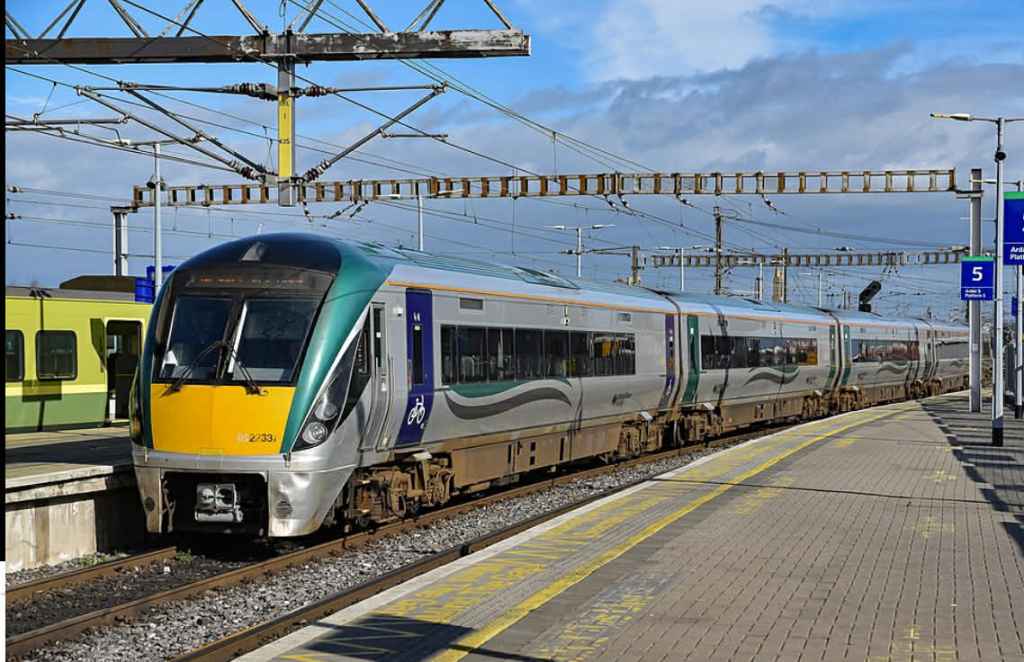
Luckily, like most European countries, Ireland has a fairly well-developed public transport system with a national rail network connecting all major centres of population and quite a few smaller ones, as well as extensive bus networks. In major cities there are local bus services all over the immediate area. Dublin also has two tramlines, the Green Line going north to south, and crossing the east-west Red Line in the city centre. Dublin, Cork, and Belfast also have suburban rail commuter services, with most such lines having service frequencies which range from every 15 minutes to every half-hour or so, depending on the time of day.
It is important to remember that since railways only serve MAIN centres, the more rural places will need to be visited by bus. The railways travel through pleasant but mostly unspectacular scenery. They do not cross any major mountain ranges or go past cascading waterfalls. You really need a car or bikes for the best of the scenery and visitor attractions outside cities—there’s no getting away from that. A few exceptions are the line from Dublin (Connolly) to Wexford, which has spectacular scenery, including a lot of coastline (sit on the LEFT heading south!), though it only has four trains a day. Also, right up north, Derry to Castlerock is stunning.
A few years ago, a private tourist train was tried, but it didn’t last past Covid—it wasn’t getting the numbers due to what was seen as a very high price, and overnights spent in railway sidings. Again, for the best of the scenery, and access to the best of the rural visitor attractions, get the bus. Rail unfortunately isn’t the thing for that.
Ireland has two political administrations, within each of which is a nationalised body that oversees public transport. In Northern Ireland, this is Translink, which operates the following:
- Northern Ireland Railways: Belfast commuter lines plus main lines Belfast–Derry and Portrush (up in the north-west); and jointly with Irish Rail the Belfast–Dublin route. Both of these routes have an hourly train service from early morning (06:00) until mid-evening. There are 15 trains a day on this route.
- Belfast City commuter buses (the pink ones).
- Belfast “Glider” services (purple articulated buses). These operate between outlying suburban locations more or less express into the city centre.
- Provincial “Ulsterbus” services within Northern Ireland. Away from the two rail lines mentioned above, and particularly in border areas, there are no railway lines any more, following large scale withdrawal of train services in the 1950s and 60s. Many longer distance services are branded as “Goldliner,” but it’s just another name for state-provided services.
In the rest of Ireland, we have the larger operators:
- Iarnród Eireann / Irish Rail. IE operate the Belfast line as above, jointly with Translink, but as well as that have longer-distance services operating from Dublin to main centres in the west and south. Going clockwise, starting due south of Dublin, you can get trains to Wexford & Rosslare; Kilkenny & Waterford; Cork, Killarney and Tralee; Limerick and Ennis; Athlone, Galway, Westport & Ballina, and Mullingar and Sligo up in the northwest. Sligo is the railhead for places like Co. Donegal, but you need to get buses north of Sligo, or better still, direct buses from Dublin to Donegal town or Letterkenny. Service frequencies to Cork are hourly, Galway and Sligo almost hourly, and other lines have between 4 and 6 trains a day. In terms of time taken, the longest journeys are from Dublin to Tralee (south-west) or Westport (west); each of these journeys take something over four hours. There are also cross-country train services from Galway to Limerick, and (albeit exceptionally slow and with poor connections) twice a day between Limerick Junction and Waterford. Nice scenic line, though! See railway timetables at www.irishrail.ie
It’s important to note that all trains in Ireland are standard class only—no first class and no observation cars—but plenty of luggage room; and no catering services, with two exceptions. Of the 15 trains a day each way on the Belfast line, six have full catering (including a limited range of hot meals) and another six have a tea trolley. On the Cork line, most services have a tea trolley. On both the Cork and Belfast lines, there is first-class accommodation on most trains, but not all. For the rest, bring your own food and snacks, but don’t bring alcohol as some train services do not allow it on board. Having said that, almost all trains are modern, clean, and comfortable. With Ireland being too small for all but two short internal flights, trains are the “go-to” for longer journeys where possible. All trains are disabled-access friendly and have accessible toilets.
- Local commuter train services operating out of Cork and Dublin cities. Some of these do NOT have toilets. These are also operated by the state rail operator, Iarnród Eireann.
- Bus Eireann. This is the national network of bus services. The express ones (red and grey buses) are branded as “Expressway” but it’s the same operator.
- Dublin Bus / Bus Atha Claith operate Dublin city commuter area suburban bus services. The city buses are either green with yellow fronts, or dark blue, light blue, and yellow.
In addition, while all of the above are nationalised state-run services, there are several limited private companies. GoAhead operates a network of bus services in Dublin and on some busier routes. Aircoach and Dublin Coach operate services between Dublin Airport and some main centres. Around the country are a number of smaller private operators, usually operating one or two routes from provincial towns to Dublin, and often aimed at commuters and students.
There is a national website which co-ordinates them all.
https://www.transportforireland.ie/plan-a-journey/network-maps/
No trains anywhere run overnight. With distances so short (Ireland is the size of the state of Maine in the United States) that means no overnight / sleeping car services either. Very few bus services operate at night, and those that do are only long-distance, usually from Dublin Airport to regional centres.
Railway stations generally do not have luggage storage facilities or lockers, and there are neither luggage trolleys nor personnel to help you carry it. So pack as light as you can if you’re using public transport. I can’t think either of any bus station that has luggage storage.
A few useful websites:
Train timetables and route maps:
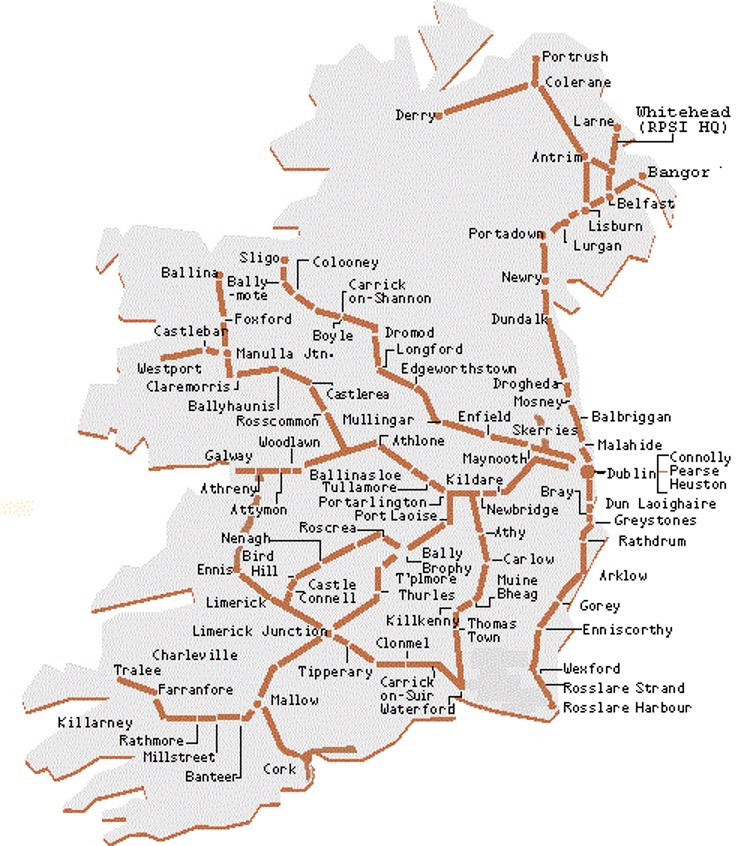
Ireland: https://www.irishrail.ie/en-ie/
Northern Ireland: https://www.translink.co.uk/ (This covers buses in Belfast and the rest iof N Ireland as well)
Buses:
Republic of Ireland: https://www.buseireann.ie/routes-and-timetables
Waterford: https://suirway.com/wp-content/uploads/2016/10/dunmore-summer-2018.pdf
Dublin: https://www.goaheadireland.ie/services ; https://www.citylink.ie/timetables/ ; https://www.dublincoach.ie/all-timetables
Dublin to north-west: https://johnmcginley.com/
Northern Ireland: Use Translink website as above.
Trams:
Dublin: https://www.luas.ie/
Advance booking is rarely actually needed, but is highly recommended as fares are much cheaper if booked online. Commuter trains do not have reservation systems; just turn up. In rush hour you mightn’t get a seat, though! Just roll with it – Irish people don’t have the same sensitivities about “personal space”! Longer distance buses are probably better to reserve; again, it’s cheaper, but once the seats are gone, they’re gone.
All trains and buses have disabled facilities, including toilets on all but the oldest trains. Mobility scooters are welcome, but you’d need to advise the railway in advance of date and places of travel, as staff need to be present to load / unload them. Mobility scooters can NOT be accommodated on all bus services, so check in advance. (In all reality, if you need one of these, expensive as it may be, you’d be better with a private specialised driver).
Taxis
So what does that leave? Taxis.
Taxis are plentiful all over Ireland, but only in main centres. In rural areas they vary. Always check in advance; many rural areas have adequate coverage, though possibly with a bit of a wait, especially on Saturday nights. Out-of-hours services need to be booked well in advance.
But in other areas there are few taxis, or no taxis at all. Bear this in mind if you are booking a bed and breakfast outside main towns or villages—it could be an unwalkable distance down a narrow, unlit small country road. There’s a good reason why it’s cheap! It’s possibly a place that’s no use to you unless you’ve got a hired car.
“Ah sure, I’ll get an uber.”
No, ye won’t, necessarily. The uber “ride-sharing” business model is illegal in Ireland; all taxis must be fully regulated, metered, registered proper taxis—so, apart from the fact that you won’t be able to save on the fare that way, you’re back to the issue of whether there actually is a taxi where you’re staying at all.
“But I’ve seen loads of ubers in Dublin!”
Well, you have and you haven’t; the uber (and other) APP may be used to hail one, but it’s a fully registered taxi. You’ll see taxis with the uber logo on them, or Bolt, FreeNow, or other apps – same story with them all. But they are not ubers as someone from the UK or USA would understand them, just ordinary taxis.
The main taxi app we use here is FreeNow, so it’s worth downloading that. Bear in mind too, that because these are all regular taxis, at busy times you can sometimes have a long wait time, as some drivers switch off their apps at busy times because there’s plenty of business to be picked up on the streets—especially early hours after a Saturday night out!
If you have a mobility scooter, in main centres there will be limited numbers of taxis which can deal with these, so advance ordering is essential for these. In rural areas, don’t count on it.
Finally, most taxis are normal family cars, which can take four people with modest luggage. Larger taxi vans, if you have lots of luggage or more than four people, are somewhat more scarce in Ireland then in other countries, so order those in advance too.
If your accommodation in a very rural area appears to be very good value, it is often because there’s no taxi, and you are therefore cut off from whatever local pub there is because you can’t walk back, and you can’t drink and drive … The law about the latter is extremely strict here, and you’ll find that almost nobody will chance it.
Taxis in Belfast are largely dominated by two large private companies: Value Cabs and Fon-a-Cab. As such, most local competition has been frozen out and they are, per kilometre, quite expensive. Taxis serving Belfast International Airport (Aldergrove) are possibly the priciest in Ireland, but there’s a bus from Belfast city centre to that airport every half hour—catch that one.
Apart from the above, for a number of reasons with roots in quirks of transport history, the normal state services for buses do not apply in the far north of Co. Donegal (and never did). However, there are a number of local private operators who serve these areas – we’re looking at the Inishowen Peninsula (Malin Head, Buncrana) and way up north – Burtonport, Glenveagh National Park, Gweedore, etc. Google the NTA website and see what services operate out of Derry city to those areas, or Letterkenny Bus Station.
So, plan away, and I’ll see you at the railway station in Killarney on Friday!
(* In Europe, the only other left-hand-drive countries are Cyprus, Malta, the Channel Islands, and the Isle of Man)
Jonathan Beaumont is Irish by Ancestry’s destination expert, historian, and tour guide. He has published seven books on Irish social and economic history, and transport history, with three more in preparation. In the tourism industry, he has been leading tours for some twenty years. He collaborates with television producers where historical context is needed in preparation for TV programmes, and is heavily involved in several groups that assist tourists coming to Ireland, in particular those tracing their Irish roots. Naturally, he still finds time for the occasional pint of Guinness, and playtime with his grandson.
 RELATED ☘️