We ask you, the Irish by Ancestry community, each month to share stories based on our Ancestor Memoir theme, and you never disappoint. This month was alla bout LOVE STORIES. Your heartfelt tales melted our chocolate. Thank you to everyone who submitted! Please keep writing, keep imagining the lives that matter so much to you. Keep those family stories alive!
Our winner this month, Sinead Tyrone, shares her ancestors’ moment of decision to start fresh in a new world, after hardship has left their hearts near empty. Congratulations, Sinead! It’s no wonder she excelled at this exercise: She is the published author of an Irish-focused novel, one we are looking forward to sharing more about in a future issue! She is the winner of this month’s Irish by Ancestry prize pack, and she will help choose next month’s theme. Here is her story …
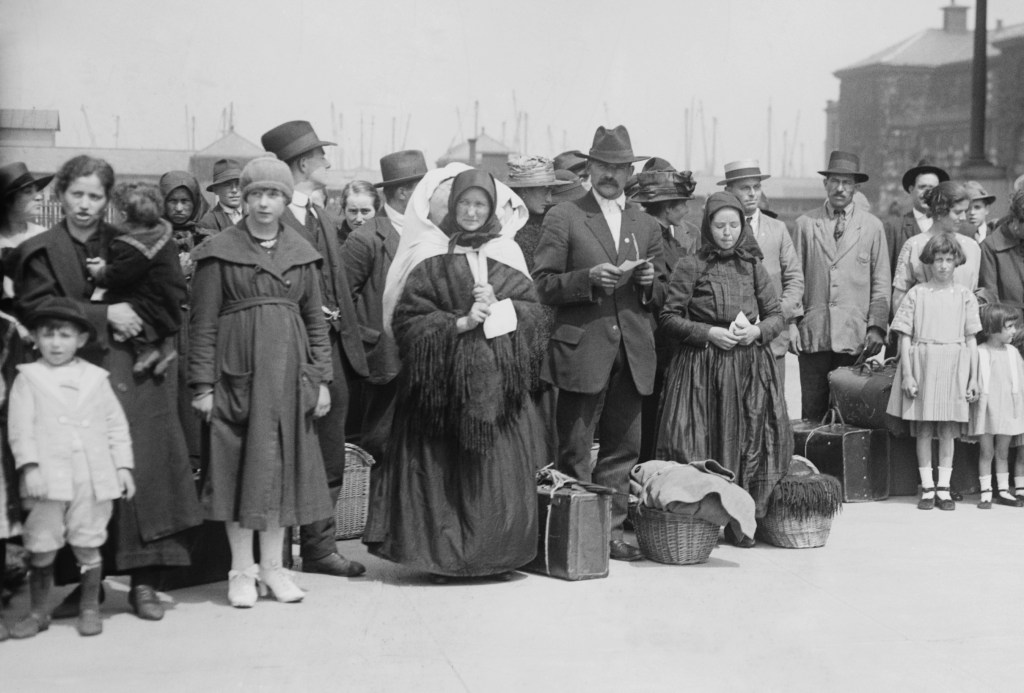
For Love of Margaret
By SINEAD TYRONE
Irish by Ancestry Member
Hugh McStravick kept an eye on his wife, Margaret, as they sat in the midst of cousins, aunts and uncles, nieces and nephews, all gathered to bid goodbye as he and Margaret had finalized plans to sail out of Killyleagh the following week, bound for America. An American wake, his aunt Catherine had called the gathering. They all knew in their hearts, the chances of seeing Hugh and Margaret in the future were slim at best.
The decision to leave at all had been a hard one. Hugh cherished his family and his roots. The prospect of leaving either behind had left him awake long into the night, long after Margaret and their wee daughter, Mary, had drifted off to sleep. He had stood over them, watching as peaceful rest smoothed the lines grief had etched on Margaret’s face, wondering what dreams Mary might be smiling over.
He, himself, no longer carried dreams inside him.
“I have to leave,” he had told his father, Nathaniel, as they’d discussed Hugh’s choices a few weeks earlier. “To stay would be to rob Margaret of the light that once danced in her eyes.”
“Understood,” Nathaniel had replied. “Your mother once had that light. She was never the same after the Great Hunger, an Gorta Mór.”
Born in 1844, Hugh had little recollection of the famine years that had hit when he was a child. His knowledge of that horrible period came from stories those around him told, mostly in whispers around a fire late at night when he should have been sleeping. Even in the dark, without seeing the haunted looks on the faces of those speaking, Hugh could feel the weight of their sorrow, the depth of their losses.
The same depth of sadness that haunted Margaret ever since their infant son, Neil, sickened from some disease the doctor had no name for, took his last breaths in her arms.
Hugh could no longer bear watching Margaret suffer. Hoping a fresh start in a new world would break the anchor of grief that pinned her down now, he’d made the decision to emigrate. Perhaps he would be wrong. There was a chance grief would follow her the rest of her life. Still, he had to take that chance. Reports of fertile farming land in the western corner of New York State enticed him. He discussed his ideas with Margaret and booked passage for them out of Killyleagh on the next ship bound for America.
Now, watching Margaret, seeing how she and his aunt were engaged in conversation and she was safe for a while, Hugh stepped outside for a breath of fresh air.
The enormity of the journey he was about to take overwhelmed him. All he knew was this country, the familiarity of the faces gathered inside and the ground over which he had walked all his life. Would the land he was about to enter be as green? Would the lakes in the new land be as blue as the one he’d grown up near? Would there be any lakes near him at all?
In the breeze that buffeted him as he watched the skies overhead, Hugh thought he heard the whispers of his ancestors, although he could not decipher their words, shrouded as they were in the mist that had settled in over the land, spoken from the other side of the veil that separated him from them.
He knew his family’s history. A subsept of the great O’Neill clan, he carried inside him a trace of the blood of Irish royalty. Cook’s Hill was the name of the land his ancestors had come from. Although Hugh himself had never set foot on that hill, it called to him like a magnet. The beginning of things. A holy place.
When his forebear Hugh O’Neill, the last of the Irish kings, had fled Ireland in 1607, Cook’s Hill and any other lands the O’Neill’s had held passed to English owners. From there, over time, his McStravick predecessors had dispersed, most of them to the Lurgan region where Nathaniel settled and Hugh had been raised.
Did the whispers Hugh heard on the wind now condemn him for fleeing Ireland? Did they curse him for severing ties with the land they had held so dear they were willing to lay down their lives for? Did they judge him harshly for his choice?
Or, familiar with their own sufferings, did they understand?
“It’s only for Margaret I’m leaving,” Hugh whispered back to them. “Please understand. I hold this land so close in my heart, I’d just as soon cut off both my arms rather than leave here. She’s heartbroken, though. I can no longer stand the pain in her eyes. For love of Margaret, I will take whatever steps I can to bring the smile back to her lips, the life to her eyes. The rest of my days, I will remember my heritage and hold my head proud. For Margaret, though, I have to leave this land behind.”
The wind softened. Hugh imagined he heard his ancestors whisper agreement as he stepped inside.
“We leave three days from now,” he heard Margaret explain to Ellen Murphy, a neighbor who had joined the gathering. “Sure, I’m not looking forward to the crossing, but Hugh has described to me what he’s learned of our new land. There are rolling hills, like our own here, and the soil is rich. Whatever we grow on our land we can keep, rather than turning it over to landlords. Aye, it will be a grand new beginning for us!”
The lilt in Margaret’s voice, and the light he saw now in her eyes, warmed Hugh’s heart. His decision would be the right one.
And of course, what issue of RELATED☘️ could be complete without an entry from our favorite bard, Eric Cronin. His story of enduring love will break your heart with tenderness, I promise. It broke mine, and I still haven’t recovered. I especially love the sense we get from the omniscient narration, that we are witnesses to these deeply personal moments, from a distance, but close enough to feel. Great job, as always, Eric. Thank you for sharing the gift of your words with us.

Unbreakable Love
By ERIC CRONIN
Irish by Ancestry Member
The car stops in the hospital parking lot, and the son carefully and cautiously helps his elderly mother out. He points to the crutch that provides support for the few steps the mother can manage. Her bones and joints creak and protest against the effort required by the ravages of time. Leaning on her crutch and clinging to her son, she follows the difficult but important path to her daily sick visit with her husband, with whom she has shared all her joys and sorrows for over 65 years. Little is said during the walk; mother and son don’t need to, it’s unnecessary. They understand each other through the silence of their gaze—nothing more, but so much more. The look says everything to them in that moment. Silence can be so expressive.
Fortunately, there’s an elevator to the room, a reassurance. Once out of the elevator, the mother shuffles bravely and seemingly a little faster to the room where her rock must reside. Her eyes speak again now, a voice of a farewell drawing ever closer, fear and despair, and above all, sadness, intense sadness. Her husband, strong and proud, intrepid, whom she always leaned on, trusted, and shared everything with, through good times and bad, lay peacefully asleep. His large and imposing body had become a gaunt shell, consumed by the merciless illness C.
On his chest lay a card, for his dearest wife, his princess, his rose, his homtiedomp, as he often playfully said. A simple birthday card with just six words, six simple words, that express the meaning and richness of more than 65 years together. Six words of unconditional love and a deep and firm attachment, a look back on years of intimate connection for each other and with each other. Years he wouldn’t trade for anything or anyone else. A resolute, short letter that expressed how his Roosje was his rock, the support and confidant he could rely on and trust all those years. Words that conveyed that he didn’t regret a single second of the time they had and still have together. Six words, and tenderly written, yet oh so rich; the card read, “Thank you for all those years,” nothing more or less, so little yet so encompassing. Gratitude in its highest form, proof that for them, their love had lost none of its value after all those years; it was a present certainty that had grown and bonded even more between them. Simple words, without the grand romantic circus we too often encounter, but so honest and precious in meaning, pure and unique to both of them; it was their way of life.
The mother read the words on the card, and once again, her brown sparkling eyes spoke, with tears, of sorrow and emotion and love, above all, deep love, for him who was and is her husband. The man woke up and spoke softly in a fragile, thin voice, “Happy birthday, I wrote you a card,” to which she replied, matter-of-factly (as she was), “I’ve already read it, Jerry, thank you,” in a tone that encompassed all her love for him.
The son was a witness to all this and remained silent. For him, this was one of those moments when he sensed the strength of their bond and the depth of their love for each other. This moment clarified for him what love was in all its meaning; no film, book, or song could have conveyed more than that one brief moment, a firm certainty.
Roos and Jerry stayed together for a while longer, and they talked about everyday things: “Do you need anything, Jerry?” “Do I need to pick up any laundry?” —just a conversation about simple and important things for them. Jerry needed nothing and closed his eyes again, his illness repressed by sleep, which for him was an escape from the daily torment he endured. A torment he never had. He was outspoken, to no one; he carried it himself. No one was allowed or needed to know about this, not even the doctors, who weren’t permitted to tell anyone; he didn’t want that, under any circumstances. But his Roos knew; she knew him far too well, and respected this even though it hurt her. That respect had to be compromised in the face of her own pain and grief.
Two weeks later, Jerry passed away. His Roos was with him. They shared this moment too, gently and peacefully, not unexpected, yet so sudden. Roosje sat next to her husband, who had departed this earthly life, quiet, subdued, and yet so matter-of-fact; “Now he has found peace,” she thought, “he is with our two other sons.”
For the next two weeks, Roos remained as Roos was, with one difference: an indispensable part of her life was gone. She didn’t complain, but missed it intensely and immensely. Not even 14 days later, Roos followed her Jerry, suddenly, as she wished to leave this earth. It was as if he called her, and she preferred being with him over staying here. She chose him, as it had always been, and so they were and are back “together,” forever and so much longer.
If you asked Roos or Jerry what love is, they both quickly had their answer ready, in their own way, simple but oh so wise: Trust and letting go, respecting each other’s boundaries and for each other, and simply loving, nothing more, nothing less. No grand words or actions with lots of bells and whistles, purely their own and those of others. Living and experiencing, the good and the bad, together, without too much fuss. Lots of laughter, putting things into perspective, and being content. And realizing no one has to do it for us, we do it together.
The story of true love, which I think I’ve found too, and the same six words, I can say and write down, day after day, hopefully for many years to come.
Thank you to everyone who participated! We will announce the March contest theme on Tuesday, February 3, so you’ll have plenty of time to get YOUR ancestor memoir written for next month. Look for my posts on Story Thursdays as well, when I share prompts, tips, and inspiration to get you started. Writing is a team sport. See you on IRISH BY ANCESTRY!
 RELATED ☘️