By SHELAGH BRALEY STARR
RELATED ☘️ Staff
The idea of Brigid burns at the heart of Irish imagination. She is a goddess of fire and poetry, a saint of healing and hospitality, both honored by a day that shimmers with the promise of spring. For millennia, her name has meant light in the darkness, warmth in the cold, and inspiration in the silence.
Long before Christianity, Brigid was worshiped as a goddess of the Tuatha Dé Danann, patron of poets, smiths, and healers. Her realms tell us who she is: the forge’s flame, where rough metal is remade; the hearth’s flame, where community gathers and is fed; the inner flame of creativity, that sudden spark of words and ideas. In all of them, Brigid is transformation made visible. Nothing passes through her fire unchanged—not even Dublin-born author Kim Curran.
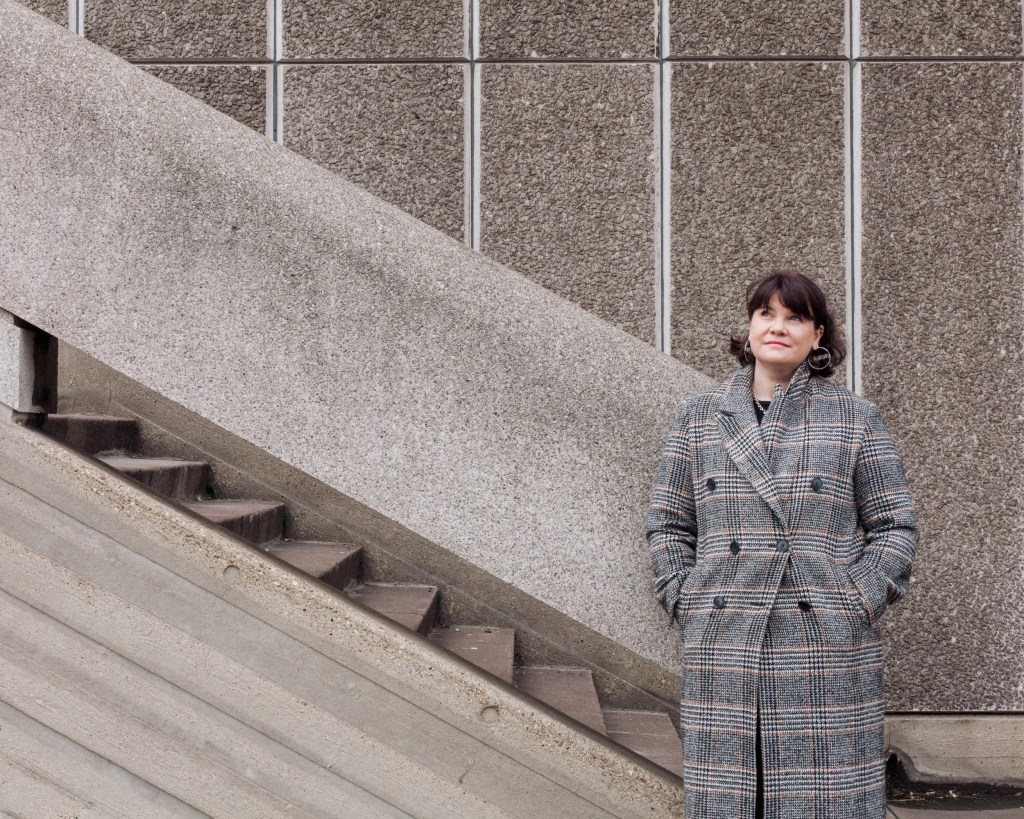
Curran had already written an acclaimed novel about the Morrigan, the war goddess, but writing Brigid felt even more intimidating.
“(Brigid) was a great mirror for the Morrigan. I was really, really fascinated about the woman. We all grow up with her, she was the role model for us as young women,” Curran said in an interview. “We make Brigid crosses in school; she was held up as this perfect being, good and wonderful. Was I scared of the Morrigan? No, I was more scared of writing Brigid. How do you write something so perfect?”
It was really important to Curran to find the woman within the many layers of stories, from myth to hagiography. But first, she had to overcome some of her own long-held misconceptions.
“I rebelled against her as a teen, (she was) giving, giving, giving. Perfect. Passive femininity,” she said. “My favorite thing is, her brother makes a crass comment about her eyes being shoved into the pillow of her husband, and she makes his eyes explode. That’s in the (historical) text, she’s not as kind and not as forgiving then. She’s described as, do no harm, take no shit.”
Curran looked at that very human response and saw something new. “I actually think now there was anger in her that she’s trying to repress, and passion—denying herself all humanity other than goodness. What would that do to a person,” she asked.
RELATED ☘️: What traditions did your ancestors keep for Brigid?
“She was so smart, working in a male dominated system. Brigid uses the church as a political system. By becoming a nun, she frees herself from being a wife and all that life. The idea of having (the story) told by the goddess brought the two together. At the start, they’re separate, then the goddess has answered her prayer, then there is a handing over of power,” she said. Bringing the two together has a transformative property. With the coming of Christianity, the figure of Brigid the goddess did not so much disappear as shift shape.

from Saint Brigid’s Cathedral, a place that reportedly stands on the original monastic site of Saint Brigid.
Saint Brigid of Kildare emerges in the records as an abbess and miracle-worker, famed for her generosity and fierce independence. This is the figure of Brigid, the novel. Legends tell of her turning water into beer for weary travelers and hanging her cloak on a sunbeam.
“There’s two ways you can react to the patriarchy,” Curran said with a laugh, “(One is to) scream into the darkness and rip out men’s throats; the other is to move into a lovely cottage with beer. Brigid built her own sanctuary without men, and how can that be sustained? Is it possible to create a space for women without men? They became lovely counterpoints.”
She founds a monastery at Kildare, where, according to tradition, an eternal flame is tended by her nuns—a sacred fire echoing the goddess’s shrine. In Brigid, saint and goddess, Ireland’s spiritual layers overlap and glow through one another.
“I was trying to find that balance, between the myth and the two hagiographies, the lives of the saints, written about her 200 years after her death. One was written by a monk from Kildare, Brigid’s church, and one was out of Armagh, St. Patrick’s church. Both were biased, either talking about their church or the one who set up their competitor church,” Curran said of her research. “We know that the sisters of Brigid, the nuns in her convent, would tend to the sacred fire, destroyed by King Henry VIII. It had lasted maybe 500 years, and they’ve relit it now. That tradition of fire goes back to the gods, so we know there’s a link from the past. They hold the responsibility of tending the fire given by the goddess. That’s the fire she is protecting, it’s knowledge,” Curran said.
Brigid’s feast, Imbolc, or Saint Brigid’s Day on February 1, marks the first stirring of spring in the Irish calendar. It is lambing time, when the land is still gripped by winter yet quietly quickening. People weave Brigid’s crosses from rushes, leave cloths on windowsills to receive her blessing, and light candles against the darkness.
Last year, Curran said she made Brigid crosses to mark the day, and gathered in an online circle, lighting candles and setting intentions. Today, Curran was in Dublin, celebrating Brigid’s feast on RTE. “If I had known how deeply beloved she was, going over to Ireland this weekend, being part of the celebration, I don’t know I ever would have written it.”
As a child, Curran said she did not know much about the day or its significance.
“My mother is from Dublin Southside. She wouldn’t have had any of the traditions. They looked down on the old ways, the Ireland of the past. They had no interest in speaking Irish. My father was from Tipperary, one of 12 kids, the only examiner of Irish-speaking, so they were much more grounded in Irish stories. I didn’t really that much grow up with Saint Brigid’s Day and the activities, but now it’s something I love,” Curran said. “She’s had a renaissance; she’s come alive for people again. So much of it is tied to decolonizing their minds, trying to throw off the past.”
Brigid is uniquely Irish, as the specter of a goddess who once protected the land, and a woman who once built a church in a time of transition, pagan to Christian.
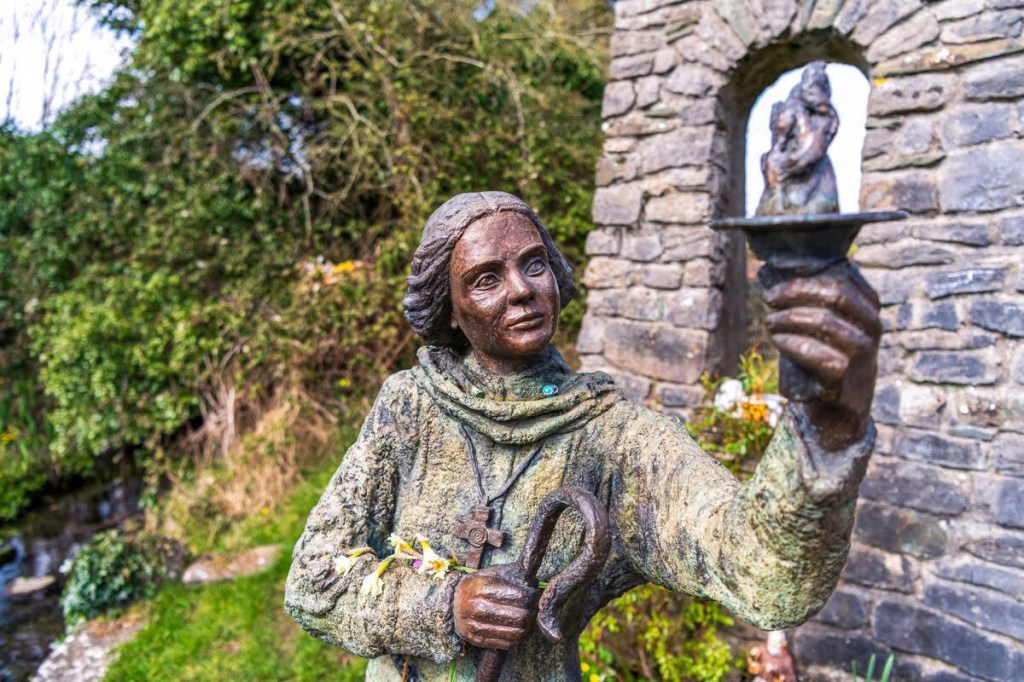
It is considered a place of healing and ancient spiritual connection to Saint Brigid. Photo by Gareth Wray
“She is told to build this place that creates and preserves knowledge while the rest of the world is sinking into darkness. The imagined Ireland versus the real Ireland—it was a sophisticated place of advancement. Irish people would recognize that part, rather than the impoverished potato famine version.”
Irish readers will also recognize the language Curran uses. “I had an English copy editor saying, ‘that’s not the right way,’ ” and I said, ‘It is in Ireland.’ Ireland is still a matriarchy; in the home, it was always women in charge. Irish women are a unique species, so I think people will recognize that.”
It is at this charged intersection of myth, faith, and season that Curran set her novel BRIGID. In her retelling, the fire associated with Brigid is not just a symbol, but a presence: dangerous, necessary, alive. That’s the fiery essence of the Brigid she found as she wrote.
“She is a woman that existed at a time of Christianity and paganism. She is a figure of liminality. She is born in a threshold, the daughter of a chieftain and a slave,” Curran said. “It’s the book I’m proudest of, I set myself a ridiculously high bar, I wouldn’t say I reached it or ever would, but I got close, from a literary craft point of view and the woman I wanted to put on the page.”
 RELATED ☘️