ROUTES & ROOTS
With JONATHAN BEAUMONT
RELATED ☘️ Staff
When I was a mere stripling, a gossoon—nay, not even that—my parents and siblings and a car load of holiday clothes (you know, raincoats, welly boots, umbrellas and so on), used to decamp to the exotic vastness of the West of Ireland for two weeks every summer in my father’s 15-year-old green Ford Prefect. The driver’s door wouldn’t open, so he got in and out via sliding across to the passenger door.
We would exit the car in excitement and explore the area (in between showers, of course), while my mother struggled to heat tinned food on an old gas stove that Noah might have rejected when planning his ark …
But it was the holidays!
My parents took the view that they would bring us to somewhere different every year. Early memories are of Inch, Co. Wicklow, a campsite in Galway, an old bed and breakfast in West Donegal, a farmhouse in Co. Sligo and many another place.
But one year it all changed.
Answering an ad in a newspaper (all by snail-mail post, of course), my father discovered a cottage for hire in Co. Mayo, in the village of Mulrany (or Mallaranny; the name translates as “The isthmus of the ferns,” and indeed the place is picturesquely covered in them, along with the bright red flowered fuchsia, and the bright yellow flowered gorse).
The cottage was an old Land Commission cottage, one of many similar built in the 1920s and 30s. It was primitive—it hadn’t been modernised since the 1950s, and if I was to describe its basic state in detail, I’d be here all night, dear reader—and the ghost of my late mother, yes, she who struggled with that gas cooker—would appear to haunt and torment me all night.
But we loved it. There was a beach nearby, and up behind the cottage were the slopes of Claggan Mountain, one of the Nephin Beg range. Gurgling and twisting down that mountain and past our cottage was a little stream. There was a deep pool in the stream where we played with our toy boats, when we weren’t on the beach.
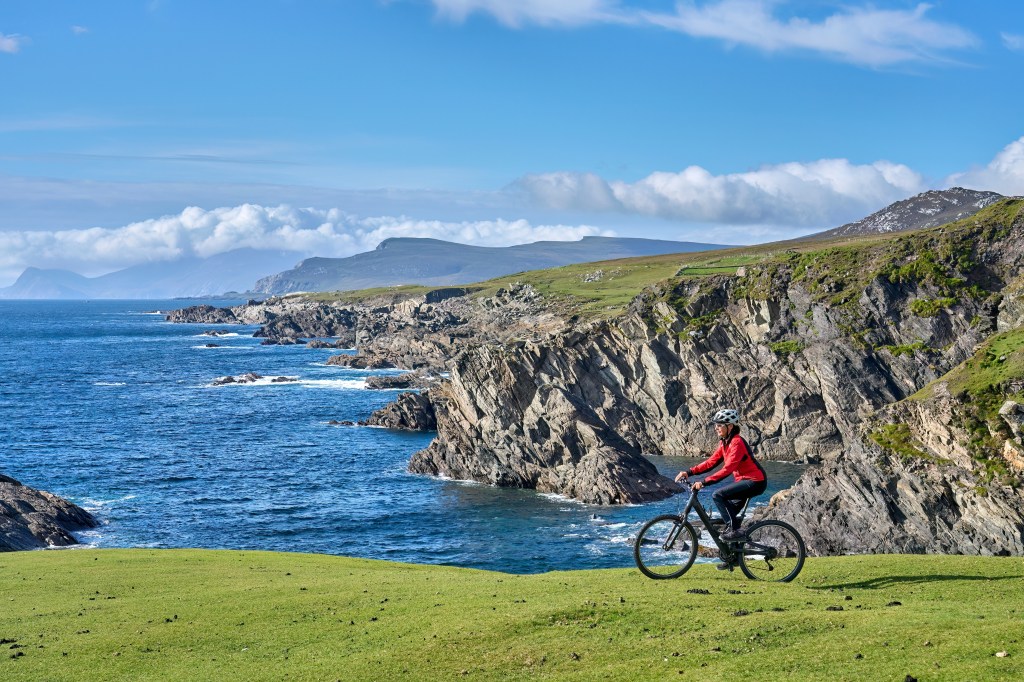
Mulrany is at the entrance to the Corraun Peninsula, the other side of which ends with a road bridge across to Achill Island, which is Ireland’s largest offshore island, some 148 sq. km. The population was some 6000 prior to the 19th century Great Famine; today it is about 2300.
Using Mulrany as a base, we visited Achill almost daily.
Now, many moons later, the tourists I take around every single corner of this island—for there isn’t a single town or village I’ve never been in—ask me “What is YOUR favourite part of Ireland?”
Well, it’s Achill.
There is nowhere on the planet quite like this island. It’s got mountains, lakes, beaches and scenery, but an atmosphere in which past and present come together, glued seamlessly by tradition, DEEP tradition, and practicality for modern life.
Achill Island has a very unique history. Home to Gallaghers, McLaughlins, Sweeneys, Lavelles, Pattens, Kilbanes, Corrigans, Mastersons and O’Malleys, among others, it was once within the fiefdom of the famous Granuaile (Grace O’Malley as béarla), dubbed the “Pirate Queen” by the English, as she held out against them in the late 1500s. She was the last great Gaelic female chieftain. Her castles stand mute witness to her widespread sphere of influence not just ON Achill (at Kildownet) but on nearby Clare Island and several locations on the mainland.
Like much of the west of Ireland, the population collapsed following the famine in the 19th century, but Achill people are nothing if not resilient. They emigrated when they could, a large number of them going to Cleveland, Ohio, where the surnames mentioned above remain commonplace to this day. Some went to England. An Achill wedding party—if you eavesdrop, perhaps in Lavelle’s Bar or Alices … listen … American accents. English accents. All relatives. The uncles, the cousins, the aunts, all coming home.
Cleveland is twinned with Achill. There’s a good reason: Achill people built that place. The skyscrapers, the legal system there, the fire and police departments—Gallaghers. Pattens. O’Malleys. McLaughlins.
There is a road in the middle of the island. The “fairy road.” People have heard voices there. I have. Yes, you read that right; and I was on my way TO a pub, not on the way back … They say it’s the “little people.” I don’t know. I don’t believe in things like that, to be honest.
But I know what I heard. It was on a summer night in August 1982.
And you know why?
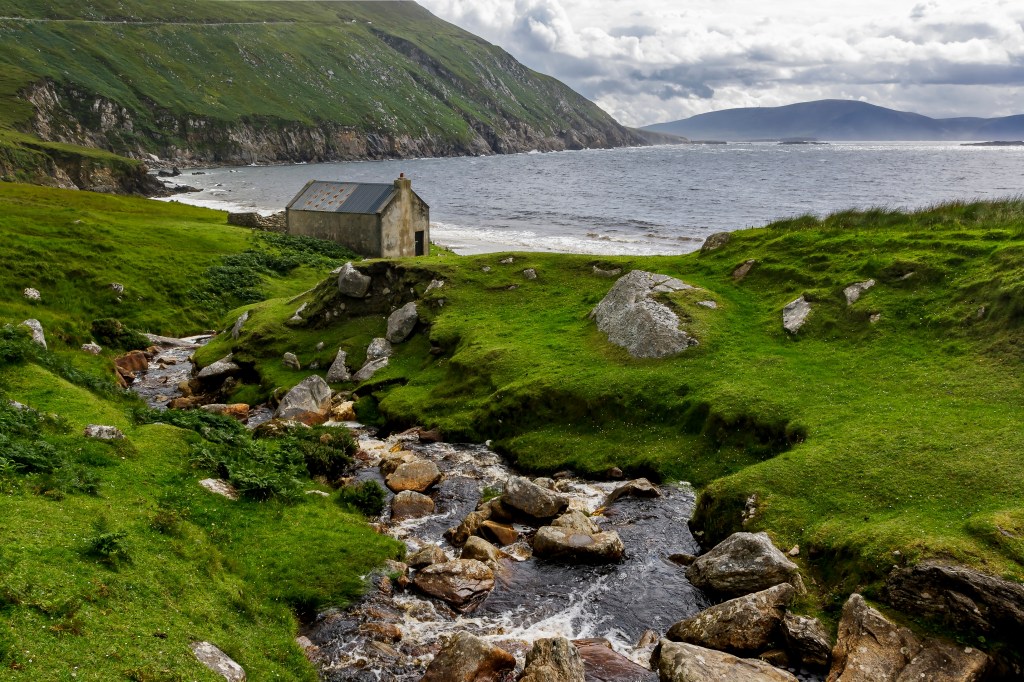
The history. The depth of the history. You’re not far from the slopes of the island’s highest mountain, Slievemore. (That just means the big mountain.) Slievemore towers over the northern end of the island, its lower slopes and surrounding areas being untouched, wild, flat, turf bog. Just a wild, expansive damp soggy wilderness, stretched out under the looming mountain and a wild, wide western Mayo sky; look out to sea—next stop: America. The clouds scud hastily across. We’re on the edge of Europe, and in winter, Mother Nature isn’t going to let you forget that. Forget that umbrella in the car, it’s about as much use as a chocolate teapot. Open it, and you’ll do a Mary Poppins; you’ll be landing at JFK in 4.8 seconds …
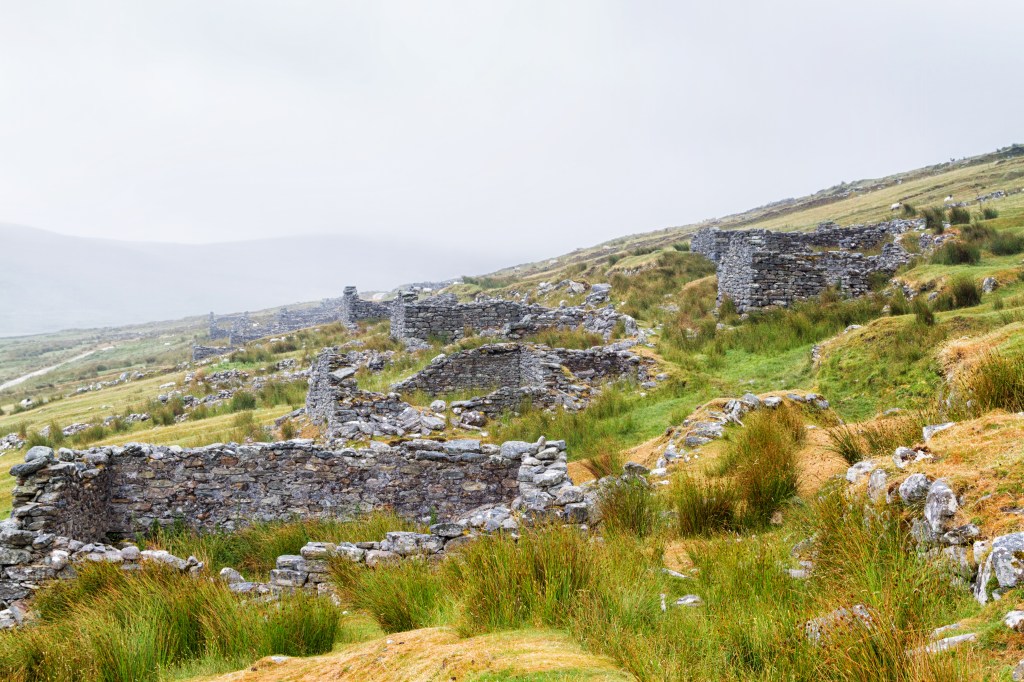
On the slopes of Slievemore is the Deserted Village.
This was once a town of more than 100 dwellings, strung along several kilometres along the lower base of the mountain. In every one of those houses, Mayo women toiled to keep the children safe and fed, and to have the potatoes boiled for the exhausted men coming down off the mountain after chasing a stray sheep, fixing a stone wall, re-thatching a roof, or out in a fishing boat, wrestling with an angry sea.
The people woke up one season, with arrears of rent and to find no potatoes in their fields. You can walk all afternoon through the old potato “lazy beds” to this day.
And here, it all comes together. Here is Ireland in a nutshell. The pride, the depth of culture, the hardship, the bringing together of a community determined to battle all the hardships and survive all the hardships, and gather together at night to hear a few tunes on an old fiddle, by candlelight, the pot of tea in the turf ashes simmering. The impossibly beautiful mountain and coastal scenery.
But, as the people said, “You can’t eat scenery.”
Between 1841 and about 1921, the population of the once-bustling Slievemore village fell from several hundred to about 20 people. The last people left about 1940, by that stage just one house, and only seasonally occupied.
Now it’s a ghost town. Well may the “little people” out in the bog cast their eye over the land. Well may they whisper in the old Lower Achill dialect of Irish of times past—and people past. Characters. Survivors. Tough, gentle people, inured to hardship but with hearts of gold and helping hands for anyone who needed it. That’s the Irish way.
Well into the 1970s, the population was still falling as the menfolk left either seasonally or permanently to work on potato harvesting in Scotland, building sites in London, or construction gangs in America. Some came back. Most didn’t.
In the modern age, tourism has provided a lifeline. Achill has the Beehive Restaurant, a multiple-award-winning place in the modern-day largest village of Keel. Ask for Patricia and tell her I said hello. Most houses have fast broadband. Everyone has modern cars, listens to podcasts, plays with their mobile phones, deletes junk mail, and eats Indian frozen meals from SuperValu supermarket. Working online is popular—why wouldn’t it be, look at the view out the window! A modern, well-educated population. When the dishwasher is loaded, off to Mickey Gielty’s pub up in Dooagh for excellent traditional music.
We have survived.
But we also remember. By god, do we remember; and may we never, ever, ever forget what brought us here. And our diaspora, over in London and Cleveland, Australia and Canada, do too.
Achill is spiritual; and it’s deeply, deeply, spiritual in a nutshell.
Visit it. Better still, let me bring you there. And if I do, you WILL come back.
And for me, our family love affair with the place started right there. We stopped going to different places every year—we just kept going back to Achill. Today, almost 60 years after our family first went there, it’s turned full circle.
My niece lives there now, a teacher in the school. Like the rest of us, brought there on holidays most years as a child. And she’s just had a beautiful little baby boy, born and bred in Achill.
When I bring tourists to Achill Island, without exception they say the place was one of the highlights of their Irish holiday.
So that’s my favourite place!
Jonathan Beaumont is Irish by Ancestry’s destination expert, historian, and tour guide. He has published seven books on Irish social and economic history, and transport history, with three more in preparation. In the tourism industry, he has been a guide for some 20 years. He assists tourists coming to Ireland, in particular those tracing their Irish roots. Naturally, he still finds time for the occasional pint of Guinness, and playtime with his grandson.
 RELATED ☘️