We asked you, the Irish by Ancestry community, to share stories about Returning to the Old Place for April’s Ancestor Memoir Contest. You did not disappoint! Thank you to all who participated, we appreciate your creativity and sharing. Keep writing, your family stories will outlive you, your descendants will have to do less research, and your ancestors will be proud.
Our winner this month, SHANNON O’LEARY shares the moment she found and explored her family’s ancestral home on the coast and what it taught her about herself. Congratulations, Shannon! She is the winner of this month’s Irish by Ancestry prize pack. She will also help choose next month’s theme. Here is her story.
Finding the Missing Pages
BY SHANNON O’LEARY
Irish by Ancestry Member
I did not recognize the lane at first.
On maps it had looked straightforward: a thin gray line veering off the road, curling toward the Atlantic like a question mark. But sitting there in the rental car, I saw only a gap between two hawthorn hedges and a sign so weathered the letters had near-faded away. Still, the shape of the hill beyond the hedgerow tugged at something in me—something old, something that did not come from memory so much as from a story I had heard many times.
“This is it,” I said aloud, though there was no one in the passenger seat to hear me.
I eased the car into gear and turned onto the lane of my great-grandparents’ townland. The gravel spat lightly under the tires. Grass grew down the crown of the road, and every few yards the hedges leaned in, brushing the car with a soft hiss. I had seen this place before in the black‑and‑white photographs: stone walls, long shadows, people standing stiffly as though being remembered were serious business. I grew up with those pictures in a frame on my parents’ hallway table, with the word “home” engraved in brass underneath, though none of us had ever lived there.
The lane narrowed and then opened out into a scatter of houses, hunched and pebble-dashed. Sheep milled around a nearby field, their wool speckled with drizzle. I pulled into a space near the small church, killed the engine, and listened as the silence unfolded around me. It was not true silence, of course. There was the constant breeze from the sea, the murmur of a tractor in a distant field, the sharp caw of a crow. But after the mechanical roar and bump of the road, it felt ceremonial.
I had been told there was a woman here, a distant cousin, who “would know all about it.” My aunt had said this with a certainty that brooked no doubt, as if knowledge, like land, simply stayed where you left it. I pushed open the low gate of a whitewashed house and knocked. A face appeared at the window first—alert, measuring—before the door swung inward.
“You must be one of the Americans,” she said with a smirk. “Come in out of that damp. You’re very welcome.”
Her name was Maura, and within minutes I was seated at her kitchen table, a chipped mug of strong Barry’s tea warming my hands. The room smelled of turf smoke and something baking. A plastic tablecloth patterned with roses was worn thin where elbows had rested for years. On the wall behind her, a calendar from the local creamery displayed April in bright green numbers.
“I’m not really American,” I said, reflexively, the desire for belonging rising in my throat. “I mean, I am, but—my people were born here. Well, not here, exactly. In this townland. So I guess I’m half‑and‑half.”
Maura indulged me and laughed again, softer this time. “We’ll claim the half that suits us. Now, tell me who you are.”
I laid out the genealogy as best I knew it: great‑grandfather Patrick, who left in 1913 with a cardboard suitcase and never came back. His sister, Brigid, who married across the parish and stayed. The house that was on the hill “above the well,” as my grandmother always said, pointing vaguely upward whenever Ireland was mentioned, as if the whole island were perched above some invisible source.
As I spoke, Maura’s eyes sharpened. She interrupted once. “Your Patrick, would he be the one who lost the cow in the bog the year of the big snow?” I blinked, thrown. I had no story for that. At home, Patrick was the tidy romantic of family mythology: the brave emigrant, the one with the sad eyes in the photograph, the one who sent money for years until the letters stopped. There had never been any cows involved.
“I don’t know,” I said. “Maybe?”
“Ah, it must be him,” she decided. “They were fierce unlucky with cattle, that family. Come on so. I’ll show you.”
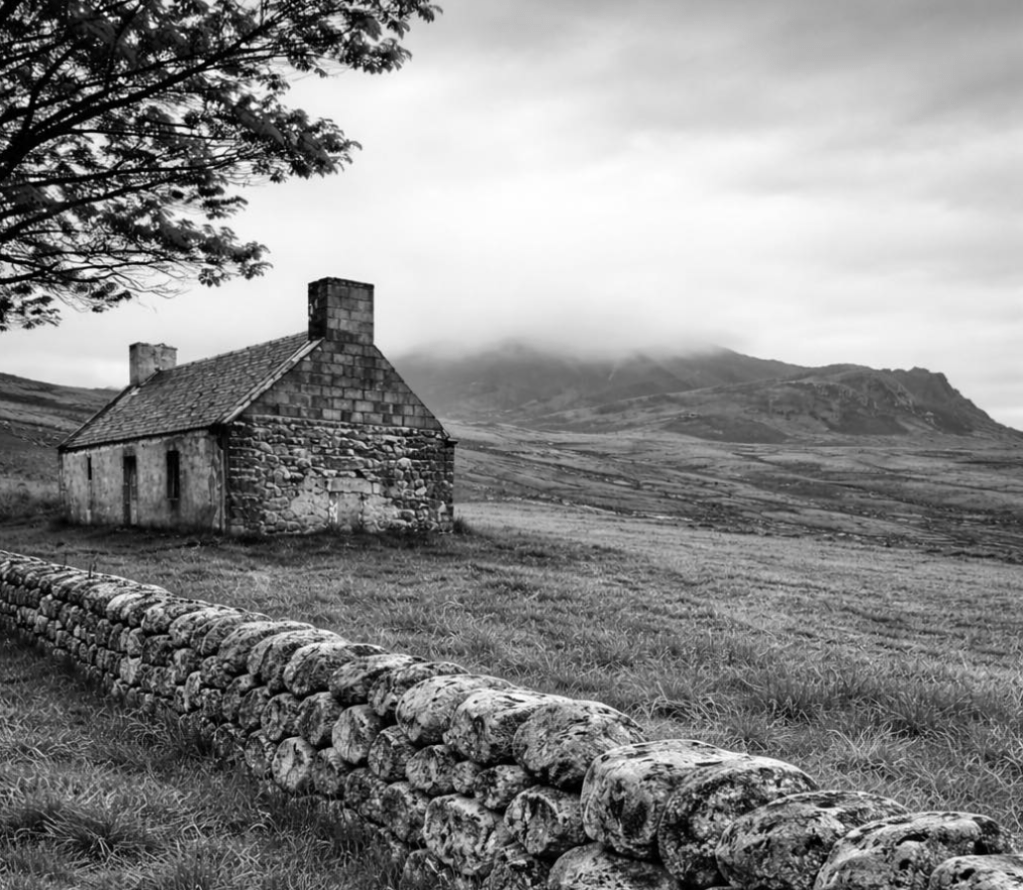
We stepped back outside. The rain had turned to a mist so fine it felt like breath on my skin. We walked up the lane past the church, then left, onto a narrower track still, its surface more grass than stone. “There was a shop there,” she said, pointing to a house with PVC windows and a satellite dish. “And your crowd lived over there. We always said ‘up at Patrick’s,’ even after he’d gone. Funny the way names stick to places, long after the people themselves are scattered.”
We climbed a small rise, the kind of hill that looks negligible from a distance but leaves you aware of your lungs by the time you reach the top. And there it was: the ruin of my great‑grandfather’s house.
I knew it instantly, though I had never seen it before. The proportions matched the background of a faded photograph at home: one low window, a door slightly off‑center, a roof now mostly gone, its remaining slates green with moss. Ivy wrapped the back wall, thick as rope. A hawthorn tree leaned against the gable as if sharing gossip.
I stepped closer, every footfall suddenly careful. The doorway held no door now, just a shadowed opening. I ducked inside. The air smelled of wet stone and earth, but under that there was a faint sweetness, like old timber turned to dust. Light fell through the broken roof in pale shafts, illuminating what had once been the hearth, blackened stone still visible under lichen.
“Mind yourself,” Maura called from outside. “There’s no floor, only whatever’s grown up since.”
I stood where the fire had once been pictured my great‑grandfather as a boy, his boots muddy from the fields, his mother scolding him, his father stoking the flames, coughing. None of these scenes had been passed down to me; they were inventions stitched loosely from scraps of story and the feel of the place. It struck me that my whole idea of “where I come from” had been like this, just an arrangement of fragments, half facts and half longing.
Somewhere above, unseen, a bird shifted, dislodging dust that floated briefly in the beams of light. For a moment, the house felt inhabited again, not by ghosts exactly, but by the tenacity of lives once lived here. They had gotten up in the dark winter mornings, fed cattle that vexed them, fetched water from the well below the hill. They had laughed, surely, and fought, and borrowed sugar from neighbors, and cursed the rain.
And then one of them had walked down the lane with his cardboard case and his good coat and not come back.
I had grown up with the leaving as the central act of our family’s story. The departure was the miracle, the heartbreak, the reason I existed in a suburb thousands of miles away. But standing in the ruin, I felt the weight of the staying, the responsibility of the ones who had not left, whose names had never been written on ship manifests or naturalization papers, who had kept this townland inhabited and the stories alive long enough for me to find my way back.
When I stepped outside again, the sky was brightening in patches, the sun pushing between torn clouds. From this vantage point, I could see the sea in a ribbon of blue at the horizon. The fields between were divided by stone walls like lines on an open palm.
“Not much to it,” Maura said, almost apologetically, nodding toward the ruin.
“There’s a lot to it,” I replied, surprised by the firmness in my voice.
We walked down to the well next, really just a clear spring in a hollow, edged with stones darkened by centuries of touch. She told me who had lived in each house we passed, whose children had gone to England, to Boston, to Sydney. She spoke of land in acres and roods, of dowries and disputes settled and unsettled. The names flowed: familiar, unfamiliar, like a litany. I heard echoes of my own family’s names in theirs.
Later, back in her kitchen, she brought out a box of photographs, a collection of stiff‑backed portraits, First Communion groups, wedding parties posed in front of the same church I had parked beside. And there, in one curling photograph, was my great‑grandfather as a young man, standing by the gable of the very house I had just walked through, his hand resting on the sill of the low window, his expression grave and slightly wary, as if he knew the camera could see further than he wanted it to.
I held the photograph carefully between my fingers. The house behind him was whole, the roof intact, smoke just visible at the chimney. It was shocking, almost, to see the same stones in two different times, once as a background to a life beginning, and then as the shell that life had slipped out of. For the first time, Patrick became more than the emigrant with the sad eyes. He was a person who had stood exactly where I had stood, feeling the same Atlantic wind on his face, perhaps dreaming of the place he would go to, the place that would someday be my normal, my unremarkable.
“I always wondered what I was meant to feel if I ever came here,” I admitted to Maura. “Whether it would feel like coming home, or visiting a museum.”
“And what does it feel like?” she asked, pouring more tea.
“Like I’ve been reading a story with missing pages,” I said slowly, “and I’ve just found a few of them. Not all, but enough to know the book was real.”
She nodded as if this made perfect sense. “Well, you belong to it anyway, whether you read it or not. Blood is a stubborn thing.”
And so deeply rich with detail, we could not exclude the account from our bard, ERIC CRONIN, as he takes us through his visit with found family at …
The Old House
By ERIC CRONIN
Irish by Ancestry Member
Traveling to your half-homeland is a collection of highlights, wonderful and intense moments. We were able to enjoy this experience during our first visit. If I reflect for a moment and let my thoughts go back to the memories of the second visit, I cannot help but also think, this trip will stick with me, and in me, until the end of my days. Ireland does not let you go; it does something strange to a person in a good and pleasant way.
The departure was different this time. I had a lot of information and, to top it all off, these things on the schedule: a visit to the recently found family, the cemetery with the headstone, and the chance to view the old family home. Eoin Brown, his wife, Hellen, and his brother P.J. had carefully arranged all of this for us. They also set up a chance to meet Eileen, the daughter of Paddy Clifford and Mary Cronin, who grew up in the old house. A direct source of information who, with a razor-sharp memory, could seamlessly tell us what it was like to live in the old house. I think I am one of the most privileged people to experience all of this.
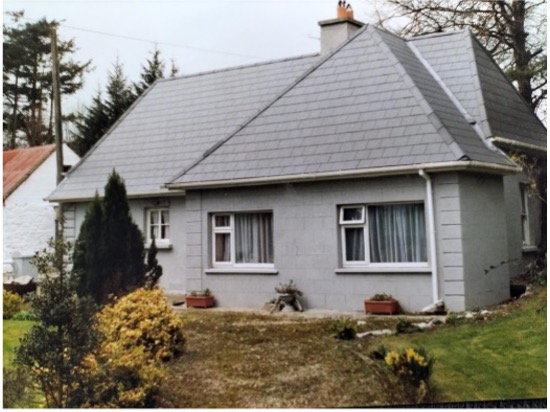
We met at Eoin’s home, and it took only a few moments before we experienced a warmth and cordiality that was heartfelt, sincere, intense, and above all, wonderful. We felt an immediate connection, though it was our first time meeting. Here, too, it is not words spoken, but thoughts and, above all, feelings. One of the first remarks Eoin made is one to cherish and place: “You look just like your father; no one can doubt that you are his son.”
The visit to the old Kilcrumper cemetery was the next highlight. Eoin took us to the family headstone. Being allowed to stand in front of it is a unique experience. You cannot get any closer to your ancestors. Reading their names and dates takes your thoughts far back in time. Who were they? How did they live? These are pressing questions that you can only answer in your imagination. But you are there, and that is the most important thing.
Eoin took us on a tour of the cemetery. As a volunteer for the working group, he knows this place like the back of his hand. We visited the headstones of other family members. A unique experience, which was rounded off by a visit to the new cemetery: Here rest Paddy Clifford and Mary Cronin, my father’s uncle and aunt. I never saw or knew them, and yet I feel a deep kinship. Probably because the bond with half my homeland never was broken. I was the “absent present.” Sometimes you realize that there is something in your life that you have, but that you do not describe; you cannot find the words. Only when you are there do you find what you have always unconsciously missed. That realization makes your life complete; you can close the circle.
After all these wonderful moments, Eoin took us to the old family home. For me, it was the moment I had been looking forward to. There you stand, following in the footsteps of your ancestors, four white walls and a roof, stables and outbuildings built 200 years ago. If walls could speak, I would listen and ask, especially ask. A home of and for four generations; the fifth is busy adapting the house to modern needs, though with care to preserve as much as possible. Eileen, Paddy, and Mary’s daughter accompanied us, and that was a bonus.
Entering the home was like stepping into a time capsule. The house had stood empty for years, and everything looked as if the residents had only just left. Eileen was born a storyteller. She commanded the audience’s attention. I didn’t want to and couldn’t miss a thing. Eileen explained that they lived here together with four brothers and a sister.
You entered an open space where they lived, cooked, ate, relaxed, and were together. Your attention was immediately drawn to the hearth; it served as both a stove and a furnace. It was where the cold of winter had to make way for the warmth of the fire. Where evenings were spent cozily and pleasantly, and where people listened to the stories that were undoubtedly told. I can picture it so clearly.
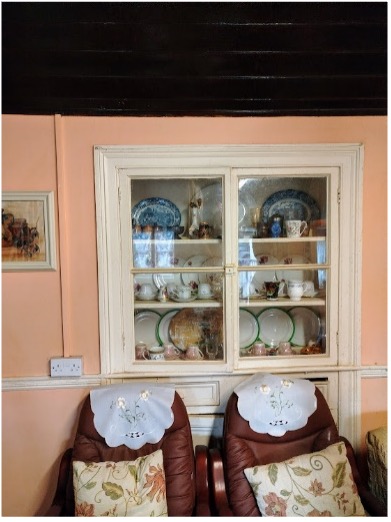
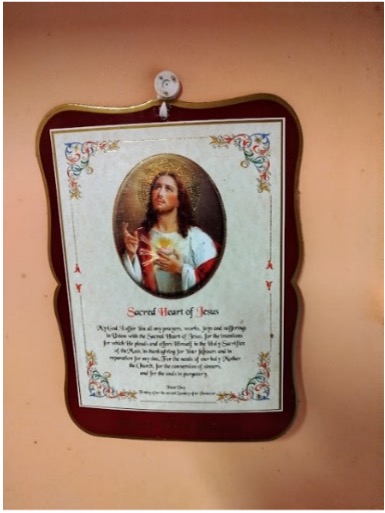
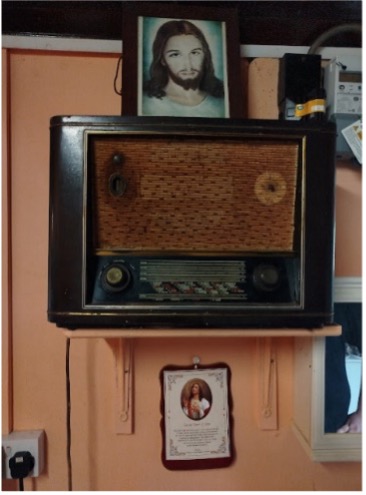
I have to think of so many things I saw in this house: the cupboard with all sorts of trinkets and items used by the residents in the distant and recent past. I can still see them before me: the egg cups with Paddy and Mary’s names written on them, for clarity and as a statement of presence. The cup with the nail clippers, so you didn’t have to search for them when you needed them. The beautiful plates and cups in the cupboard, probably only used for special occasions, and so much more. The Frames of Jesus on the wall are more than likely a fixture in every home. The table, on which lay a calendar from the year 1977. A book from the library with a date and stamped instructions. And so many more ordinary, everyday items and accessories, which we take for granted now, but hold a treasure trove of emotional value because they have flawlessly withstood the test of time.
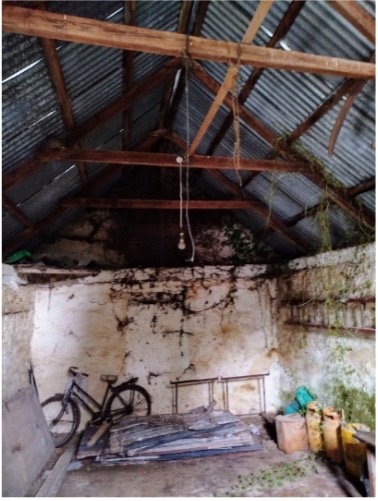
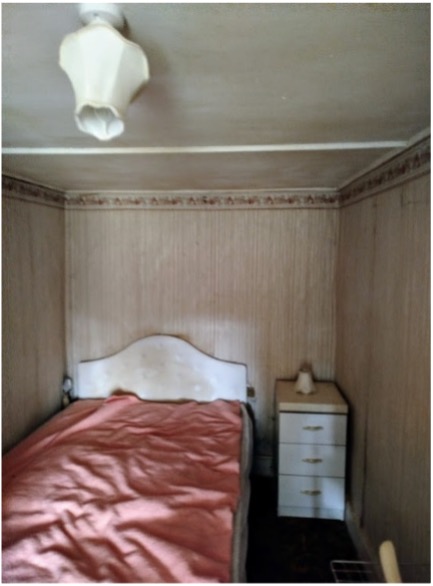
The stables, filled with things that make you nostalgic, such as an old bicycle, a ladder, and so much more. The small bedrooms, “the best room,” with all their necessary accessories, the beds still made, as if they were going to be slept in that very evening.
I could write thousands more words; it would not be enough to describe how much I enjoyed myself, and how intensely grateful for this opportunity my family gave me. Thank you so dearly, Eileen, Eoin, Hellen, and P.J. You gave me the time of my life.
Thank you to everyone who participated! We will announce the May contest theme on Thursday, April 2, so you’ll have plenty of time to get YOUR ancestor memoir written. Look for my posts on Thursdays, when I share prompts, tips, and inspiration to get you started. Writing together is easier, and saving these stories for history is important work we get to do together. See you IRISH BY ANCESTRY! —Shelagh

