We asked you, the Irish by Ancestry community, to share stories using the theme Her Name Lives On for this month’s Ancestor Memoir Contest. We had a record number of entries! Here are the top 3. Thank you to all who participated, we appreciate your creativity and sharing. Keep writing! Your family stories will outlive you, your descendants will have to do less research, and your ancestors will be proud.
Our winner this month, MARY-ALICE WILDASIN, follows the possibilities in a trail of data to breathe life back into the woman she honors here. Congratulations, Mary-Alice! She is the winner of this month’s Irish by Ancestry prize pack. She will also help choose next month’s theme. Here is her story.
Visions of Johanna
By MARY-ALICE WILDASIN
Irish by Ancestry Member
Johanna Doran.
Her name lives on in me.
My third great-grand aunt, Johanna was baptised 17 May 1849 in Summerslane, Coolaghmore, Kilkenny, just outside the market town of Callan. She was the youngest child of Timothy Doran and Margaret (Peg) Walsh. The time was toward the end of an Gorta Mór, The Great Hunger.
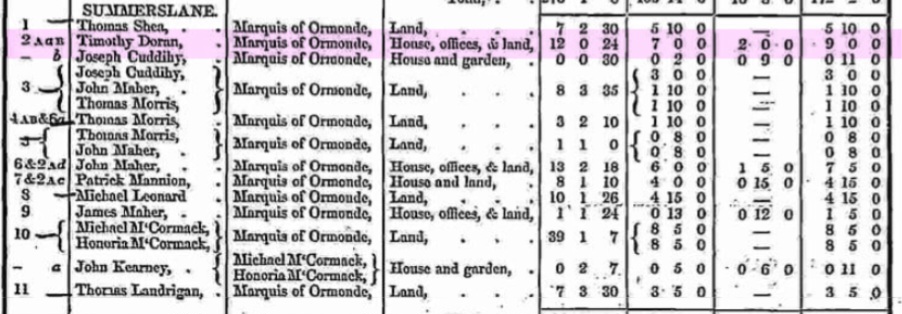
At that time, Timothy held a modest farm of approximately 12 acres, as recorded in Griffith’s Valuation, which he leased from the Marquis of Ormonde of Kilkenny Castle. The Ormonde estate, under the Butler family, was generally regarded as comparatively fair in its treatment of tenants during this difficult period.
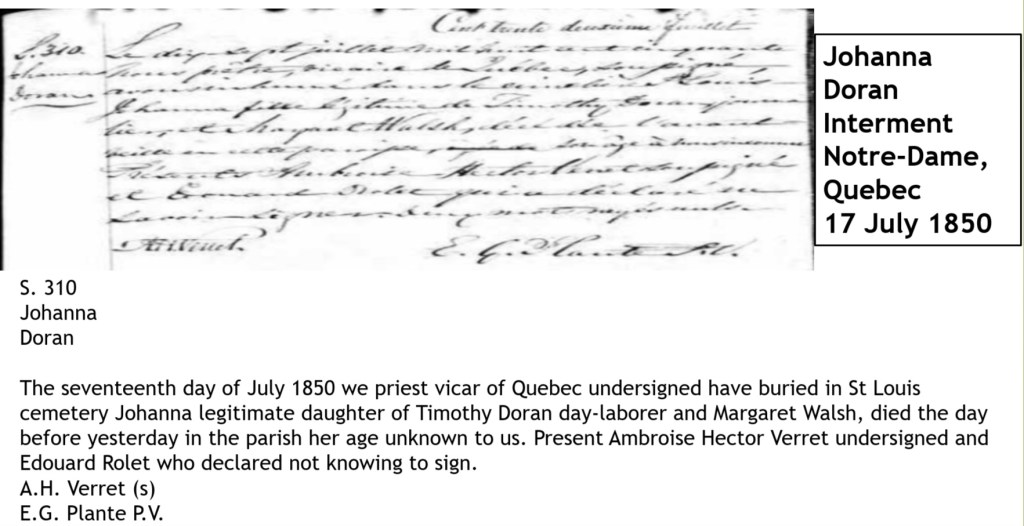
The family next appears in records in Québec, Canada, where their story continues under difficult circumstances. The earliest documented event is the enterrement (burial) of young Johanna on 17 July 1850. At just 17 months old, her brief life was shaped entirely by the upheaval of emigration—likely including passage across the North Atlantic on a crowded “coffin ship,” as was common during this period. There is a high probability that she died of either typhus or cholera, as so many Irish did. Hence the name, coffin ships.
Tragedy followed soon after: Her father died on 30 December 1850. The five surviving children who reached Québec were effectively left orphaned and taken in by other Irish families living along Champlain Street in Lower Québec, an area where many immigrants found work in the timber trade and shipping industries.
Peg does not appear in Québec records, and her fate remains uncertain—it is unclear whether she made the journey at all.
Another thread in the family story centres on Catherine, the second-youngest child, baptised 5 July 1846, who also does not appear in Québec records. However, a compelling clue emerges through DNA evidence: a match to a Catherine Doran in Melbourne, Australia, whose second great-grandmother was a Catherine Doran born in 1846 in Kilkenny. This strongly suggests a possible identification with our Catherine.
In Melbourne, a Catherine Doran married Timothy Geary, a native of County Cork, in 1871. Notably, their first child, born in 1872, was named Johanna. Whether this reflects a mere coincidence or serves as a familial tribute to Catherine’s younger sister—only three years her junior—remains an open question for further research. If the latter is true, Catherine must have held her younger sister in the highest regard—and she would have been heartbroken to learn that she died so young.
Adding to the intrigue, four of the Geary couple’s eight children were given names that correspond with those of Catherine’s siblings, hinting at enduring family connections carried across continents.
Johanna Doran.
Her name lives on in me 177 years later.
Our next submission from EILEEN MIZE shares the hard work of the Dowling women who persevered through hardship and change. Great story, Eileen, thank you! Here it is:
Dowling Women: From Limerick Drapery to San Francisco Life
By EILEEN MIZE
Irish by Ancestry Member
My grandmother, Eileen Patricia Dowling Vaio, was born in San Francisco in 1913, the daughter of Irish immigrants whose lives bridged two worlds. Her story—and theirs—is one of resilience, quiet strength, and the enduring imprint of women whose names, in some cases, were nearly lost to time.
Eileen was the third of four daughters born to Michael Gilbert Dowling of Limerick and Wilhelmina O’Reilly of Dublin. One sister, also named Wilhelmina, died in infancy—a reminder of the fragility that shaped many Irish and immigrant families of that era. Raised in San Francisco, Eileen would go on to marry there and begin raising her own family, establishing deep roots in the Bay Area that continue today.
Her parents’ story reflects the classic early 20th-century immigrant journey. Michael Dowling arrived through Ellis Island in April 1907, already with a job prospect in hand. Wilhelmina O’Reilly followed in October of that same year, and within weeks they were married at St. Mary’s Cathedral in San Francisco. Michael built a career as a retail manager with prominent establishments such as O’Connor-Moffatt and The Emporium, continuing the family connection to the clothing trade in Limerick.
That trade had been sustained, notably, by a Dowling woman. After the early death of her husband, Elizabeth “Lizzie” O’Flanagan Dowling—my great-great-grandmother—continued running the family drapery business at 26 Patrick Street with the help of her daughters. Records show multiple Dowling women working as assistants in the shop, demonstrating that female labor and leadership were essential to the family’s survival. Lizzie’s determination ensured continuity through loss, a theme that would echo in later generations.
Eileen’s early life was marked by both opportunity and tragedy. Her younger sister, Claire, suffered from mental illness and died at just 22 while institutionalized. On that same day, Eileen’s mother, Wilhelmina, also died in what was reported as a murder-suicide. Contemporary accounts describe a heartbreaking letter reflecting the despair and stigma surrounding mental illness at the time. The event cast a long shadow over the family and was rarely spoken of in later years.
Despite this, Eileen built a full and vibrant life. She married George Rudolph Vaio, the son of Italian immigrants, blending two strong cultural traditions rooted in San Francisco. Together they raised four children—George, Valerie, Jerry, and Patricia—in the Outer Sunset before later moving to San Anselmo in Marin County.
Like many women of her generation, Eileen’s working life came in phases. Early in her marriage, she worked as a medical laboratory technician, a path also followed by her older sister Elizabeth. After raising her children, she returned to the work force in medical records at the San Rafael Medical Group, where she worked with one of the earliest computer systems—an enormous machine that filled an entire basement—witnessing firsthand the rapid evolution of technology.
I was named for my grandmother, and though I was only in sixth grade when she passed away, my memories of her are many and vivid. We lived nearby, and I spent a great deal of time with her. She was especially close with my mother, Patricia—the youngest of her children—and through that bond, I felt deeply connected to her as well. I remember small moments: being taken along to “rescue” her from work for lunch, or simply spending time in her steady, warm presence. Those everyday interactions have become some of my most treasured links to her life.
Eileen’s story is also one of connection across distance. Though her father left Limerick as a young man, ties to Ireland endured. Family stories recall dresses being sent from San Francisco to cousins abroad—likely sourced through Michael’s work in retail—and assistance given to relatives emigrating to the United States. These threads suggest a family that, though scattered, remained connected.
The physical roots of that family still exist in Limerick. At Mount Saint Lawrence Cemetery, a Celtic cross marks the Dowling grave, bearing the names of multiple generations: Mary, who died at just 23; her young daughter Anne; Michael Gilbert Dowling; and Elizabeth “Lizzie,” the matriarch who carried the family forward. It is a tangible reminder of the women whose lives anchored the family long before it extended to America.
Today, the Dowling name no longer continues directly through my grandmother’s line, as it gave way to Vaio, and later to names like Manick and Mize. But the legacy of the Dowling women endures—in stories, in records, and in the lives they shaped.
My own connection to that legacy has come full circle. I lived in Limerick from 2000 to 2001 while attending the University of Limerick, long before I fully understood how deeply my roots ran there. Since then, I have returned twice—most recently with my sister Megan—when we had the opportunity to meet Dowling descendants who still live in the area. What once felt like distant history has become something far more immediate and personal.
There is also a small but meaningful continuity that feels almost poetic. The family’s former address at 26 Patrick Street—once home to the Dowling drapery business—is still a retail shop today, specializing in ladies’ garments under the name Irish Handmade. It remains a family-run business, continuing a tradition that echoes the work of the Dowling women generations ago. Even before I knew the significance of the address, I found myself drawn to that shop—an unexplainable pull that now feels like something more.
As I continue this research, I am reminded that family history is not only about uncovering the past, but about recognizing the threads that carry forward into the present. The Dowling women—entrepreneurs, mothers, survivors—left a legacy that stretches from a shop on Patrick Street to generations across the Atlantic.
My grandmother, Eileen, stands at the center of that story, a bridge between Ireland and America, and a lasting testament to the strength of the women who came before her.
And finally, a story from S.E. KING creates a compelling memoir narrative from records and personal observation. We really enjoyed this one, S.E! Thank you for sharing. Read on:
Her Name Was Delia Kilroy
By S.E. “KILROY” KING
Irish by Ancestry Member
Bridgett “Delia” Kilroy was born April 1, in a townland called Killasolan. April Fool’s Day. Which, once you know anything about my family, feels less like coincidence and more like a personality trait she arrived with.
In Ireland, Delia was a common nickname for Bridgett. Softer on the tongue, easier to carry over an ocean. By the time she crossed the Atlantic, she had become Delia entirely. Whether that was her choice or just what happened to Irish names in American mouths, I like to think it was hers. New city, new name, same fire.
I’m her great-granddaughter. Growing up, my family hadn’t cared to tell me about Delia, and the little I had heard, it turns out, was remarkably unfair. She had been almost forgotten. Dead women, it seems, are as complicated as those living. Sometimes more so.
Delia’s dad was a Kilroy; her mom was a Creaghan. They were laborers from the same small townland, both from families that had survived the Famine and gone back to farming the limestone fields of east Galway as though survival was all there was. Delia’s mom was born the year the blight struck. She signed her marriage certificate with a mark because she had never learned to write. She died of rheumatism after ten months of illness, and her husband reported her death to the registrar by pressing an X next to his name. He could not write either. He died four years later of pneumonia.
The land went to Delia’s brother Martin. As it always did. Delia was 27, both parents in the ground, and the question that defined a generation of Irish women with nothing left but their nerve was: Where do you go when you’re alone?
Delia set off for New Orleans.
Why New Orleans? The records don’t say. Irish immigrants followed chains: a relative who wrote home, a parish connection, a ship route. It was a port city with work and the chaos that absorbs people who arrive with nothing and intend to leave with something. It absorbed young Irish women with enough spirit and determination to not be what the century was trying to make of them. Delia fought for her life. And for a while there, she had won.
Delia married a contractor born in New Orleans whose father had come from County Sligo, also a Famine immigrant who had arrived with nothing and built a world anyway, in the heat and magic of Louisiana. Two families from opposite ends of the Irish west, finding each other at the mouth of the Mississippi. As one does, if one is courageous and lucky enough.
For a moment, it looked like the working-class Irish immigrant dream. She birthed four children, three lived. Then Delia died. She was 43. The cause is not known. She is listed in the records, and then she is not listed at all. She was lost in the silence that slowly suffocates women before anyone thinks to properly write their story down.
Delia’s husband found a new wife, it would appear. Her name I do not know. Her daughter was sent to live with a relative. Delia’s two sons were placed in an orphanage in New Orleans. One of them ran away at 14. He grew up. He signed official documents with the word Self in the space for his father’s name.
That son fell in love and started a family with a French Creole Isleños woman who fished on the bayou. But the pain of his childhood stayed in the shadows. I’m his granddaughter, a storyteller who named the protagonist of a book I’m writing Kilroy, for the Delia Kilroy in my blood, a name that felt right before I understood why. Which, I suppose, is the most Irish thing I’ve ever done without knowing it.
I look for women’s forgotten history to honor their grit and humanity. I found Delia months ago. I hadn’t searched for her thoroughly, because I had been busy looking forward. I finally was ready to stop and look back. It started as research for my book inspired by my New Orleans family. One thread led to another. A birth record in Killasolan. A marriage record in Caltra. A death register in Mountbellew that confirmed five generations of Kilroys in the same small townland, from the 1790s to the 1870s. The Famine arrived and some of them held on. But one of them left.
The civil birth record reads:
Name: Bridgett Kilroy. Date of Birth: 01-April. Address: Killosolan.
Born April Fool’s Day. Daughter of a man who never left Killosolan and never got to see the world through his daughter’s eyes — and of a Creaghan woman whose family motto was carved in a Sligo abbey in 1506:
“Cor mundum crea in me Deus.” Create a pure heart in me, O God.
Here is what I know about Delia Kilroy: She survived a childhood shaped by famine. She buried both parents before she was 30. She sailed to America alone. She arrived in a port city still raw from yellow fever that had killed thousands of Irish immigrants the decade before. She forged a life against all odds. She birthed children. She died before she could see them become themselves.
Her orphaned son built a family of nine, and his granddaughter named a character Kilroy without yet knowing the battles she was carrying within her. I suppose that’s how the dead stay alive. Not in what we were told about them, but in what we carry without knowing we are carrying it. In the names we give our characters and children. In the stories we create before we know the weight of their truth.
Her name was Delia, and she made a life worth telling. She crossed an ocean and carved out her story.
Now I know a little of where she came from. And a little of where I come from, too.
Do you have an ancestral memoir you want to share? You could be our next winner! The July theme will be announced June 3. Send a note to stories@byancestry.com with the subject line MEMOIR THEME to be notified by email.

