We asked you, the Irish by Ancestry community, to share stories using the theme The Ancestors Visit for this month’s Ancestor Memoir Contest. We received some touching entries. Thank you to all who participated, we appreciate your creativity and sharing. Keep writing! Your family stories will outlive you, your descendants will have to do less research, and your ancestors will be honored.
Our winner this month is Jill E. Doty. Congratulations, Jill! Her memoir is emotional, honest, and thick with enough detail to make us feel we are standing in the graveyard with her. She is the winner of this month’s Irish by Ancestry prize pack. Here is her story.
By JILL E. DOTY
Irish by Ancestry Member
I have always had a deep and unexplainable yearning for people I have never met. It began with sepia-toned memories of a lyrical Irish accent and black-and-white photos. My grandmother let me go through a box of her mother’s things, photos and documents that reminded her of where she came from. I could not reconcile the memories I had of a very elderly great-grandmother and the beautiful, raven-haired woman staring back at me. I wanted to know everything about her; where she came from and who she came from, and ultimately who I came from.
That longing led me to Ireland with my adult children. We had spent six glorious days driving all around Ireland and exploring every tourist destination imaginable, but on the train to Belfast, it suddenly felt personal. As if my ancestors were calling to me across time and space, and somewhere deep in my bones, I knew I was going home.
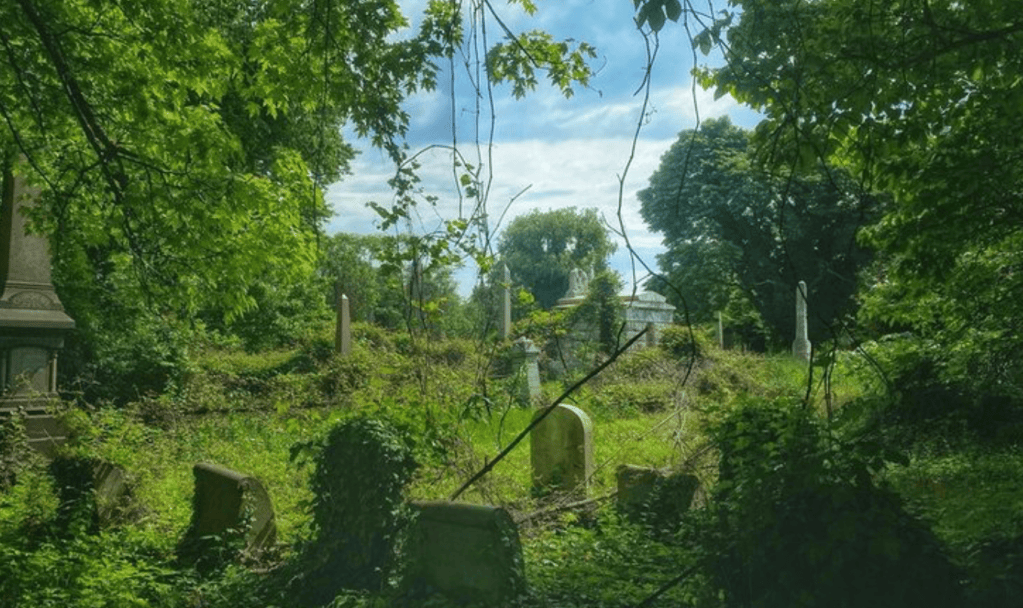
The hidden cemetery at Carnmoney is exactly as it sounds, hidden behind a hedge in a vast sea of graves. This section of the cemetery is so old, the sandstone has worn smooth on many of the headstones, which were so overgrown with ivy and lichen that they looked like an army of crooked, playful forest pixies. The trees overhead had bent toward each other to embrace in a protective canopy that splayed dappled sunlight over the worn paths, and the stillness and silence were broken only by the mournful singing of birds. Stepping through the hedge felt like entering a spell, like being suspended in a magical sphere where time stood still and the veil between this world and the other was sheer and thin and full of possibility.
I had come to Belfast to find Catherine. The five of us, my son, daughter, their partners and I spread out across the hidden cemetery in search of the grave of my great-great-grandparents, William and Catherine Jamison. I wandered my section, scanning stones and speaking aloud softly to Catherine, whom I had never met but longed to know.
I spoke to her with the familiarity of an old friend, whispering, “Okay, Catherine, I came all this way to find you. Help me out.”
Although I had never seen her face, I imagined her in my mind, dark hair and dark eyes like her daughter, and a fierce tongue like her granddaughter, and implored her again, “Catherine, send me a sign, help me find you.”
I wandered up and down the grassy paths, lost in the quiet tranquility and enveloped in the stillness, thinking about Catherine. I wondered what she would think of me. I wondered if my American accent would sound brass to her and remind her of all she lost. I wondered what she
would think of my daughters and their careers and their independent lifestyles. I looked down at the path and saw a feather lying in front of me and wondered aloud, “Is that you, Catherine, sending me a sign?” Feeling a little silly, I spoke aloud to myself, “It possibly is a sign, but I will wait for another.”
We had been in the cemetery for hours and had made slow progress in locating the grave we sought. Between the map we had, the plot number, and the location of other graves listed on Find-A-Grave, we were able to narrow the location to an area that was densely overgrown with bushes armed with thorns. There was no getting in there. My daughter called the cemetery to see if they would send someone out; no luck. My son tried to push his way into the center of the prickly bushes with a stick; no luck.
I sat on a low stone wall across the path from this giant, stickery obstacle and sighed. “Look, if she is in there, it’s okay. I came here to speak to her and honor her and I can do that without seeing her headstone.”
I had traveled from New Jersey with a pocketful of stones to leave on her headstone to mark that we were here and that we remembered her, but more importantly, I wanted to thank her. I wanted to thank her for being brave enough to let her daughter get on a ship with her four little grandchildren and sail across the ocean, knowing she would likely never see them again. I wanted to thank her for raising a daughter brave enough to leave her home and her family and start over in a new country so very far away without the comfort of her people around her. I wanted to thank her for being strong enough to let the people she loved the most go, because if she had not, I would not exist.
After I said my piece, we prepared to go, but my son was hesitant. Still holding that stick, he gave one last shove into that enormous tangle of branches and thorns. As he brought the stick back behind him, it pushed into another bush with a soft thunk. There was something solid under that mass of leaves and vines. He cleared off the ivy to reveal a weathered stone with no visible writing. He bent down to trace his finger in the hollow lines where letters used to be, spelling out “Jamison.”
I looked down at the ground next to my feet. Another feather. The realization washed over me in waves of emotion. He had found them.
It felt as though Catherine had slipped her arms around me in an embrace that transcended time, and as I met the eyes of my daughter, I realized that she had always been with me. That courageous, strong, proud Irish woman was in every cell of my grandmother, my mother, my daughters, and in me. She had been staring back at me through the mirror for my whole life.
Jane, Kathleen, Jayne, Jill, Lauren, and Michaela … we are her legacy. And she is proud.
We have a bonus entry from our favorite Belgian-Irish bard, Eric Cronin. Here is his story of discovering his father’s letters, bringing him present once more. Beautiful memories, Eric. Thank you for sharing with us.
Father’s Letters: Memories to Cherish
By ERIC CRONIN
Irish by Ancestry Member
After my parents passed away, we faced the unpleasant task of clearing out our old family home. It was an encounter with everyday objects—things that had once been so ordinary, they were easily forgotten or taken for granted. Yet, in moments like those, they take on a special significance. Every item—whether large, valuable, or small—evoked memories of cherished moments from the past.
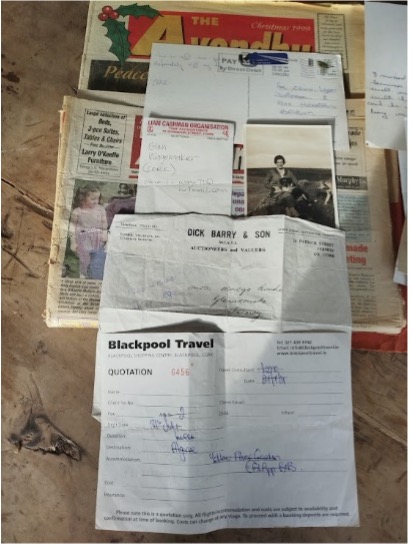
Sometimes you stumble upon things you never knew existed. That is how I found my father’s “Ireland folder”—a binder filled with letters, photographs, notes, receipts, and much more. It was likely his way of maintaining a connection to his homeland. It is strange to think that it took sixty-two years for me to see the things that had meant so much to him. Going through that folder was like a journey back in time—a discovery of the unknown. Moreover, I found answers to questions I had never even asked—questions that now make me think, “If only I had known.”
The contents of that folder are far more than just a collection of papers; they represent memories, answers, and insights from a bygone era. It feels as though your father is standing right beside you, sharing a part of his life.
I also found two old newspapers. Today, newspapers are important—even indispensable—to many people. Yet, the very next day, they are discarded and vanish as waste paper. In the past, they were useful for wrapping French fries or other goods, but even that function has largely disappeared. Today: new, fresh, and essential; tomorrow: forgotten and replaced by the next edition. Just imagine being a newspaper … That is how my thoughts sometimes wander. I read the newspapers carefully; I took the time to do so deliberately and was richly rewarded for my effort.
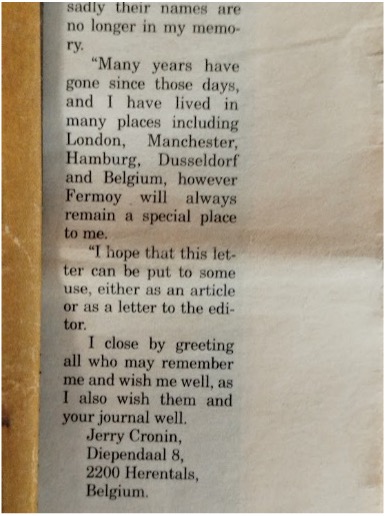
In one of the papers, I found a letter from my father, written after he returned from a trip to his native land more than twenty years ago. He was sixty-seven at the time and possessed a flawless memory. I suspect he was just as surprised to see his letter appear in the paper as I was when I found and read it.
The article describes a period from the distant past—memories of how things were and how they were experienced. The love for and pride in “his” homeland; so much value found in an ordinary “old newspaper.” I read the article and enjoyed it; it is remarkable how yesterday can suddenly become today … How chance can bring happiness. It felt like traveling through his memories—memories of his native land, the years he spent there, and so much more.
He described his childhood in Fermoy and life on his grandparents’ farm in Ballyhindon, where he and his mother stayed for a time after his father’s death.
The two-story schoolhouse—the upper floor for the youngest children and the lower for the older ones. The teachers, some stricter than others. His friends—people he still knew and would meet again during his trips home. The poverty, evident above all in their clothing and footwear; holes in shoes and worn-out cardigans and trousers were commonplace for them—old yet clean. And the strictness of the mothers whenever they did things that might soil or ruin their clothes. For the simple reason that there was no money to buy new ones.
The trips by horse and cart to weekly Mass, the meager pocket money spent on sweets, the older children buying Woodbine cigarettes—five for sixpence.
Summers spent barefoot. The cinema visits whenever possible, the film titles, and so much more.
Reading it transported you back to a distant past, and the images in your mind painted a picture of a carefree childhood, despite a life of hardship and poverty. It offered a glimpse and an understanding of what life was like and how it was experienced—first-hand information arriving via a long, roundabout route. Something to cherish and hold onto.
Father wrote a great deal, mainly to clarify matters or raise issues; whenever something was amiss, he saw a letter to the parties involved as the solution. My mother let him get on with it; “they won’t do anything about it anyway” and “it won’t make a difference” were her standard responses. She was often right, though sometimes she wasn’t.
The final paragraph of his article was significant: Father wrote that although he had lived in many places, Fermoy and Ireland were forever woven into the very fabric of his heart. It was an expression of deep love and longing for his homeland.
I remember well how, every year around his birthday, he would become quieter, more irritable, and more bad-tempered. His adopted country would then bear the brunt of it. He thought little of life here, saw few bright spots, and insisted that everything was so much better back in Ireland. “Just let him be; it’ll pass,” was Mother’s stock reply: “Jerry is going through his Ireland phase”—a form of homesickness, a recurring annual phenomenon. After a few weeks of sulking, the mood would lift.
For him, writing was primarily a way to stay in touch and maintain bonds with friends and family; I found some of those letters in his “Cronin-Clifford” folder. I discovered two that he had never sent. Last year—more than twenty years later—I was able to give them to the intended family members; mail delayed by over two decades. Upon reading them, the family members’ reactions effortlessly bridged the intervening years; they responded as if it had all happened just yesterday.
It is strange that the longing for his—and our—homeland only truly surfaced after his passing. I am still searching for the answer: Why only now?
I am certain that Father instilled an awareness of their Irish roots in his children in his own unforced way. I feel and experience this, day after day, after day.
Do you have an ancestral memoir you want to share? You could be our next winner! The October writing theme is OUR FAMILY TABLE. We invite all of you to share a story of grand holiday celebrations or simple foods that hold memories, a special ancestor whose food has become a tradition either at the holidays or any other time of year. We would love to see what dishes hold special meaning for your families, and preserve them for future generations. Please send your 1000-words-or-less submission with recipe and any photos of the dishes to stories@byancestry.com with the subject line ANCESTOR MEMOIR. (Please note: No AI-generated submissions will be published.)

