IRISH GENEALOGY How-To With Mel Howes
Would you benefit from a knowledgeable second set of eyes on your findings? Do you have an Irish genealogy puzzle you just can’t crack? Send your request with the subject line HOW-TO WITH MEL HOWES to stories@byancestry.com.
Howes is a longtime member of our Irish by Ancestry Facebook group and has been a helpful resource for RELATED features in the past. She is chairperson of the Irish Family History Society and a professional genealogist working in Dublin.
This month’s question comes from member Lily Hough, who sought more information on her great-great grandparents.
QUESTION
Hi, I have been struggling again a bit with my family tree, particularly that of my great-great grandfather James Corrigan and his wife Catherine Corrigan (Nee’ Leneghan), both of whom are my grandfather Peter Corrigan’s grandparents (if that makes any sense).
James and Catherine had their marriage solemnized in the Roman Catholic Chapel of Ballycroy, Co. Mayo, Ireland, on the 9th February 1873. Both list their residence as Doona (which is in Ballycroy, Co. Mayo) and their fathers are listed as Daniel Currigan & Pat Leneghan (both listed as farmers for profession), all according to their marriage certificate/record.
I can’t seem to locate James Corrigan’s birth certificate, or Catherine Corrigan (Leneghan)’s birth certificate. I also don’t know their mothers’ names or whether their parents were from where James and Catherine grew up, etc.
James was born circa 1844 (as on their marriage certificate in 1873, he is listed as 27 years old) and his father was Daniel Corrigan (also spelt Currigan). I don’t know his mother’s name unfortunately. James died in 1892 at the age of 48 in Doona, Ballycroy, Co. Mayo, with Catherine (his wife) being present at the death.
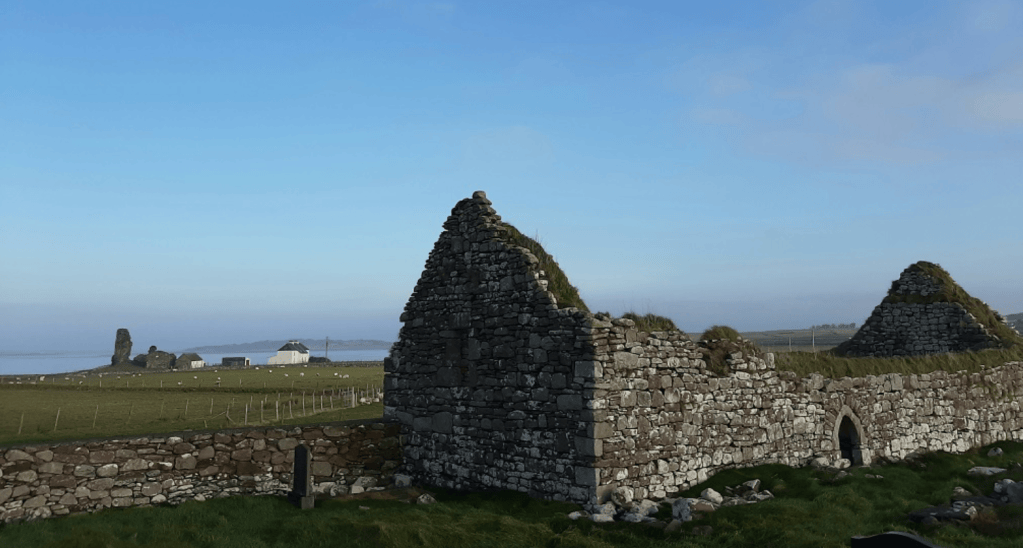
Catherine was born circa 1861 (as on their marriage certificate in 1873, she is listed as 23 years old) and her father was Pat Leneghan. I don’t know her mother’s name unfortunately. Catherine died in 1939 in Doona, Ballycroy, Co. Mayo, with her granddaughter Mamie O’Boyle being present at her death.
On the 1901 & 1911 census records respectively, Catherine is listed as head of the family with her children and in the column that says ‘Where Born,’ it says Co. Mayo for her and her children.
I did find two birth records for a Catherine Leneghan on irishgenealogy.ie, one being born in Islandeady, Co. Mayo in 1864 and one being born in Strokestown, Co. Roscommon in 1867. Both records list a Pat Leneghan as the father with different names for the mother (Rose Leneghan nee’ Callaghan for the Islandeady record and Anne Leneghan nee’ Sherman for the Strokestown record).
I can’t narrow it down out of the two if this is genuinely Catherine’s birth record or if she was definitely born in 1861.
I am subscribing to RootsIreland.ie toward the end of the month, but wasn’t certain given the fire in 1922’s Irish Civil War whether I’d even find the record or not of Catherine or James’ births.
Any help would be greatly appreciated,
Lily
ANSWER
This is a great query, Lily, thank you! There are three parts to my answer, and I hope they will help you with your research and provide some useful ideas for others facing similar challenges.
Start with what we know
James Corrigan and Catherine Leneghan married on 9 February 1873 in the Roman Catholic chapel at Ballycroy, Co. Mayo. As this marriage took place after civil registration of Roman Catholic marriages began in 1864, a civil marriage record is available through IrishGenealogy.ie.
Looking carefully at the record, we can extract several useful details.
James Corrigan was recorded as a 27-year-old farmer, and his father, Daniel, was also a farmer. Catherine Leneghan was recorded as 23 years old, and her father, Pat, was a farmer.
Both gave their residence as Doona, a townland in Co. Mayo. I use Townlands.ie to investigate unfamiliar Irish place names and understand where they are located.
There is an important discrepancy to address before we begin searching for birth records.
James’ recorded age suggests that he was born around 1845–1846, while Catherine’s suggests a birth around 1849–1850. These dates do not agree with all the other information in the question, particularly the suggested birth year of 1861 for Catherine. James’ death record, which gives his age as 48 in 1892, also suggests a somewhat earlier birth than his marriage record does.
Historical ages are not always accurate, so I would record these discrepancies rather than assume that any one age is correct. They are important clues to consider when evaluating potential records.
The marriage record also gives us the names of two witnesses: Peter Loughan and Catherine Cafferty. I would record these names in my research notes. Witnesses may be relatives, friends, or neighbours, and their identities can sometimes help establish connections between families.
The original document shows that James and Catherine made their marks rather than signing their names, I would record that observation too, while avoiding any firm conclusion about their overall literacy, though it is likely they could not write.
Work around missing records
Our main objective is to identify James’ and Catherine’s mothers and, if possible, establish more about their families and origins.
You mention that you are considering subscribing to RootsIreland.ie. Before paying for a subscription, I would always check which records are available for the parish and period I need.
On RootsIreland, go to the online sources for Mayo North and look for the Roman Catholic parish registers for Ballycroy. The collection currently lists baptisms from 1885 to 1916 and marriages from 1890 to 1923.
Unfortunately, these records begin too late to help us locate James’ or Catherine’s baptisms or their 1873 parish marriage. This is a useful reminder that an online genealogy subscription may not cover the records needed for a particular research problem.
It does not necessarily mean that no other relevant records survive, but we need to look beyond this collection.
A word of caution, it’s unwise to search using names only. Without the context of place, any potential matches you find, for example you mention Islandeady and Strokestown, are unprovable. Unfortunately, you can nearly always find a potential match, but the proof is in finding one in the right place at the right time, as well as with the right names.
Search for their children first
I would start by identifying children born to the couple by searching for their civil birth registrations. These records can help confirm the children’s identities and provide further information about their parents, such as any changes to occupation. Once you have established the children’s names, dates and places of birth, you can compare the information with the census records and other sources.
Look for James and Catherine’s wider families
Another useful strategy is to work sideways through the family tree. Search for possible Corrigan and Leneghan marriages in the Newport civil registration district, checking for couples whose fathers were Daniel Corrigan or Pat Leneghan. Pay attention to townlands, occupations, and other details that might help distinguish the correct families from people with similar names.
You can then investigate the children of these couples and look for the families in the census records.
A matching father’s name is not sufficient on its own to establish a sibling relationship, so I would treat these records as potential connections until other evidence supports them.
Remember to search spelling variants, including Corrigan and Currigan, and consider alternative spellings of Leneghan.
Search the census records
The 1901 and 1911 censuses are valuable sources for establishing household relationships, ages, occupations, and birthplaces.
The 1926 census is now also available through the National Archives of Ireland. As Catherine died in 1939, this census provides another opportunity to investigate her household and family connections.
I would also look beyond the immediate household. An older relative living with an adult child, or a group of people with connected surnames living in the same area, may provide useful leads. However, these relationships need to be investigated rather than assumed.
Investigate Doona through land records
We know that James and Catherine lived in Doona when they married. It would therefore be worth searching Griffith’s Valuation on Ask About Ireland.
The County Mayo valuation was published in 1857. If you find a Daniel Corrigan or Pat Leneghan in Doona, that would be a promising lead suggesting that someone with that name occupied property in the townland during the relevant period.
It would not prove that the person was James’ or Catherine’s father, but it would give you another piece of evidence to investigate.
Record the occupier’s name, the property details, and the associated map reference. The maps can help you understand the location of the property and may prove useful if you find other records connected with the same place.
What about the 1922 fire?
You are right to consider the impact of the 1922 fire at the Public Record Office (PRO) of Ireland. However, it is important to distinguish between records destroyed in the fire and records that were lost for other reasons.
Most of the original Irish census returns for 1821, 1831, 1841 and 1851 were destroyed in the fire. The 1861 and 1871 returns had been destroyed earlier, while the 1881 and 1891 returns were destroyed during the First World War.
Some earlier census fragments survive, but they do not cover Co. Mayo. Consequently, searching these fragments for Daniel Corrigan or Pat Leneghan in Doona is unlikely to help with this particular research problem.
The fire also destroyed many other important historical records, including wills, deeds, court records and Church of Ireland parish registers. However, the extent of the losses varies by record collection, and not every record of every type was destroyed. In particular, no Catholic parish records were destroyed, they were never present in the PRO.
It is always worth checking whether a relevant copy, transcript or alternative source survives elsewhere. The Virtual Record Treasury of Ireland is particularly valuable in this respect. It brings together surviving records and related material from institutions in Ireland and beyond, helping researchers investigate aspects of the country’s documentary heritage that was lost in 1922.
Although the missing baptism records may make this research more challenging, I would not consider it a dead end. By combining civil registration, census records, land records and evidence from the wider family, you may be able to establish stronger connections between James and Catherine and their respective parents.
Good luck with your research, Lily!
All the best,
Mel
Mel Howes, Dolmen Genealogy

