We asked you, the Irish by Ancestry community, to share stories about THE NAME ON THE STONE: WHAT DID YOU FIND? for December’s Ancestor Memoir Contest. You flooded our inbox with your fascinating entries, so many that it was difficult to choose a winner. Thank you to all who participated, we appreciate your willingness to share. Keep writing, keep those family stories alive.
Our winner this month, Kathleen Probst, shares the proud, difficult story of her ancestor, and the many experiences that her gravestone does not reveal. Congratulations, Kathleen! She is the winner of this month’s Irish by Ancestry prize pack. She will also help choose next month’s theme. Here is her story.
A Woman’s Grave Contains Multitudes
By KATHLEEN PROBST
Irish by Ancestry Member
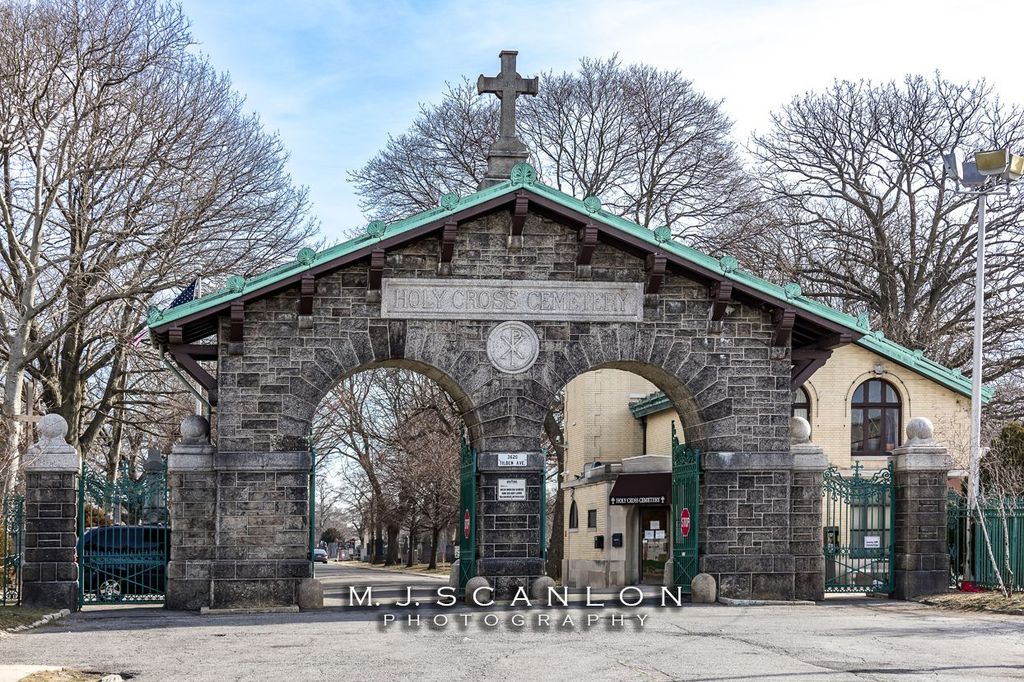
The name on the stone at Holy Cross Cemetery in Brooklyn, New York, says Mary Meyers, 1848-1915. That tells us so little of this remarkable woman except that she lived and she died.
It does not tell you that she survived the Irish potato famine when her parents, Patrick Caulfied and Mary Webb, left Loughglynn, Roscommon, Ireland and ended up in Warrington, U.K. where she was born and raised.
It does not tell you of the young bride who married Thomas Galvin in 1866 and gave birth to seven children but lost three babies from ailments that had no cure at the time. It does not tell you of the woman who trusted her husband to go to America in 1880 and send for her. During that time, her youngest baby, Eliza, died. It took two years for her husband to send for her. She had to get on the ship Arizona in September of 1882, with her four surviving children and just hope he would be at the other end.
This headstone doesn’t tell you she had a very hard time adjusting to life in America when she had an Irish last name but a very English accent. How their neighbors tormented her and her children for being “English” when she was really just as Irish as they were. They had settled in an Irish neighborhood in RedHook, Brooklyn, near the docks. She had to fight her way into life in America.
It doesn’t tell you how there was a blizzard in 1888 and her husband Thomas helped all his neighbors and got sick and died in May of that year, leaving Mary with a 4-year-old child as well as her other children. She had to send them to live with their married sister and go work as a live-in housemaid. She only saw her youngest children on her day off.
In 1894, she married a French sailor named Frank Meyers, whom her husband Tom had brought home years before. She had a daughter, Anna, at 46 years old with Frank.
And then it doesn’t tell you that her son Thomas became a widower with two babies in 1906 and moved in with her. Or that her daughter Julia died in 1907, leaving six orphaned children and that Mary took them all in. Her husband Frank worked in the NY city sewers. It doesn’t tell you she was Mary Caulfield Galvin Meyers. A very strong Irish woman.
Karen Cunningham shares the surprising poignance of discovering gravestones for family never known in life, but well known in heart. She found shipping records that traced this ancestor to Portadown, Co. Armagh. She notes she’s had no luck finding the “Deryanvil” that is indicated on the gravestone, but she and her husband are planning to go there in 2026 to look for themselves. Here is her experience.
More Than the Name on the Stone
By KAREN CUNNINGHAM
Irish by Ancestry Member
Visiting an old cemetery can be a rollercoaster of emotions, can’t it? There’s the hope of finding a connection to your heritage, the anticipation of uncovering new information, and the elation of finally standing in front of a piece of history that holds your ancestor’s name.
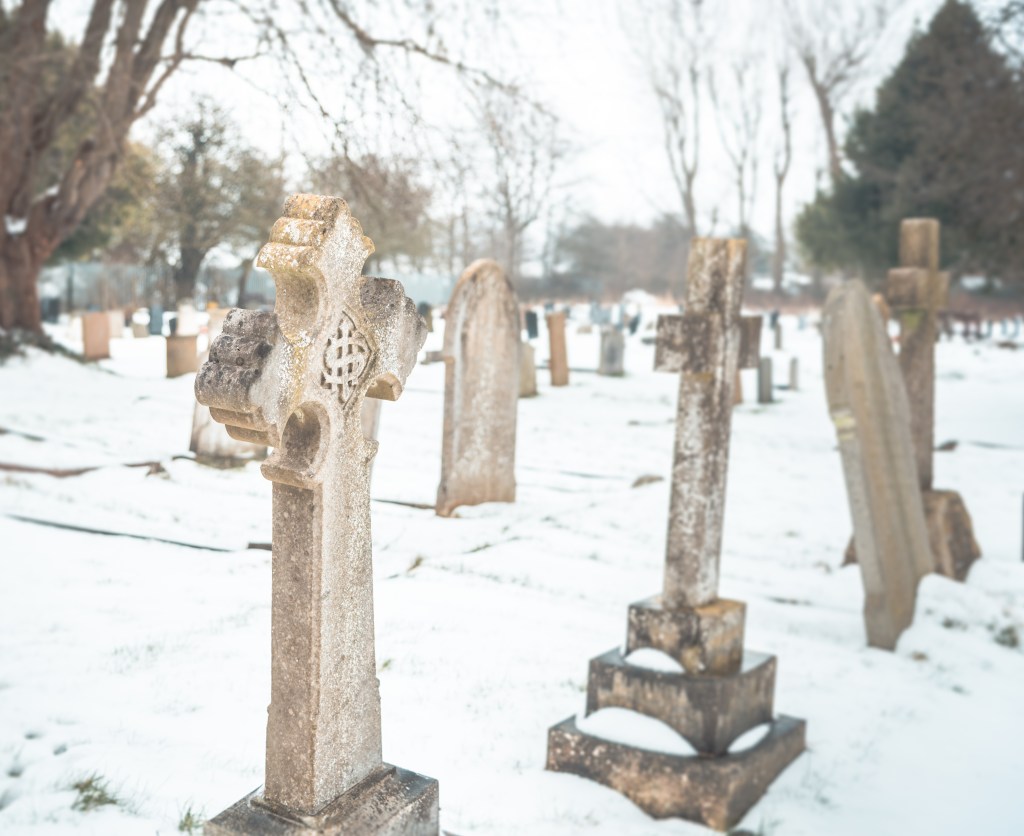
For me, walking through the gates of Witton Cemetery was like stepping back in time. I felt a deep connection to my children’s three-times great-grandfather, John Matchett, also known as “Irish John.” His broken stone, lying in the red dirt, told the story of a man who lived a full life, passing away at 65 in 1892. The inscription, “In Loving Memory of John Matchett Who died at Myall Park 6th June 1892 Aged 65 years A Native of Derryvale Ireland,” was like a window into the past.
And then, just a few rows over, I found the grave of his daughter, Sarah Matchett. Her stone, erected by her children Fred and Beatrice, shared a poignant message: “Erected by Fred & Beatrice In Loving Memory of Our Dear Mother Sarah Barnes Died 17 May 1932 Aged 72 years.” As I stood there, I couldn’t help but wonder about Sarah’s life, her personality, and her experiences as a young mother in country New South Wales.
What struck me most was the realisation that Sarah passed away just months before her grandchildren were born. As a grandmother myself, this made me feel very sad for her. It’s a poignant reminder of the connections we have with our ancestors, even if we never got to meet them.
Cemeteries like Whitton are more than just places of rest; they’re gateways to our past, holding stories and secrets waiting to be uncovered. As the saying goes, “Every headstone tells a story, it’s so much more than just the name on the stone.”
This unique essay from Isabella Moon expresses the perspective and shared experience of so many who cannot find relatives’ stones. Here is Isabella’s story.
When Your Ancestors Are There But Not Quite There
By ISABELLA MOON
Irish by Ancestry Member
To write this article, I had to start with two questions:
Question 1: Do I have Irish ancestors?
Yes. LOTS and LOTS of them. All over my tree. Everywhere.
Question 2: Are any of these ancestors known to have a headstone?
Ummm … No. Not one.
Now, I don’t live in Ireland, so obviously that doesn’t help my search. But the internet can be great at filling in these gaps, giving virtual access to headstones hundreds or even thousands of miles from home. Everywhere except Ireland, that is. Believe me, we’ve tried. Global graveyard websites, Irish-specific ones … if you’re looking for an Irish relative who died in the 1960s or later, you might be in luck. But my ancestors all left Ireland way before then.
It’s so strange. How can I be Irish if no one in my family has lived there since the 1800s? Yet, out of my 64 4x great-grandparents, at least 25 of them were Irish. A lot of people say, “My family left Ireland during the famine.” I have so many Irish ancestors, that one-size-usually-fits-all story doesn’t quite work. Yes, some of my ancestors left during 1845-52 (understandably), but some actually left before that—and others didn’t leave until decades after the Great Famine. In their cases, it must have been something else that convinced them to cross the ocean to Britain—probably job opportunities or smaller-scale famines (yes, sadly the big “Great Famine” wasn’t the only famine 19th century Ireland faced …)
Do I know where in Ireland my ancestors came from? Again, it’s a different story for everyone. Many British census enumerators didn’t bother to say where anyone was born more specifically than “Ireland,” so some are doomed to remain a mystery forever. But there are some lucky cases where an ancestor was alive in 1911 or 1921 to fill in the census themselves. So there are a handful of specific locations within Ireland where I can pinpoint my ancestors, like Swinford/Kilconduff in Co. Mayo, Killoran and Easky in Sligo, and a couple more scattered parishes in Co. Kilkenny.
Once a place is pinned down, you can maybe find out a little bit more background about your ancestor who left Ireland. Grey-tinged microfilm pages from parish registers might reveal their parents, the odd sibling—very occasionally, even details of grandparents. Having concrete proof of these people is amazing, however, the part my family always struggles with is finding out what those parents/siblings/grandparents/aunts/uncles actually did in their lives. Or even how long they lived.
You see, the problem is, whereas most places in the world that keep parish records generally record three things: births, marriages and deaths, many 19th century Irish Catholic churches only recorded births and marriages. Not deaths. They weren’t important, apparently. I think I remember reading somewhere this was because of Catholic beliefs about death not being the end of life?
I can’t help but think of a more sinister possibility, too—given everything the Irish people suffered in the 1800s, surely it wouldn’t be surprising if there were periods when the poor rural parishes were simply in too much chaos and losing too many residents to keep track of everyone who had died. I don’t want to imagine this, but what else am I supposed to think? And continuing to think about it, in instances where the priest or parish clerk died in a famine or epidemic, maybe it took a long time to find somebody else who could keep records for the community, since so many Irish people had no formal education? When you consider the situation from this standpoint, it seems unbelievable that small parishes managed to keep their birth and marriage registers going at all, especially during the 1840s.
And I suppose, if there’s one of the three events you’re not going to write down, maybe it’s best that it’s deaths—after all, details of death go on tombstones anyway. Most ancestors have tombstones, right? It seems that way in England at least, where only the very poorest or socially isolated forebears don’t (and even they might get a very small stone). So why haven’t I found a single ancestor with a gravestone in Ireland? Well, just like with the parish registers, there are lots of factors to consider. Like if the ancestor could afford a headstone in the first place, if the parish had access to large stones and labour to put them up, if the settlement is still inhabited today, and if the church is still in regular use with a priest who answers letters or a parishioner who records graves, and if the stone hasn’t weathered, fallen down, or been vandalised, reused for building, or replaced by a modern grave at some point in its history. Since we know we are talking about a nation that has suffered extreme poverty, fierce religious conflict, and significant emigration and depopulation of its rural areas (thus less upkeep of those areas), these are some VERY big “ifs.”
And … *breathe*…
So … now I’ve discussed all these barriers to finding headstones in Ireland, what now? Where does this leave me and my family? We are definitely Irish, but we can’t find any family graves in our ancestral nation—and we don’t know if we ever will. How does this make us feel?
Sad. Disconnected. Confused. Frustrated. Like we’re missing a big part of our family story. Almost like fakers in our own ancestral diaspora.
And the thing is, I can’t fix the past or make gravestones magically appear. But what I hope to do by writing this article, is let other families know that it’s not just you. That you’re not going crazy. That no gravestones doesn’t mean no Irish ancestry. That you are not alone in this situation—we share it together.
And finally, we’ll close out this month’s entries with a special one from our resident bard, Eric Cronin. Visits to a grave can become a ritual of comfort, and create surprising connection. Here is Eric’s story.
Bringing My Father a Little Bit Back Home
BY ERIC CRONIN
Irish by Ancestry Member
Ireland is my father’s birthplace. He came to Belgium, met my mother, got married, and stayed here. The marriage was blessed with the birth of five sons.
My mother had hoped for a daughter, but that never came to pass. My parents and two brothers have passed away, and all four are reunited in a single grave. So together until the end of time, something my mother always wished for. My brother’s death deeply affected my parents, and yet, together and through each other, they found a way to move on, however difficult it was for them. My brothers’ final resting place was a place for my parents to find peace in their deep sorrow.
Every single week, they visited my brother’s grave. The flowers they brought to place at the gravestone were the weekly allowance they were entitled to, even after their death. For them, it was their way of letting their sons live on, in their thoughts, actions, and being. They weren’t gone; they were in and with them. For them, the visit to the cemetery was an unmissable appointment, a highlight of the week.
The rare times one of them couldn’t attend this appointment were a moment of panic, great concern, and immense sadness. Although we, as remaining sons, took this over, our brothers were not allowed to miss their weekly pocket money under any circumstances. I can still see the grief and sorrow in their eyes when they had to miss this visit. Reassuring them at that moment was a tough job; no matter how much we reassured them, it was the loss of being able to be with them at that time of the week that was difficult and unbearable for my father, and especially my mother.
My parents weren’t afraid to leave this world; they knew they would be united with the children they had been missing from this earth for so long. There was only a deep concern that literally kept them awake at night: Who would bring the pocket money when they were no longer there? It was simple: We promised them we would continue this task. They knew that a spoken promise is sacred to us; we only promise what we can fulfill and carry out, nothing more or less. And every Sunday, my brothers and parents are visited and given pocket money. For us, too, it’s a moment of peace and a time of being present with our brothers and parents.
For many years, the cemetery has been our place to be together, to maintain and cherish, to hold on across the boundaries of life and death. A borderless encounter between the earthly and the other dimension we call “death.” I know for sure that my parents and brothers are not gone; they live on, in and with us, until we too can go to them—a certainty.
I have a thing about cemeteries. For me, they aren’t gruesome places or settings for horror films, but places where peace, silence, memories, sadness, and quiet thoughts are paramount. They are universal pursuits, regardless of where you might be in the world, I think.
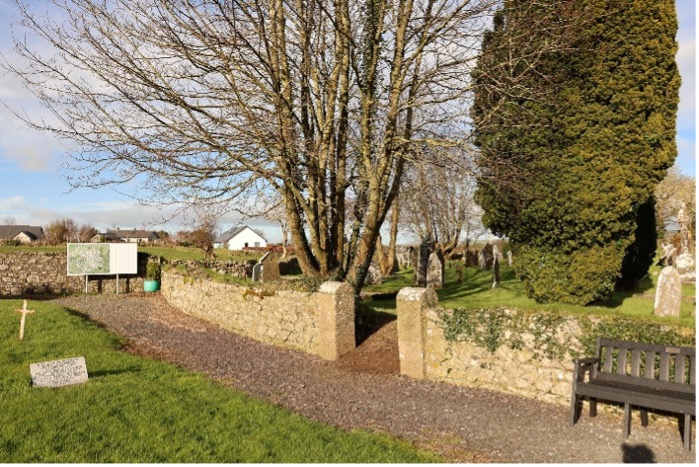
The old Kilcrumper Cemetery is one such place that holds a special place in my life. It’s where the gravestones of my ancestors are located. I only realized this after my first visit to Ireland. I received a photo of the graves of my grandfather, great-grandfather, and grandmother. More photos followed, and the dear Mrs. Emma Brown visited the cemetery especially for me to deliver these images, for which I am deeply and forever grateful. Viewing these images gave me, and still gives me, a sense of connection and belonging to my Irish family, an indescribable feeling of inner richness and deep connection, a pride and confirmation that my blood is a blend of Irish and Flemish lifeblood.
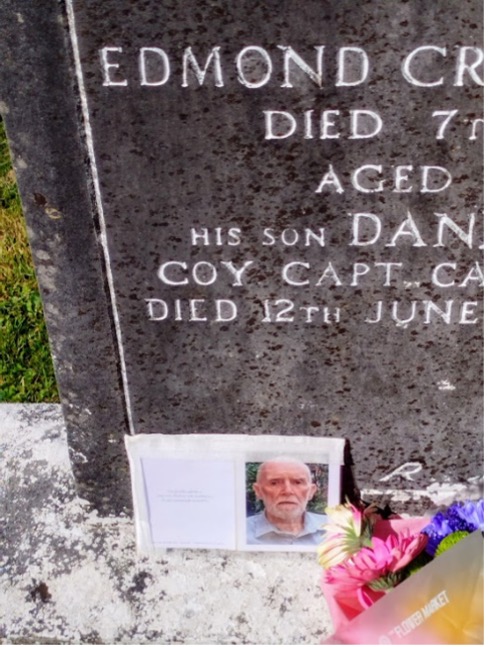
What makes my experience even richer is the fact that through this final resting place of family members, I was able to start a new beginning with relatives I’d never known before.
A wonderful thing. A simple post, made on a Facebook group of volunteers dedicated to restoring, maintaining, and reviving this cemetery, opened this door for me. A simple comment to a question of mine was a surprising and stunning opening: “Hi Eric, we must be family, we have the same great-grandfather.” Reading this is a bit of a shock, and similar comments followed. The cemetery and the gravestones offered the opportunity to experience something new and rich in my life. It was no longer an end or a final resting place; it was a beginning filled with something new. In a few minutes, I had gained numerous new family members, people I’d never known, and who, in a few seconds, felt as if I’d always known. As strange as this may sound, it’s how it feels. Following the comments, emails were exchanged, culminating in a trip, a family gathering, and a visit to the cemetery.
A moment to hold on to and cherish, as long as I’m allowed to walk this earth. Walking in silent thoughts on this, for me, a Holy place, looking at the names and the dates on the old graves. Imagine who they were and what they did, asking myself, what was life like when they lived? Walking with questions, thoughts, and special feelings as companions.
A special feature of all this was the opportunity to bring my father back home to his native country, a promise I made to myself to fulfill this task. I was allowed to place a reminder of my father’s memory at the gravestone, and I was able to do so. It gives me inner peace to know that I did something my father would be happy about. My father is back home in his beloved country, where he is with his father, grandparents, and family for endless times. A precious feeling, to know I could make the circle round.
THANK YOU to everyone who participated! We will announce the January contest theme on JANUARY 3, so you’ll have plenty of time to get YOUR ancestor memoir submitted for next month. See you on Irish by Ancestry!
 RELATED ☘️