By JONATHAN BEAUMONT
RELATED☘️ Staff
“I want to hear REAL Irish music – not country and western!”
“I went to that bar last night, but all they played was Beatles, “Wagon Wheel” and “Wonderwall”!”
“I was at a place last night where they said they’d music, but none of it was Irish!”
“We went to a famous Irish music bar after dinner, but there was no music at all!”
And so it goes; so what’s happening?
First, it’s important to understand where the music comes from.
Like all old cultures and traditions, the music, poetry, legends, art, dance, and all other forms of culture has its origins in people amusing themselves before smartphones, computers and TV were ever invented. People finished their day’s work and found ways to amuse themselves. Evening gatherings, stories told and news exchanged. Tea boiling, nothing spectacular, pull up a chair and “tell us the craic.”*
When we travel, and this writer has been travelling round some 40-odd countries over more years than I like to admit now, we see what people in other countries do. We might recognise some of it, and the rest might be completely alien to us; travel, as always, broadens the mind.
One thing all old cultures have in common is this. The folk traditions, be they music, dancing or storytelling, were never intended as “shows.”
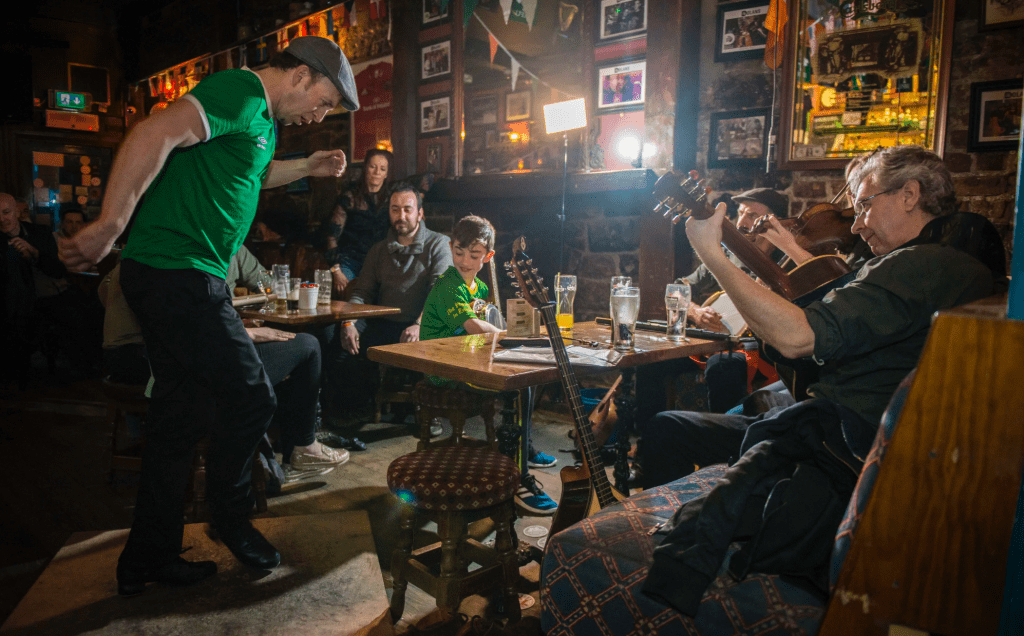
Before we get further, let that sink in.
If you want REAL Irish culture, a genuine session in an old pub where people have been gathering long before tourism was ever invented, you are not, absolutely not, “going to see a show.” Yes, there ARE shows, which “showcase” all this, and very good indeed they all are. I’ve seen most of them. By far the best would be Celtic Steps in Killarney, but Galway’s Trad on the Prom, and Dublin’s several equivalents are, indeed, all good.
But I’m looking here at the roots of it all. The real deal. The songs and music that Christy Moore wrote about, that our ancestors brought with them when they were forced to flee the land for America during the Famine, “to ease their troubled minds.” In the vastness of the USA, with its many cultures mingling, our Irish tunes ended up transposing into bluegrass, which merged with other ingredients to create country and western. And our returning emigrants brought it right back home to Ireland, y’all!
Fun fact about Ireland (apart from the fact that nobody here EVER says “top of the morning to you!” and “Danny Boy” isn’t even an Irish song): Country and western music is today THE most popular music in Ireland, especially in the midlands and northwest. What do ye think of that! So you actually WILL get C&W all over the place, or at least a medley of the international “standards.” So that explains that part …“yeee-ha!” as the good folks of Co. Donegal might say.
It’s Irish music we are looking for tonight, not “Country Roads Take Me Home … (back to Tyrone!) …” But Irish music is not as universally available as many visitors hope. Let me explain.
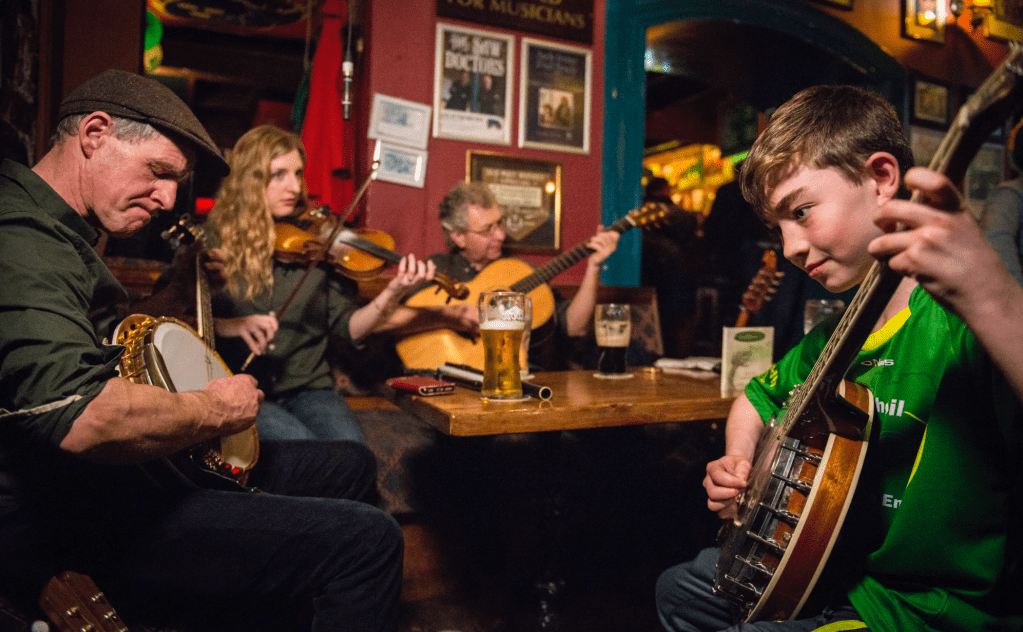
What we are seeking out is a corner in a pub, where a group of people will gather. Occasionally, it’s a complete one-off, where someone has encouraged someone else to sing some song their oul granny from round the corner knew well. It might develop into more, or it might be over before you’ve got your iPhone out of you bag. More often, the reason they are here is because they meet here every Tuesday night, because Timmy can’t do Mondays, Martin works evenings on Sundays, Pat has to babysit on Thursdays and Fridays, and the two Sarahs are rarely about on Saturday.
Think of the (American!) Billy Joel account of “the regular crowd shuffling in” to hear the Piano Man. But even he is a paid performer, one presumes. A proper session, as we call it—a traditional music session, a “trad night” or a “sesh” consists of whomever is free. The owner of the bar might set them up with the odd free drink, but other than that, it’s a social gathering for people with nothing more than a shared interest in music. Sometimes they sit and chat for longer than they play tunes. Sometimes, nobody turns up who sings, so it’s jigs and reels all night. Sometimes it’s this and sometimes it’s that. It’s open night.
All are welcome! Can you sing? Tell them!
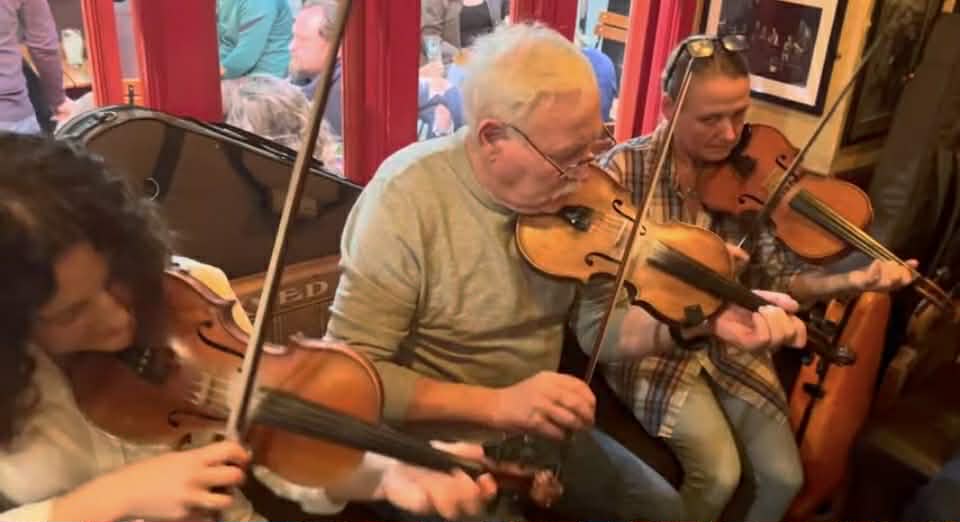
There’s John on the left, with the fiddle. He’s a local national school teacher. Teaches piano and violin as private lessons, too. The fella beside him is a sports coach in the gym. The girl with the curly black hair—that’s Mags, she works in the local supermarket. The younger girl on the right with the guitar, I dunno her at all, never seen her before, and the man beside her with the pipes, well, I know him vaguely to see … ah yes, get me another pint.
I know a lady in one rural town who plays box accordion in sessions the odd time. Her day job is as a psychiatric nurse in a nearby large public hospital.
So, pull up a seat, get a drink, sit back and enjoy. If there is some tune you like, ask them what it is. Talk to them—they’ll be delighted to share their enthusiasm for the music!
So, how do you FIND all this, as opposed to what was mentioned above? Ask, in the town you’re staying in. But here are a few pointers.
First, the vast majority of proper sessions are later at night. Very, very few, beyond a handful aimed at tourists, take place in early evening, and fewer again in daytime. Why? John the fiddler is teaching geography to 13 year olds. Angela is at college studying marketing. Jimmy is going for a job interview. Anne is collecting her son from school, and minding Aggie’s dog today. Paul has to go to the bank. Eamonn is struggling with a roofing job, while Louise is doing a presentation to the board meeting. Her cousin, who plays flutes, is up the fields trying to fix a broken-down tractor. And he’s nearly out of phone battery. Better go and get Paddy!
Half past nine is typically when sessions start. Often, it’s 10 or afterwards.
Second, he majority of session are at the weekends. Look at our friends above; our board member and our teacher will be free on Friday, Saturday or Sunday nights, but not during the week, especially when the shopping has to be done. So if you’re staying somewhere that contains a pub that you’ve established has proper sessions, it’s very likely to be Fridays only, or Sundays only, or something.
Now that we’ve covered those basics, where ARE the best spots?
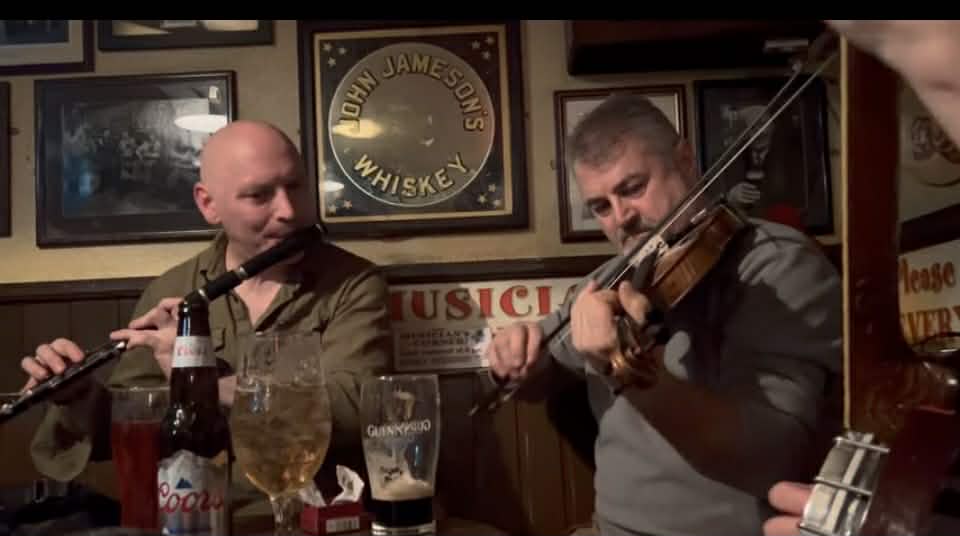
Imagine you’re one of the locals, who can play and likes playing, and sharing with others of a like mind. You live in a particular town, even a larger city. There will be one or two famous spots for music, in some cases famous long before you were born. Now, isn’t that exactly where you’ll head?
So, even in bigger places, maybe one spot they all gather. Every OTHER bar will have a man with a mic and amplifier and electric guitar on a tall stool, broadcasting “Sweet Home Alabama” all over the street, but that’s not where you are going to go with your fiddle. No, you’ll head to see the usual crew, down the street, turn left, past the post office, and second right. Oh yes, the postmistress, when she’s not visiting her mother, is a GREAT singer!
In Dublin, the serious musicians head to O’Donoghue’s in Merrion Row. (Tell Victor I said hello.) You will get early sessions there quite often. But, as purists, they use no microphones nor amps, which means that unless you’re standing near to them, you won’t hear a thing. This, unfortunately, applies to many places where there’s a trad session. They almost always have later-on sessions, too. Good if you’re staying in the St. Stephen’s Green / Harcourt Street / Dublin 4 area. The Cobblestone in Smithfield—impossibly packed solid—has probably the best sessions in the city, and some of the best in the whole country. The Pipers in Marlborough Street has sessions most nights, but hours are unpredictable.
OK, I hear you say, but what time should I be there?
Musicians start when they’re ready, and finish when they finish. That’s it.
If you want to get near them, get there EARLY! A good hour before the earliest time they are likely to start. If you’ve been told it’s 9:30 p.m., get there at 8. And get a drink.
Please, please—this is etiquette here—do not occupy a whole bank of seats and not drink anything. I have seen people being told off for this, or told to give up their seats. Yes, a bit over the top, but think about it. You’re not the audience sitting in a row at a show. You’re monopolising the place and keeping genuine enthusiasts away. Don’t like beer or alcohol? Zero, zero problem. They’ve bottled water, orange juice, no-alcohol beer, and minerals.
There are other places in Dublin, of course; I simply mention the “main” ones where so many of my own musician friends will tend to gravitate.
In Belfast, go to the Points on the Dublin Road after 10, seven nights a week. Nice spot. Fibber Magee’s in the city centre (behind Robinson’s Bar) has music most evening and earlier, but it’s a mixture of Irish music and the divil himself only knows what else. Maddens sometimes has sessions. But the best is Tuesday nights in the Errigle Inn, in the eastern end of the city. Book your return taxi first! When the session there is over (say hello to Jason for me!) there are hardly any taxis about outside. It’ll be worth it. I’ve seen up to 15 or 16 musicians in full flow there. Absolutely priceless!
In Donegal town, McCafferty’s has good sessions at weekends at times, or good traditional singers at least. In Letterkenny, Co. Donegal, at the weekends you’ll get trad music in a couple of the bars – try the Central. In Westport, Co. Mayo, you’ve one particular gem—with proper trad sessions seven nights a week, starting usually about 9:30 p.m. This is Matt Molloys—yes, he of the world-famous Chieftains. Matt bought the bar about 40 years ago, and still occasionally plays there himself. His son, Peter, is a TOP class musician there, too. Say hello to Dan for me! Again, you need to get in there at the very latest 8 p.m. Get a table at the back wall, as the place gets absolutely rammed solid packed. Get your drinks and sit yourself down, and do say hello to the musicians. You might see the great man himself!
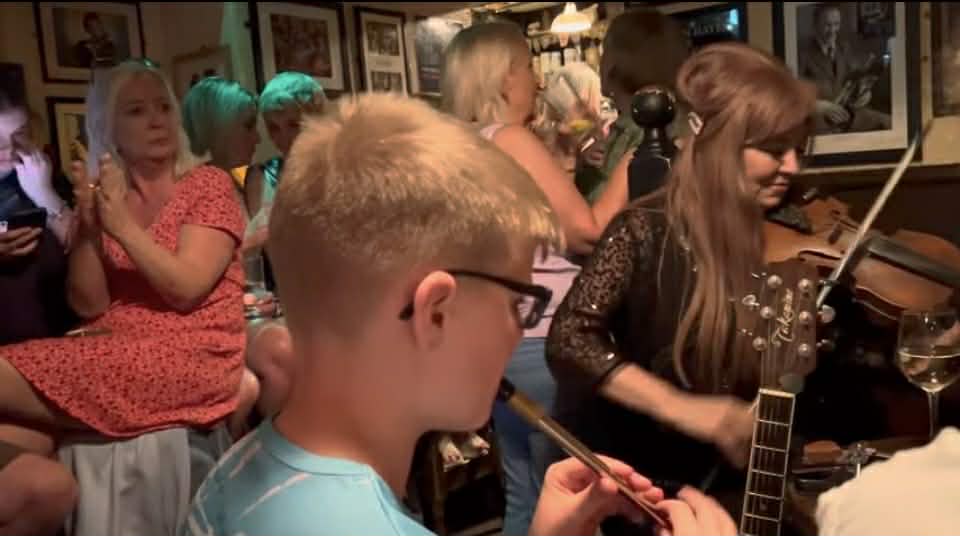
In Galway, it’s Foleys at the top corner of Eyre Square, or Thirteen on the Green at the bottom, opposite the bus station. In the former, go at the weekend, and you might get an early-ish session there, too. But in the latter, Thirteen, go on either Monday or Tuesday night, and you will get the only one they do in that bar, but which is one of the very best in Ireland. (Say hello to Terry… ah, ye get the picture).
However, down in the pedestrianised city-centre area, there is music everywhere. For traditional Irish, some nights in the Kings’s Head (they’ve music there seven nights a week, but it’s not necessarily Irish), and EVERY night across the road in Tigh Coílí (red frontage). Again, get in before 8:30, and it tends to kick off between 9:30 and 10. Further across the city the Crane is another good spot.
Head south round the villages and towns in Co. Clare. You’ll get an amazing session, but not every night, in the Old Ground in Ennis, plus a few other spots within a 10-minute walk. Ask what’s happening the night you’re there. Gus O’Connor’s in the tiny coastal village of Doolin is another.
Limerick and Cork have a number of pubs, but they are larger cities and again, ask, depending on what area you’re staying in. Similar story along the south coast in Waterford. Try the area around the Viking Quarter there.
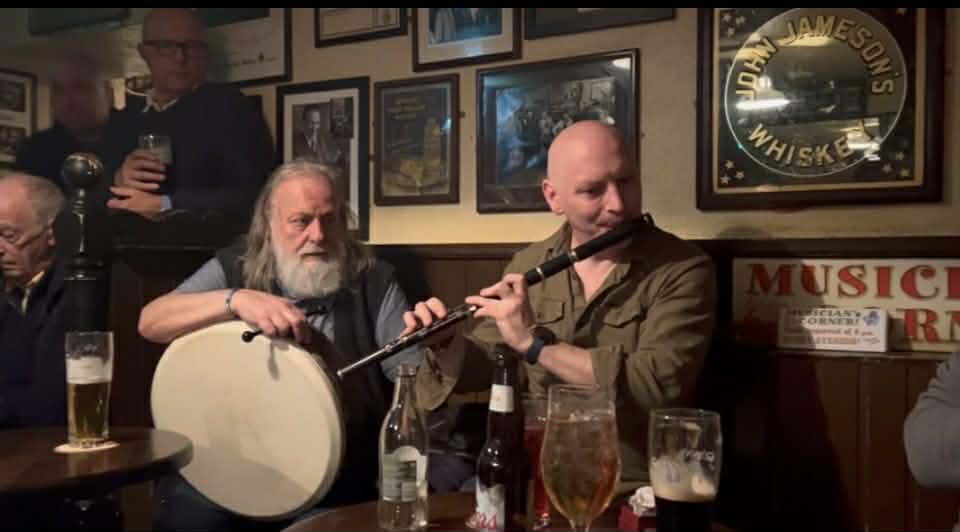
Finally, though, Killarney. Seven nights a week, there’s a mighty session of some sort—they vary – in Paddy Sheehan’s (known locally as the “Killarney Grand”), as well as a live rock band later on. Sessions are somewhat earlier in the Grand—they’re usually on the go by 8 p.m. On some nights, Reidy’s Bar has trad music, too.
While I made the distinction between “sessions” and made-for-tourist shows, Celtic Steps is a must when in Killarney. It usually starts early April and goes on until maybe the second weekend in October. It’s on six nights a week (not Saturdays).
If you are in a rural place, there may not be taxis. Make sure you’re either in walking distance from your place of bed later on (yes, it’s perfectly safe) —or, you’ve a lift arranged or taxi ordered from earlier. Just be careful if it’s after dark and your walk is on a narrow country road. Bring a torch to see the verge you’d need to step well onto—you’ll see and hear a car coming, but he mightn’t see you.
If you have a hire car, please, please (another!) do NOT drink and drive. Stick to the zero-alcohol Guinness or orange juice. Drunk driving is somewhat tolerated in many countries, but we are not one of them. If you’re caught, they are extremely strict and won’t even think of letting you off. Not a good holiday experience!
A final point to make—traditional musicians tend to favour traditional pubs. Not modern huge ones. Sitting round a table, not on a stage. Not in a room or hall that doubles as a nightclub after midnight. That is not the intimate setting of the session. Remember where it all started? At the HEARTH, where you sat in the flickering candlelight, listening to that tune your great uncle used to play on his old fiddle, while your big sister danced a few steps. Now, what that means, is that all too often the places you’re in are small, cramped, with low ceilings and no artificial ventilation; it’ll be roasting in there, even on a night as cold as it is here right now as I’m writing this.
You like your “personal space?”
Ah.
The concept simply does not exist in such a place. Not at all. Some are OK that way, many others are not so much. You might be (very) up close and personal. Wedged solid amidst humanity! But ye know what? It’s Ireland. ’Tis what we do. Forewarned is forearmed. Travel broadens the mind!
Best way is to get there early, as I said.
Now you’re installed, Chat to those around you, get a pint in your hand, and sit back in your corner. Ask the musicians to play Drowsy Maggie or Cooley’s Reel…..You’ve managed a mad oul sesh. Congratulations, and enjoy!
(* as in “What is your news today?”)
Jonathan Beaumont is Irish by Ancestry’s destination expert, historian, and tour guide. He has published seven books on Irish social and economic history, and transport history, with three more in preparation. In the tourism industry, he has been leading tours for some twenty years. He collaborates with television producers where historical context is needed in preparation for TV programmes, and is heavily involved in several groups that assist tourists coming to Ireland, in particular those tracing their Irish roots. Naturally, he still finds time for the occasional pint of Guinness, and playtime with his grandson.
 RELATED ☘️