By SHELAGH BRALEY STARR
RELATED ☘️ Staff
On Easter Monday 1916, as most of Dublin observed a public holiday, a few hundred Irish Volunteers, Citizen Army members, and Cumann na mBan activists stepped out of the ordinary and into history. Just more than a week later, much of the city center lay in ruins, nearly 500 people were dead (more than half of them civilians), and the leaders of the rebellion had been executed. The Easter Rising, a military failure by any conventional measure, had become the spark that transformed Irish politics and ultimately reshaped the map of this island.
Marking its anniversary means looking beyond myth and counter‑myth, and understanding the Rising as both a dramatic insurrection and a profoundly human, often ambiguous, event.
The background is crucial. Ireland in 1916 was still part of the United Kingdom, but the question of self‑government had dominated politics for decades. A Home Rule bill, promising limited autonomy within the empire, had passed Westminster in 1914 but was suspended with the outbreak of World War I. Unionist opposition in Ulster, armed militias on both sides, and the mass enlistment of Irishmen in the British Army created a tense, militarized atmosphere.
Within this landscape, a smaller revolutionary minority concluded that only armed rebellion could secure full independence. The Irish Republican Brotherhood (IRB) worked in secret, infiltrating the more open Irish Volunteers. James Connolly’s socialist Irish Citizen Army, originally formed to protect workers during the 1913 Lockout, brought a class‑conscious edge to the conspiracy. When World War I began, the conspirators saw Britain’s distraction as their opportunity.
The Rising itself was far from a flawlessly executed nationalist epic. It was marked by confusion, poor communication and last‑minute cancellations. Eoin MacNeill, the nominal head of the Volunteers, tried to call off what he saw as a disastrous plan. As a result, fewer men and women turned out than expected. The hoped‑for nationwide rising never materialized; outside Dublin, only sporadic actions took place.
Yet in Dublin’s city center, the rebels moved decisively. They seized key buildings: the General Post Office (GPO) on Sackville Street (now O’Connell Street), the Four Courts, the South Dublin Union, Boland’s Mill, the Royal College of Surgeons, and others. From the steps of the GPO, Patrick Pearse read the Proclamation of the Irish Republic, declaring the right of the Irish people to the ownership of Ireland and pledging equality for all citizens, men and women. It was a radical text for its time and remains one of the most quoted documents in modern Irish history.
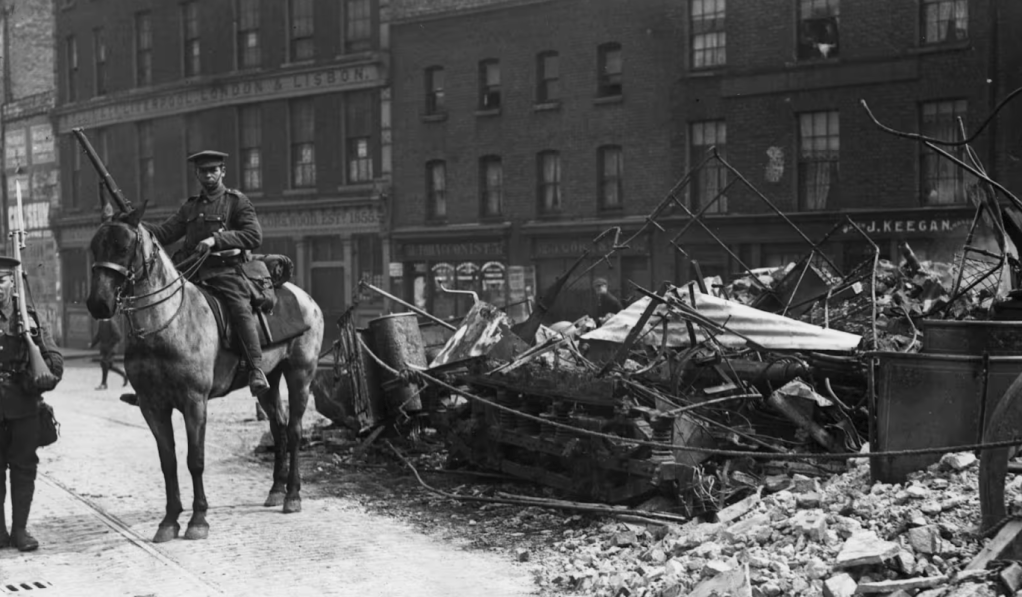
The British response was initially hesitant, then overwhelming. Once the scale of the rebellion became clear, troops, artillery and naval guns were deployed. Shells hammered the GPO and neighboring streets; machine‑gun and sniper fire turned central Dublin into a battlefield. Civilians found themselves trapped in the crossfire, with no safe passage in what had been their familiar, safe streets. The Rising was not just a clash between rebels and empire, it was a disaster for ordinary Dubliners.
By the weekend, the situation for the insurgents was untenable. Fires raged through the city center. With his headquarters collapsing around him, Pearse agreed to an unconditional surrender on April 29, hoping to prevent further civilian casualties. Rebellion had lasted six days.
In those first days after the Rising, public opinion in Dublin was largely hostile to the rebels. Many blamed them for the deaths, destruction, and economic hardship that followed. It is easy, in retrospect, to project admiration back onto 1916, but contemporary accounts record jeering crowds and deep resentment.
What transformed the Rising from an unpopular revolt into a cornerstone of Irish nationhood was not just what happened during Easter Week, but what followed in its grim aftermath. British authorities decided to make an example of the leaders. Between May 3 and May 12, 15 men—including Pearse, Connolly, and Thomas Clarke—were executed by firing squad in Kilmainham Gaol. Connolly, wounded and unable to stand, was tied to a chair before he was shot, an image that traveled far and shocked many.
These executions, along with mass arrests and internment of hundreds of others, changed the tone. Sympathy began to shift. What historian Thomas Bartlett and others have highlighted is how commemoration itself—especially at the 50th anniversary in 1966 and the centenary in 2016—has continually re‑framed the Rising. In 1966, a young Irish state presented it as a heroic founding moment, emphasizing sacrifice and unity. Television documentaries, pageants, and military parades helped cement a near‑sacred narrative.
Later generations have been more questioning. The centenary in 2016, as surveys of publications and state events show, placed greater emphasis on inclusivity and complexity, remembering not only the executed leaders, but also civilians, British soldiers, nurses, the Dublin Fire Brigade, and lesser‑known groups such as Cumann na mBan and St. John’s Ambulance. Articles such journals as History Ireland and special issues of military and cultural magazines have asked uncomfortable questions about violence, legitimacy, and memory.
Understanding the Easter Rising on its anniversary involves holding several truths together. It was a bold and, in strictly military terms, doomed attempt by a small minority to force a political transformation. It led directly and indirectly to the Irish War of Independence, partition, and the creation of the Irish Free State. It inspired anti‑Colonial movements elsewhere, who saw in Ireland a sign that the empire was not invincible. At the same time, it brought terrible suffering to a city that had little say in the timing or form of the revolt.
Commemoration adds a further layer. Anniversaries are not just about the past; they are mirrors held up to the present. How Ireland chooses to mark 1916, whom it includes in ceremonies, which stories it highlights or omits, reveals contemporary concerns about identity, plurality, and the legacies of violence. As scholars of memory note, each major anniversary has rewritten the Rising in the context of its own era.
A century on, the bullet scars on the GPO’s columns remain visible, but the meaning attached to them has evolved. To understand the Easter Rising today is to see beyond the simple binaries of glory and folly, and to recognize a complex event in which high ideals, strategic miscalculation, imperial power, and ordinary human vulnerability collided, leaving a legacy that Ireland is still, on each anniversary, negotiating and re‑imagining.

