By JONATHAN BEAUMONT
RELATED☘️ Staff
Many of our widespread diaspora—some with a treasured old photograph of a grandparent or great-grandparent standing outside a little cottage—have fond memories of a childhood visit to Ireland, as their great aunt or an elderly man who knew their family when he was young tells stories about the area to you, the visitor.
Will you have a cup of tea?
Of our 80 million worldwide diaspora, 43 percent are from America alone—some 35 million. In comparison, the island of Ireland today contains 7 million. That’s just a bit less than that of Massachusetts or Tennessee.
But there’s more: In 1841 the population of Ireland was something between 8 and 8.5 million. Then along came the “Great Hunger” or An Gorta Mór, as the famine was called. Over the next few decades, our population declined eventually by over 50 percent, with the lowest point being around 4 million.
The enormity of this cannot be understated. This is equivalent to 170 million Americans fleeing the USA in the next few decades. Nobody coming back, as there’s nothing to come back to.
Think of that. 170 million gone. No invasions. No tsunamis. No pandemics. No terrorists.
No food. None.
Of the 4 million who left, they went mostly to the USA, the UK, and Canada and Australia, though some went elsewhere, too.
Back to that little photo you had. Look at their faces. That picture was taken in 1832, though. That’s almost a century after the famine. The people in the photo are the lucky ones who were able to stay behind. And YOU—you’re the equally lucky descendant of John who went to Sydney, Alice and Mary who went to Chicago, William who went to Liverpool, or Michael Pat who ended up in Vancouver.
But you’ve saved to come back; now the red sunsets of the Dingle Peninsula in West Kerry are calling you, over the centuries, the Atlantic, and through the determined aeons of human endurance and endeavour. They are calling you through the spirits of your ancestors to come home! Come home! Sit awhile, have a drink, and tell us all the oul craicfrom Australia, from Toronto, from Wyoming or Manchester. Yeah, and you’ve a very different accent now. But sure, what of it.
Now, today, you can relax here, watch the sun rise as well as go down; it’s a new world today. We’ve looked at the area where your O’Sullivan uncles came from, your O’Shea great-grandfather, and the O’Donoghues and Healys who were related to your spouse.
Oh yes, those are Kerry names. Within your “Irishness by Ancestry,” do you recognise those names—or Sayers, O’Croghan, O’Connor, Moynihan, Gallivan or Spillane? Or a few McCarthys, Coopers or Cliffords?
If so, your ancestry could well be from hereabouts.
So, as the light fades, we’ll head up the road for a pint or two. In the morning, we’ll get up and have a fry, and then get going. I want to show you a few things. Eggs, bacon, and toast all right in the morning? Take your time. The tea will be on.
The morning dawns. There’s a mist outside, but the sun will burn it off. You can’t see the Reeks (mountains) across Dingle Bay, but it’ll be gone by lunchtime. That’s normal here.
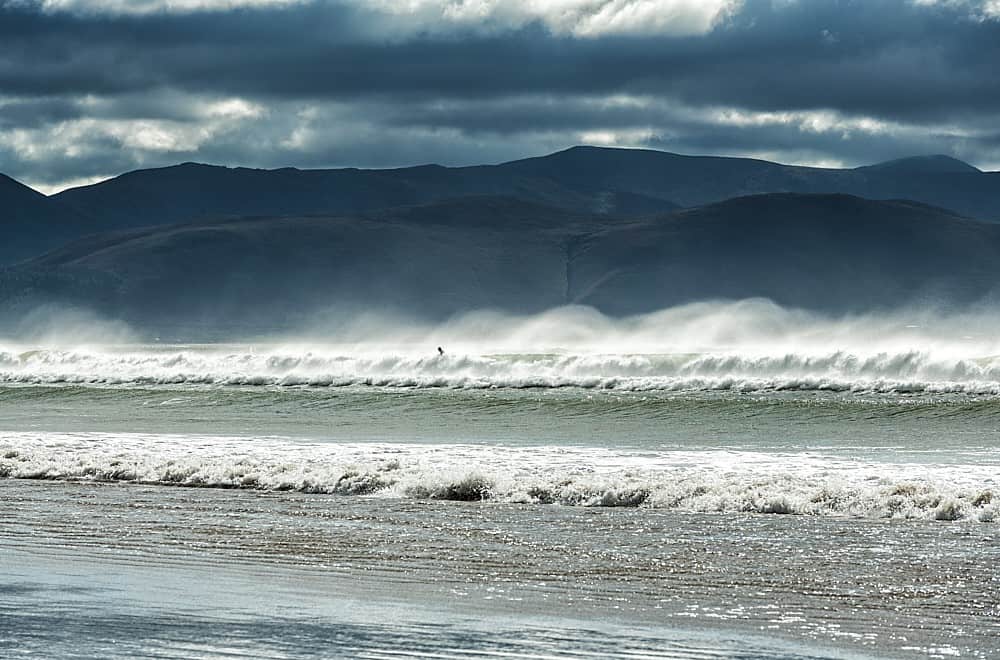
We set off for Dingle, but the sun is poking its way through the clouds. We’ll stop at Inch Beach first. Doesn’t sound like much—a beach an inch long, is it? No! It’s not. It’s INCH Beach—that is, a long sand spit. You see, to the Celts, an island was not just a lump of land surrounded by water. It could also be a lump of land surrounded by bog or swamps—makes sense when you think of it; or it could be an isthmus or peninsula. Inch Beach is a sand spit stretching way out into Dingle Bay.
Quite simply, “Inch” is an Anglicisation of the Irish word “Inis,” which means “Island.”
A huge beach here, ideal for clearing the lungs, or being taken for a run by your dog.
The Dingle Peninsula is where we are today. One of the most beautiful places on our island.
And it’s spring, it’s near Easter, and it’s lambing season. All around the place, especially in the west of Ireland and in mountainous areas (it’s both here), the new lambs sport and gambol about, snuggling under their mother when the rain starts. Springing up and down ancient paths, up and down rocks, which are only known and only subtly discernible to themselves, and maybe the odd fox—but we won’t go into that …
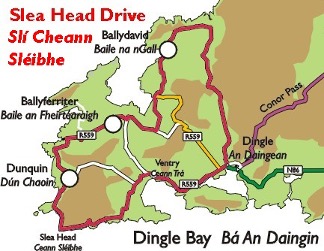
As we head away from Inch Beach, where there is also a nice coffee and souvenir shop, and toilets, we will head west along the road you can see on the map. Bottom right is Killorglin, where the annual “Puck Fair” takes place each August, presided over by “King Puck,” a wild Kerry mountain goat. Now head up to Milltown and Castlemaine (the home of the “Wild Colonial Boy” —google him!), and west past Fybagh townland to Inch. There you see the long beach. Now go west again on the map, and we come up to join the main (green) road near Annascaul. If you turn immediately left (west), you’re heading on out to Dingle. But turn right into the village. If it is after mid-day, in a minute you’ll see an old bar on the left just opening up. That’s the South Pole Inn.
Between 1901 and 1904, two Irishmen, Ernest Shackleton and Tom Crean, undertook probably the most challenging expedition of endurance that man has ever done. Crean was from Annascaul and opened this pub when he retired. He survived an incredible 492 days on Antarctica, more time than even Shackleton did, and trudged 800 miles across it in arctic storms. The pub still functions as such, but has fascinating displays devoted to Crean. This one’s a must.
But let’s keep going. Finish your Guinness—you’ll get a chance for more later!
West, we come to the main town on this peninsula, Dingle itself, or as shown on the map, Daingean Uí Chúis—in Irish. You’re now entering the West Kerry Gaeltacht, or Irish-speaking area.
Browse? Sure! Lots of places to browse. Hungry? Yes, many options. Wander about the town, having first parked near the harbour. There is a big car park there, but be aware that in summer the place gets packed, and parking isn’t always easy there. Spring should be fine, though.
As a base, there are many small hotels and bed and breakfasts in and around Dingle. But make sure you book well in advance. “Winging it” with accommodation in Ireland is never a good idea, and in busy places in season, impossible unless you want some place up laneways with zero public transport, zero taxis, and near nothing, or something very overpriced—or, perhaps, no options at all; keep driving. Look out for signs for the Beehive Huts on the right. This area is rich in ancient, pre-Celtic history, and many medieval settlements are to be seen, and open to the public. Walk into them (steep climb first) and contemplate the thoughts of Celtic priests meditating in there several thousand years ago.
Look west, Ceann Trá, or Ventry in English. We head out the road. Some of the sheep and lambs have coloured dye on them. Red and blue are common; amongst the tour guide fraternity, we tell English tourists that the red ones are the Labour supporters, and the blue the conservatives; we tell American tourists that the red ones vote GOP, and the blue ones are Democrats. We tell everyone else that the sheep are different colours so we can tell the Protestant ones from the Catholic!
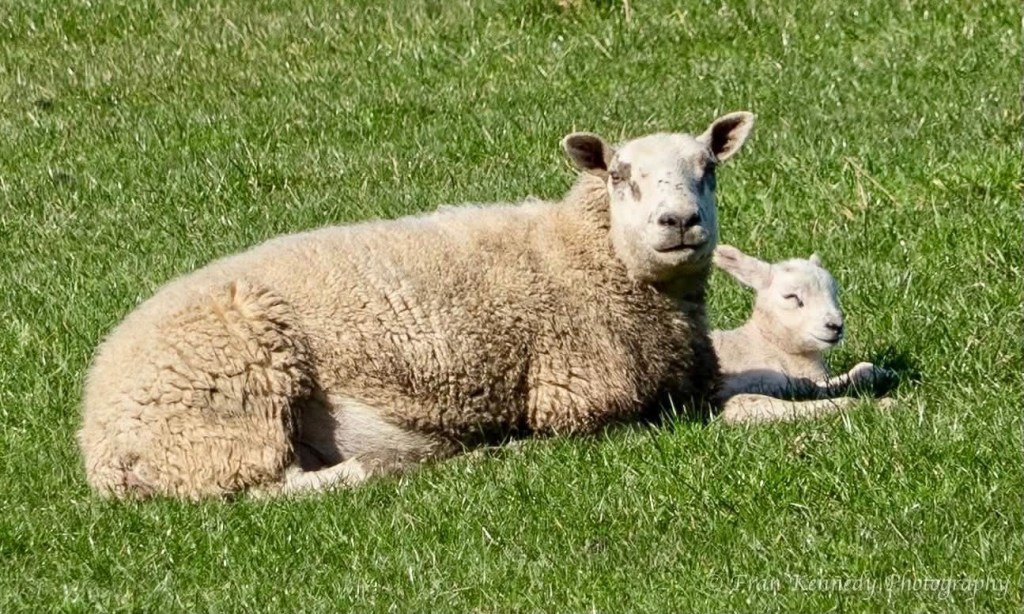
Of course, the alternative theory is that it is to denote different owners, as sheep mingle on common areas of marginal land and mountain sides … But sure, lookit; who am I, dear reader, to let truth get in the way of a good story?
Would you like to see some up close, or feed them with a bottle? Would you like to hold one, a newborn? (Bring baby wipes, because if they are newborn, you might end up with their trademark on your new white coat—yes, I’ve seen that happen!)
So, we’ll visit Aidan. For a nominal charge, he gives you free reign. Go up into his shed where the babies are, lift, hold, stroke and photograph them as much as you like. You’ll see his sign at the side of the road as you head along the road on the Slea Head Drive. There are actually several places along this stretch of road where you can meet and get up close with the little fur babies.
Kerry people have a great sense of humour. A sheep farmer I know down there used to do a sheepdog demo for coachloads of tourists I would bring to him. He knew that after we left, our next stop was the lunch stop. In his rich Kerry accent, he would exhort my tourists to “support the local industry, and have a GOOD KERRY LAMB DINNER.” Pause … “And, if any of ye are vegetarians, don’t worry. The sheep are vegetarians, too!”
And some of them did, and they weren’t disappointed … But I digress!
On this road, west of Dingle, you’ll get many spectacular views as you head round headlands. Bring a paper map. The wifi reception isn’t great here and there, and google maps and other map apps (mapaps?) become discombobulated, muddled and confused. There’s one mountain road that satnavs love to send you up, and I’m sure there are people up there still, driving about in circles since 1990.
Now, have a look at the western end of that map and you will see a long, razor-shaped island. This is the Great Blasket.
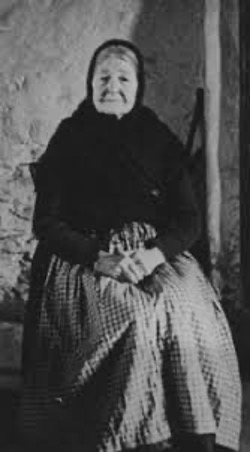
Much has been written about the Great Blasket and its people, most notably by islanders Peig Sayers, and Tomás Ó Criomhthainn (O’Crohan). Suffice to say that by the time the last people left the place in 1953, the island was the last place in Ireland to hang onto, and live by the rules of, our most ancient Gaelic societal ways. They all spoke Irish to the end, their unique dialect being (thankfully) extensively recorded.
If you never visit another visitor centre in your life, you absolutely MUST visit the Blasket Visitor Centre just beyond Ventry, looking out across at the island itself. For the intrepid, you can stay over there now, but there’s no electricity, running water, or sophisticated comfort. Not even a shop—you need to bring your own “stuff” and food. Check it out!
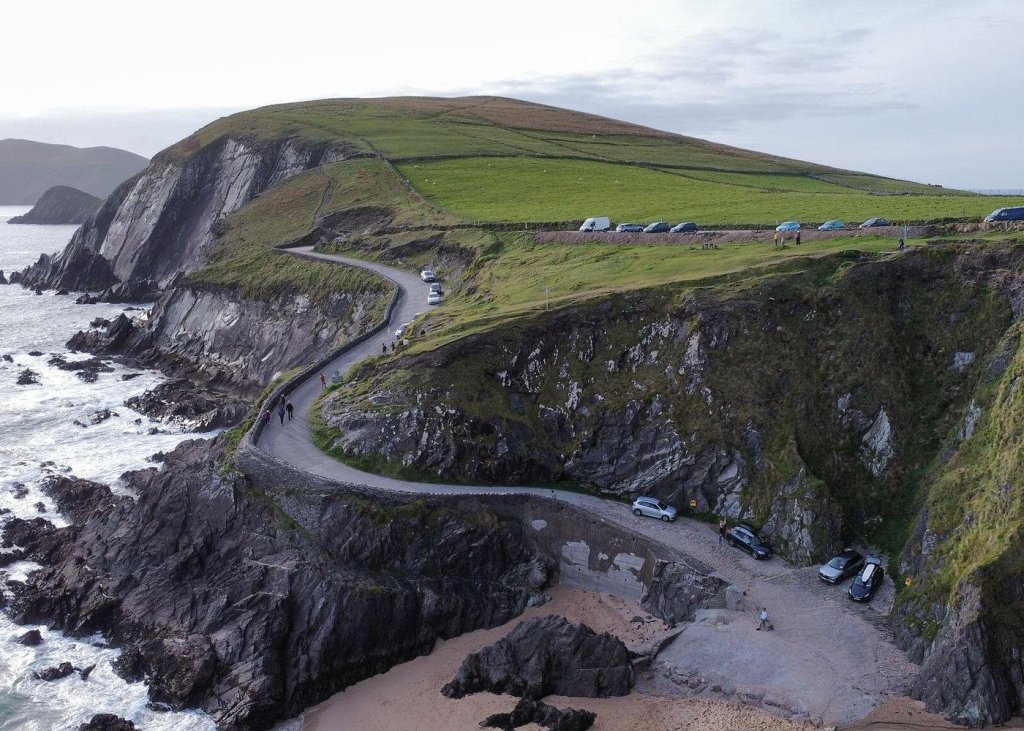
Now, right down to the end of the peninsula, you’ll arrive at one of the wildest series of scenic spots I’ve ever seen anywhere, let alone in Ireland. This map and picture give an idea.
Look at the stretch between Dunquin and Ballyferriter, and up to Ballydavid. You’ll see Clogher Head and Ceann Sibéal. Now, you are looking out to sea.
The Wild Atlantic. You can hear the waves and the persistent wind far below you. It’s peaceful. Vibrant. Exciting. Deep. Exhilarating and calming, together.
And the lambs crying for their mothers up the mountain.
And the distant, persistent voices of your ancestors, calling, calling you through the ages.
You’re home. At last, returned to the bosom of the western European island that your folks left.
Look at the horizon. How many generations of locals stared out there, wondering how their relatives were doing in Manhattan, Ontario, and Texas. They eagerly awaited the next letter with a few dollars in it.
In some cases, they never heard again from their people.
Pause awhile and contemplate.
Finally, we are off, back to Tralee, Killarney, or wherever we will spend the night. Look at the map; if you’re adventurous, and don’t mind a long, twisty mountain road, go back to Dingle and up the Conor Pass, to Castlegregory—a pleasant little town—or if not, go from Dingle along the green coloured road over the Glenagalt Pass towards Tralee. Just west of Castlegregory on the north side of the peninsula you can see a huge, curved bay. Another massive beach there is a great place to watch the sun go down if you’re staying locally. That’s Brandon Bay. Not far away – do you like fish? Go to Ashe’s Restaurant!
What I’ve described above is a full day tour. Don’t try to fit it into a few hours—that just won’t work.
It’s Easter. New buds have appeared; lambs play in the fields—and, didn’t you get to hold one today! And there’s an Easter egg in the car for everyone!
The summer awaits us.
And don’t forget that Kerry lamb dinner …
Jonathan Beaumont is Irish by Ancestry’s destination expert, historian, and director of tours. He has published seven books on Irish social and economic history, and transport history, with three more in preparation. In the tourism industry, he has been a guide for some 20 years. He assists tourists coming to Ireland, in particular those tracing their Irish roots. Naturally he still finds time for the occasional pint of Guinness, and playtime with his grandson.

