By KARLEE TWINER
RELATED ☘️ Staff
Before your Irish ancestors ever named a village, parish, or county, they belonged to something far older and more intimate: a townland. These small, often overlooked divisions of land are the bedrock of Ireland’s geography and identity, tiny places that carried enormous meaning, especially for those who left.
What Is a Townland?
A townland is the smallest traditional land division in Ireland, and its origins stretch back centuries—long before modern maps, postal systems, or standardized addresses. There are more than 60,000 townlands across the island, each with its own unique name, often derived from the Irish language and rooted in landscape, family names, or local history.
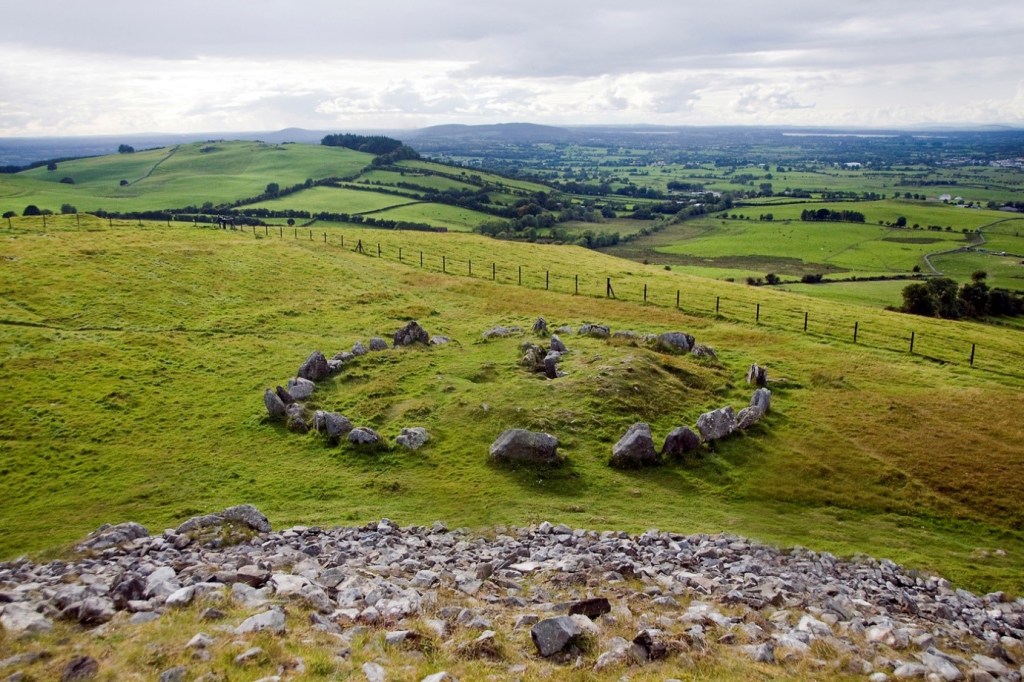
Despite the name, a townland isn’t necessarily a “town” as most are rural, though sometimes your ancestors’ townland will be within a town. Some are just a few acres; others span thousands. A single townland might include a handful of farms, a cluster of cottages, or even just open fields bordered by hedgerows and stone walls.
What defines a townland isn’t its size or population. These names have endured for generations, passed down through speech and memory long before they were ever written down.
Why Townlands Still Matter
Even today, townlands remain a fundamental part of Irish addresses, particularly in rural areas. While modern systems have introduced postcodes and street names, many people still identify their home first and foremost by townland.
For genealogists, this matters enormously. Irish surnames are often concentrated in specific areas, and many families shared the same names within a parish or county. Without a townland, distinguishing one Murphy or O’Connor from another can be nearly impossible.
When Irish men and women left their homeland, they didn’t always give their townland. Or, if they did, those recording the information went with the easier choice of just “Ireland.” This can make it hard to figure out which townland they are from.
Letters sent back to Ireland were addressed using townlands. No street numbers. No ZIP codes. Just a name, a townland, a county, and somehow, they found their way home.
This is because townlands weren’t just geographic units. They were places people lived for generations. They held families, neighbors, stories, and identities. To name your townland was to locate yourself in a web of relationships and memory.
The Challenge for Modern Researchers
For anyone tracing Irish ancestry, the townland can be both a key and a puzzle.
If you know your ancestor’s townland, you have a powerful starting point. Irish records, including land valuations and parish registers, are often organized geographically. With a townland, you can narrow your search to a specific patch of land and the families who lived there.
But if you don’t know it, research becomes far more difficult.
Many historical records created outside Ireland list only a county, or worse, just “Ireland.” Even when a place-name is recorded, spelling variations can obscure the original townland beyond recognition.
That’s why learning how to identify and confirm a townland is one of the most valuable skills in Irish genealogy.
Research Tips: Finding Your Family’s Townland
So how do you go from a vague reference to a precise location on the map?
Here are three essential steps to guide your search.
1. Use Griffith’s Valuation
Conducted between 1847 and 1864, Griffith’s Valuation is one of the most important resources for mid-19th-century Ireland. It lists occupiers of land and property, along with the townlands where they lived. This includes renters and not just land owners.
By searching for your ancestor’s name in this record, you can often identify a specific townland associated with the family. Even if your ancestor emigrated before or after the valuation, relatives may still appear there, providing a crucial clue.
Pay attention to neighboring names as well. Families often lived close to extended kin, and clusters of familiar surnames can help confirm you’re in the right place. Sometimes the people around them in the place they ended up emigrating to can be the ones who actually get you back to your ancestor in Ireland, especially if you are dealing with a common name.
You can also use John Grenham’s very helpful Surname Search to see where your surname occurred across Ireland in Griffith’s Valuation. That can be accessed here: johngrenham.com
2. Overlay Historic Maps
Once you have a townland, the next step is to visualize it.
Historic maps allow you to see the exact layout of the land including fields, lanes, rivers, and buildings. By overlaying these maps with modern ones, you can pinpoint where your ancestor lived with surprising accuracy. Ask Ireland has a wonderful feature that overlays Griffith’s Valuation maps with modern maps. You can find that here: https://www.askaboutireland.ie/griffith-valuation/index.xml
You may even be able to identify the specific plot of land they occupied, especially if you cross-reference map numbers from Griffith’s Valuation.
This step transforms research from abstract to tangible. You’re no longer just reading names. You’re seeing the landscape your family knew.
3. Check Parish Registers
Townlands are closely tied to parishes, and parish registers, which include records of baptisms, marriages, and burials, are essential for confirming family connections.
Once you’ve identified a likely townland, search the corresponding parish records for your ancestor’s name. Look for patterns: recurring family names, consistent townland references, and relationships between individuals.
This helps ensure you’ve found the right family, not just someone with the same name in a nearby area, which is a common pitfall in Irish research.
Finding Your Way Back
It’s easy to overlook townlands when you first begin exploring Irish history. They don’t appear prominently on modern maps, and their names can be unfamiliar or difficult to pronounce.
But for generations of Irish people, these small places defined identity in a way that larger divisions never could.
For emigrants, that sense of belonging traveled with them across oceans. Even as they built new lives in distant countries, the name of a townland remained a fixed point.
If you’re searching for your Irish roots, think small.
Don’t start with the whole country, or even a county. Start with the possibility that your ancestor’s idea of “home” was a place so small, it might not appear on a modern road atlas.
Find that name, and you don’t just find a location. You find home.
Look for Karlee’s posts every Genealogy Wednesday on Irish by Ancestry, when she posts tips and tricks for finding those elusive relatives in records. She also takes questions for her biweekly FB Live sessions, Wednesdays at 5pm EST, so get them in early. Take advantage of the great benefit of a resident genealogist, a trusted resource: You have someone knowledgeable and available to make your searches easier. Ask her!
You can also take her classes. This month’s offerings— Your Irish DNA (today-Weds, April 1, 6 pm EST); The 1901 and 1911 Censuses (April 15, 5 pm EST); and the Long-Awaited 1926 Census Party (April 19, noon EST). All classes are on Zoom. You can sign up HERE.
 RELATED ☘️