Guides, Restoration Teams Preserve Precious Clues to Ireland’s Past
By SHELAGH BRALEY STARR
RELATED☘️ Staff
The path to family history runs where you were too afraid to go as a kid—right through the graveyard. The discovery of inscriptions, burial patterns, and cemetery records can supplement your genealogy research with rich detail.
In Ireland, where civil records may be late and parish registers patchy, cemeteries can summon the welcome spirits of dates, relationships, and stories that simply don’t exist anywhere else.
Seamus Breslin, volunteer with Friends at Derry City Cemetery, has been running tours for 14 years. Derry City Cemetery opened in 1853, just after the An Gorta Mór (the Great Hunger), when the local church graveyards did not meet the requirements to stem such rampant diseases as cholera and typhus. By planning new cemeteries a safe distance from the city, the people felt more protected from what they called “miasmic vapours.”
So Derry City Cemetery sits upon a hillside, where from the highest point, it yields panoramas of the River Foyle, and counties Derry, Donegal, and Tyrone.
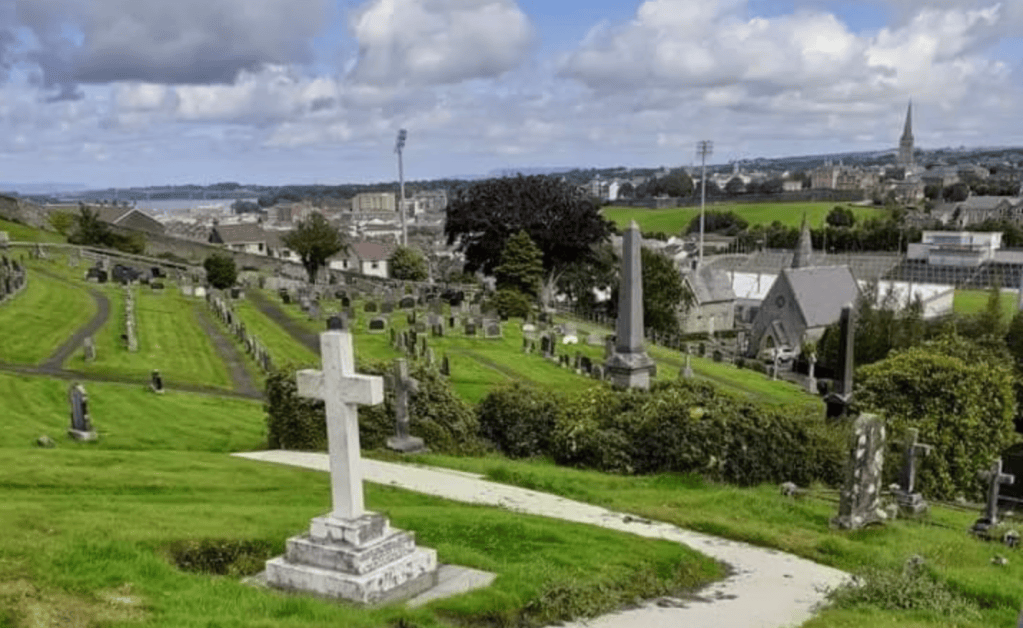
“Many, many visitors say this should be prime real estate, it has such beautiful views,” Breslin said in an interview. Buried at Derry City are activists, artists, and celebrities, whose graves draw historical lines through the Troubles up to modern times.
Breslin imbues Irish history into every tour. “It’s like going to the museum and the gym at the same time, at the top of the hill,” he said with a chuckle. “And it’s rarely not raining.” But the visitors don’t mind, who, “about fifty-fifty, are coming for their ancestors.”
And often, Breslin said, someone knows their kin. “A recent visitor from New Jersey found her second cousins.” She had sent Breslin a picture of her grandmother who emigrated from Derry City, with two sisters left behind. “She had a picture of the Campbell grave, for who was left here,” Breslin said, finding her family after she’d tried all the conventional means. He knew where the grave sat—which is no small effort, considering 88,000 stones line the green hills and valleys of Derry City Cemetery.
“It’s at least as big as five or six American football fields,” Breslin said of the cemetery that serves the whole city. It might be daunting for some, but Breslin points to the organization of the plots as the first line of help. “For starters, it is separated into Catholic and Protestant sections, and if (genealogy visitors) have some timeline, it’s usually either the Victorian or Edwardian (era),” Breslin said.
One of the most attended events in the religious year is the Blessing of the Graves in June, and he noted that very few graves are left untended. “People here are very good at looking after the graves, and their ancestors.”
“We find out who looks after them, and once you find who tends the grave, you find the family. It’s so simple, it’s so direct. Especially the Catholic side,” Breslin said. “If they mention a surname, we can almost direct them toward it right away.”
Breslin and his fellow volunteers are careful with their preservation efforts, with family consent. “We actually consult experts on anything that I want to know about restoring and preserving graves,” he said. “Some are absolutely works of art, with jewels, and Celtic crosses, carved by master craftspersons. At the same time,” he cautioned, “you don’t want the cemetery looking like a doctor’s surgery, you want a balance.”
Breslin recommends visitors seeking relatives’ graves bring as much previous research as possible. “We are here to help you. If we can’t help you, we know who can. I have never failed guests not showing them headstones with their surnames on them,” Breslin said. “Thinking, ‘This could be my great great-grandfather’s brother,’ you get that feel-good feeling.”
While Breslin tours guests around in Derry, author, folklorist, and college lecturer Shane Lehane guides students as they record gravestone details in St. Joseph’s Cemetery in Ballyphehane, Co. Cork. Lehane is course director of cultural and heritage studies at Cork College FET, where teams work in the public cemetery affectionately known as “the Botanic.”
As Lehane explained it, Father Theobald Mathew, a well-known friar, saw people dying from cholera in the late 1820s, and there was nowhere to bury them. As a solution, he bought 5.5 acres of the Cork Botanic Gardens on Tory Top Road.
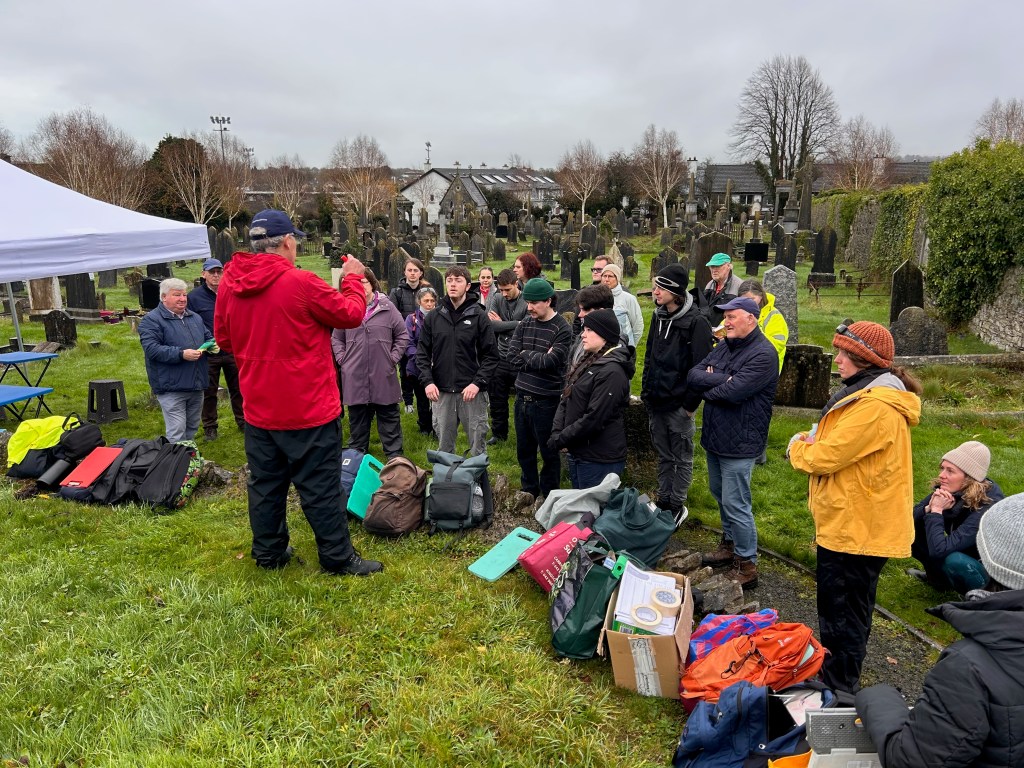
“He never told them what he was going to use it for,” Lehane said, “a burial place for all, because up till now, you had to have permission from the Protestant bishop to bury your dead.”
Now Lehane and his students traverse the cemetery where original botanic garden wall ruins still stand. Working with archaeologist John Tierney of the Historic Graves Project and Cork City archaeologist Ciara Brett, Lehane’s students have photographed, transcribed, and researched hundreds of grave memorials, many of which are at risk of being lost to weather, vegetation, and time. With assistance from Ella Motherway and Geospatial Technology students, their findings are being compiled into a significant online database.
“We’ve been saving gravestones, teaching students how to record diligently what stone is there, what the inscription might be, using high luminosity to read the stones,” Lehane said. “We have all different techniques.”
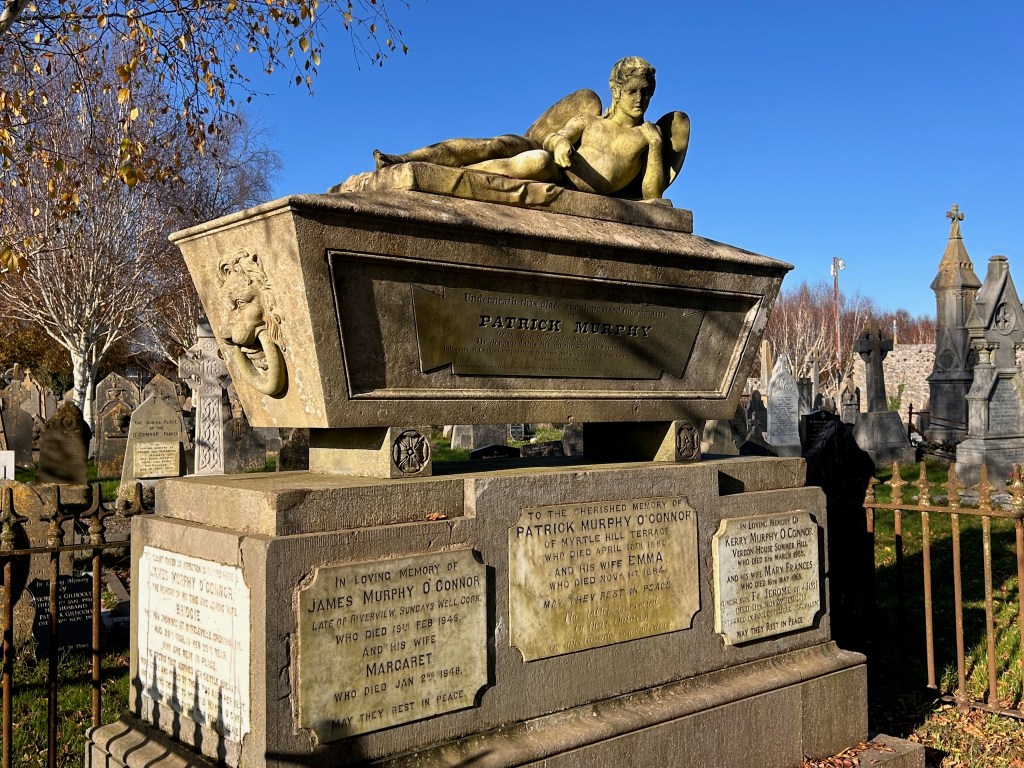
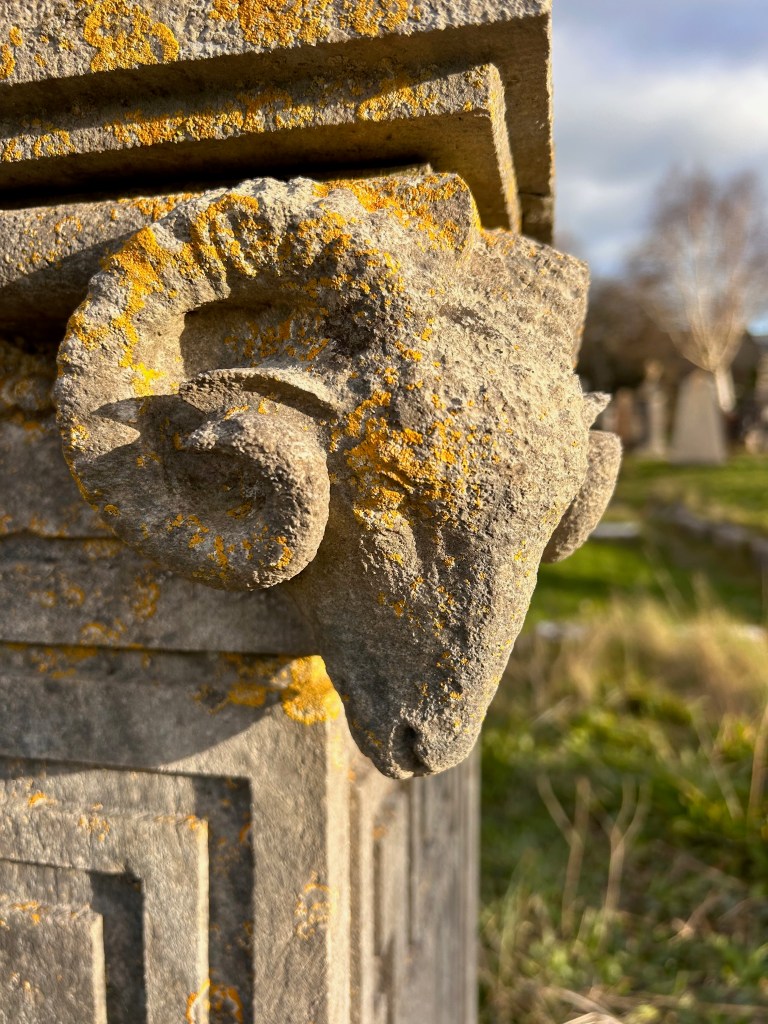
Preservation initiatives like Lehane’s aim to make genealogy searches more accessible. Graves, though available for anyone to visit, sometimes hold the most challenging, uncollected information depending on the age and condition of the stones. Graves might be unknown to kin, and without visitors, sites go dark with disrepair. This is where restoration and mapping become crucial, not only for genealogy purposes, but for deeper historical understanding.
“We are interested historically, when it comes to things like periods when people died, like in a pandemic,” Lehane said. In searching through the collected cemetery data, “(We can say) show us in the cemetery, 1824-1830, or show me all the McCarthys or Murphys. We can begin to see ages as well, we can do deep analysis.”
Lehane’s classes look for more than who is buried, they extrapolate data from the stones that expresses the artistry and socio-political movements of the time.
“We do a lot of work on the iconography, such as the use of the Irish language,” Lehane said. “You can see when they started using typefaces, let’s say, symbols that will show someone’s cultural identity. For example, very strongly from the 1880s onward, we start seeing the Celtic crosses and the use of the Irish language. English was the language of record, so therefore, when they began to challenge the orthodoxy, we are seeing that in an archaeological manifestation.”
The changing trends of the time are obvious among the stones, Lehane pointed out. “We see interesting symbols, obelisk collections and cherubs, grand gothic monuments, showing the Classical world.
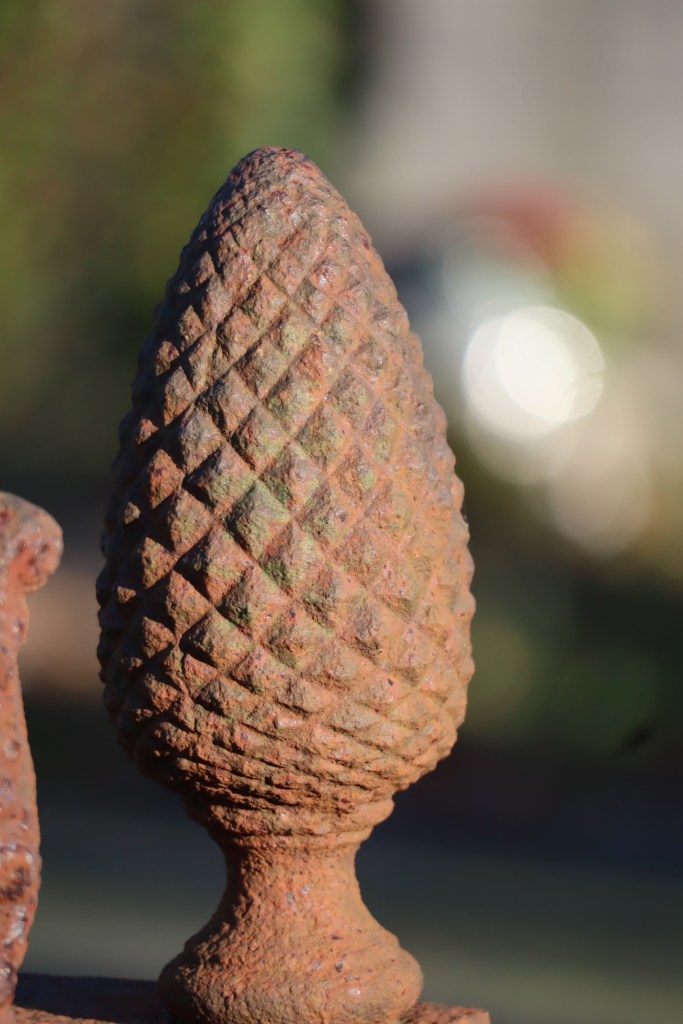
“One really good example was with the Industrial Revolution,” Lehane said. “Around that period, there was very much a move toward using iron as a memorial as opposed to stone. The early examples of that were cast iron, where people’s names were represented in this new way.” But this form of memorializing didn’t last, he said, only from 1820 to maybe 1900.
“There it’s a snapshot of how people were thinking. It’s almost like, ‘what new way can we express ourselves?’ and this was an example in the past.”

