NOVEMBER BOOK REVIEW for Brigid’s Library Book Club, the book club exclusively for Irish by Ancestry members and friends
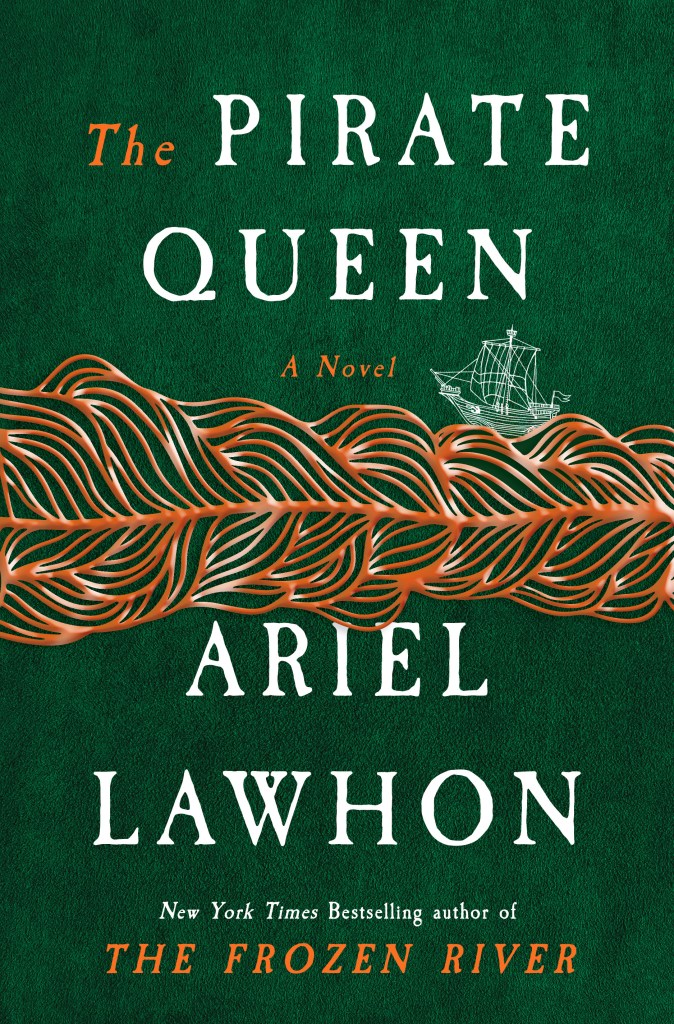
THE PIRATE QUEEN, by Ariel Lawhon, Doubleday, September 2026
BY SHELAGH BRALEY STARR
RELATED ☘️ Staff
To write about Gráinne O’Malley is to take on a historical figure and confront a legend. Known as Ireland’s “Pirate Queen,” O’Malley has survived in popular imagination as a larger-than-life rebel, a ruler, and a maritime outlaw. In THE PIRATE, the new bestseller Ariel Lawhon launched in September, the novelist takes on the challenge of pulling that legend back toward the human being inside it.
When Lawhon appeared at Portsmouth Music Hall, she seemed fully equal to the task — polished, funny, and composed in a cream skirt, black shirt and black boots. Onstage, she described O’Malley with both admiration and precision: “Brash, rebellious, proud, clever.” That combination, Lawhon suggested, is what makes her irresistible. She is an emblem of female defiance whose life still feels unruly, difficult, and alive. Many can relate.
Lawhon has made a career of writing women whose stories have been obscured or misread, and she said she is especially drawn to “subversive women.” O’Malley may be one of the most formidable she has tackled. “Queen Elizabeth considered her a great nemesis, she called Grace the nurse of all rebellions,” Lawhon said. But the real challenge in writing her lay in navigating the fragments of often hostile records left behind.
“The only record of Gráinne was written by her enemies,” Lawhon said, referring to the English documents that track O’Malley through the lens of the empire, full of conflict and suspicion. In the Annals of the Four Masters, the major chronicle of Irish history through the early 17th century, O’Malley herself barely appears. Her father, sons, and both husbands are named, but she remains largely absent. To build the novel, Lawhon relied on decades of English letters about her, as well as the 18 questions Queen Elizabeth sent to her in 1593. Those materials, shaped by perspective of the questioner as well as prejudice, offered some evidence. The work of the novelist then became restoration.
Lawhon said she is less interested in “historical fiction” as a genre label than in what history can offer a story. “I think there’s no such thing as historical fiction,” she said. “It’s not a genre like others, it’s just setting.” What matters to her is character, and O’Malley, even through the distortions of the archive, emerges as politically shrewd, emotionally complex, and impossible to contain within the simple outline of myth.
Part of Lawhon’s solution was structural. In researching Celtic symbols, she encountered the triquetra, a three-cornered knot associated with interconnection. One of its meanings, she said, can represent the lifespan of a woman. That idea became a way into O’Malley’s life. Drawing on but revising the phrase “mother, maiden, crone,” Lawhon explained, “I’ve always hated that term, crone. And I love alliteration, so I changed it to matriarch.” The structure, she said, “lets readers feel they have experienced her entire life without it feeling episodic.”
Lawhon reflected on being in her own “mother era” for nearly 24 years and now having only one child left at home. “My matriarch era,” she said, saying that O’Malley continues to exert such power as a character, because she offers not only adventure, but a way of thinking about womanhood across time.
O’Malley’s public story contains all the expected elements of ships, raids, politics, and rebellion, but Lawhon emphasized that her private life mattered just as much. She noted that O’Malley had two marriages, “one where she was married for politics and one where she actually got to experience love and have a love story.” That distinction led to a broader observation about fiction itself. “In romance, the characters have to drive to a happy ending,” Lawhon said. “But in a love story, that’s not necessarily the case. The characters can find love and something else can still happen to them.” For a woman like O’Malley, whose life unfolded amid violence and instability, that distinction allows for feeling without fantasy.
The research behind the novel appears to have supplied Lawhon with both intellectual rigor and comic material. She traveled to Ireland and recounted the trip with dry amusement. “My job is so hard,” she said. “I had the time of my life.” Everyone told her she had to go to Galway; eventually the repetition itself became memorable enough to migrate into the novel through a character’s insistence. “Well, Galway must be great if you’re in your 20s on a girls’ trip, but less so in your 40s,” she joked.
Then there were the boats. Or, more accurately, the challenge of learning enough about them to write convincingly about a woman whose life was inseparable from the sea. “I hate being a pirate,” Lawhon said. “I hate boats. It’s full of nerds — in particular boat nerds.” One enthusiast helped her by creating a model of Grace’s galley ship that could hold 300 men and posting each step online. Without that kind of obsessive detail, Lawhon said, the reality of O’Malley’s world would’ve been impossible to re-create. “Other than that, the boats of the time I found in pictures were canoes. That’s not moving 300 men, I thought.”
The novel, set on Ireland’s western coast in the 16th century during English incursions, also draws on the region’s natural beauty, O’Malley’s seaborne education under her father, and even hints that she has “the sight,” though with limited effect. Lawhon mentioned, too, material she regretted cutting: historical notes from English documents that cast O’Malley as a “mistress and leader of all rebellions.” Such lines reveal the fear she inspired, but they also show how thoroughly powerful women are translated into menace by the records that survive them.
That, ultimately, is the challenge of taking on an Irish legend. In Portsmouth, Lawhon seemed keenly aware of that burden and energized by it. Her O’Malley is formidable and worthy of her legend, but readers will see that she is more, as a strategist, mother, lover, leader, adversary, and survivor. In THE PIRATE QUEEN, Lawhon attempts exactly that, taking one of Ireland’s most enduring female icons and returning her to life.

If this book interested you, and you’re craving more thoughtful conversation about books, consider yourself invited to Brigid’s Library Book Club.
We are a warm, welcoming global group of readers who dive deeper into what we read, share honest reactions, and participate in relaxed conversations with each other and the Irish-focused authors who share their talents with us.
Whether you are a voracious reader or just getting back into books, you’ll find a friendly space to connect, reflect, and discover your next great Irish read. Pour a cuppa and join the conversation at Brigid’s Library.
Our November book club pick is THE YEAR OF THE CHILD by Niall Williams. We always meet on Zoom the last Tuesday of the month, Nov. 24 at 6 p.m. EST.
Join the group through the website to receive our monthly notes on books and events to discuss them, then share your thoughts, reviews, and recommendations on our Facebook group. Your new favorite cozy corner of the Irish literary world is waiting. See you there!
Shelagh Braley Starr is head librarian at Brigid’s Library, admin of Irish by Ancestry, and editor of RELATED☘️ magazine. A journalist with special interest in Irish history and literature, she has written her first novel, based on the Irish myth of Cú Chuláinn’s wife, Emer. You can reach her at shelagh@byancestry.com

