BY SHELAGH BRALEY STARR
RELATED ☘️ Staff
For artist Shauna “Anseo” Blanchfield, murals are not just a way of transforming walls. They are a way of transforming how people see themselves.
“My work has been focused on myths and legends, and I’ve only just figured out why,” she said in a recent interview. “I’m really interested in people and small stories. What I’ve been doing is framing people as monumental characters but telling small stories about them.”
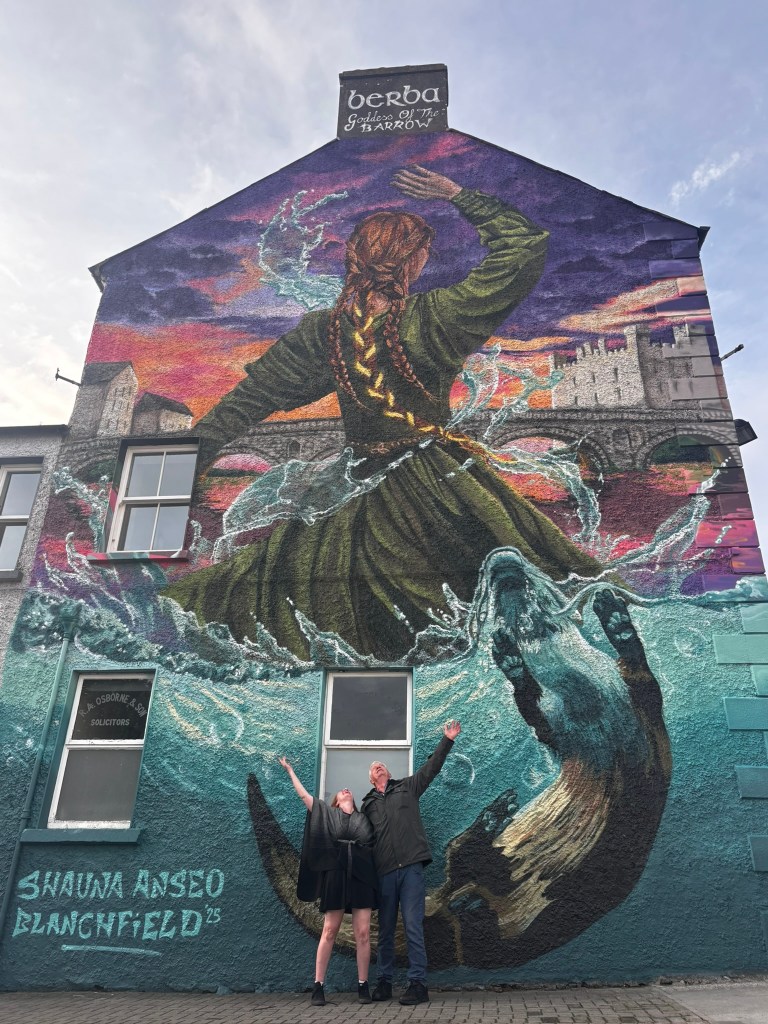
That instinct rises from the heart of her mural in Athy, Co. Kildare, a colorful, striking work centered on Berba, the goddess of the River Barrow. It brought new life to Emily Square, not far from where her father grew up.
“It was really special because my dad helped me paint it,” Blanchfield said. One of 16 in his family of Blanchfields, “It’s his hometown. (Visitors to the mural site would ask) ‘Whose kid are you,’ then they tell you a story about your family before you. So, in a way, I was collecting stories of my family.”
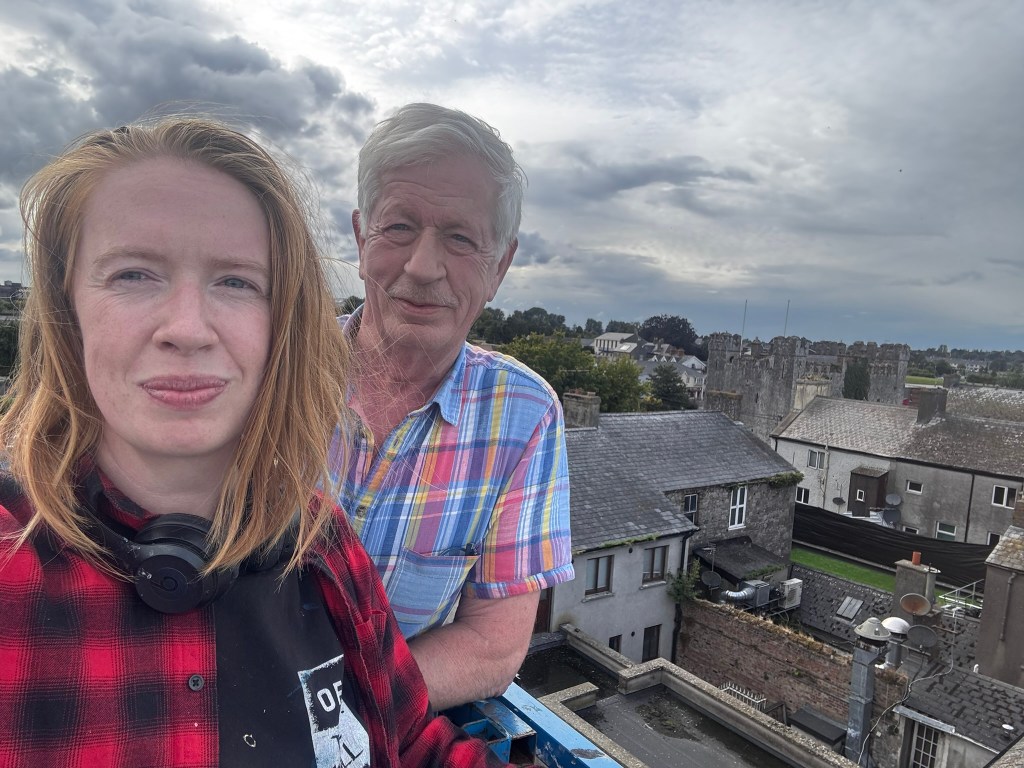
During the project, her father assisted with what he could, keeping up conversation. “We used to go up above the rooftops to see the sunset,” Blanchfield said. “He’d come and collect me, and we’d go up (on the lift). He used to work on the Portobello Towers in Dublin, so he’s always telling the stories of the heights.”
Shauna said her mother did not share his enthusiasm. “And my husband won’t visit me, he says, ‘I know you’re at height, but I don’t want to see it,’ ” she said with a laugh.
She recounted the big celebration, with music and speeches for the opening, thrilled with the response from the community. “They loved it,” she said. “There’s a lot of murals in the town, but I think this one, they weren’t expecting. It was really special.”
“The day that the mural opened, we changed our flights so we could be there. It’s a small town. People kept walking up to (my father), shaking his hand, ‘You raised your young wan, and she painted for the town.’ It was heartbreakingly sweet,” she said. “Oftentimes, you don’t get to hear what the local people say, but because they knew dad, I got to eavesdrop on the people who would necessarily have told me how much they like it.”
The mural draws on mythology, but Blanchfield is quick to point out that myth, for her, is not an escape from ordinary life. It is a lens through which ordinary life can be re-seen.
She uses light as a visual device, but also as a metaphor. “By shining a light, you elevate the experience and the person,” she said. “Light can change how you see something.” Her murals frequently hold a dramatic contrast between darkness and illumination, shadow and flare. “Not everything is technicolor. There is always the glow of something special.” In the Barrow mural, Berba is the lit figure, the flashpoint around which the whole composition turns.
Originally from Co. Laois, “right bang in the center of Ireland, where nothing ever happens,” she joked. Blanchfield is now based in London, after eight years in Dublin and a move that initially had little to do with muralism. She had worked in museums and galleries, including the Tate and the Royal Observatory, and during the Covid period relocated to New Cross, where she was beginning her own arts project. By chance, the London School of Muralism was operating on her street.
She had been interested in murals but suddenly found herself with the time and proximity. Like many beginners, she started by learning to spray-paint. “I hated it,” she said bluntly. “I was bad at it,” though her instructors did not agree. “They said, you’re not as bad as you think, you should look into it.” That difficult beginning opened a new path. She also became involved with WOM Collective, an all-female London-based arts collective. She had planned a practical route to painting for a living.
The plan changed, she said, when she discovered murals were more compelling.
“With murals, you paint big, and that releases you in a way, the bigger the better. All the artwork is done before the painting starts, so you already know people will like it.” Unlike studio work, where uncertainty can shape the process, a mural commission begins with conversations with the locals.
“They have asked for this artwork,” she said. “You interact with the public all the time.”
Although she has a strong visual style, Blanchfield resists imposing it on every site. “I’m not the one who lives with it,” she said. Instead, she works to distill the identity of a place into something cohesive and resonant. “The job as an artist is to distill it into one vision.”
That approach shaped the Barrow mural in Athy. The town was in a moment of regeneration, with its square being redeveloped and the Shackleton Museum reopening. The brief asked for something connected to the River Barrow. Blanchfield’s cousin, artist Emily Rainsford, had already completed a smaller mural nearby and had gathered research on local mythology. Together, they pitched a work centered on Berba, one of the river goddesses associated with the Barrow.
The mural shows a moment of transformation from the myth, three goddesses swimming in the river as otters before revealing themselves in divine form. In the mural, Berba emerges in a twisting motion, turning toward the town as she changes. On one side sits the castle, the older vision of the town; as Berba transforms, so too does modern Athy. The myth, she said, becomes a way of narrating civic renewal.
“You need to tell them a story they don’t know that is rooted in the place,” she said.
As an Irish muralist, she is also conscious of working within a particular tradition. Ireland, and especially Northern Ireland, has a long and politically charged history of mural-making. For generations, murals were socially and sectarian charged, and that legacy still shapes public attitudes and regulations around the art form of muralism. While Blanchfield does not describe her own work as political, she said she understands that Irish mural culture carries an awareness of public space that differs from purely aesthetic street-art traditions.
She points to key public artworks around the marriage equality and abortion referendums, including Joe Caslin’s the Claddagh Embrace and Maser’s Repeal mural, as moments when Irish muralism helped visualize a changing national consciousness.
Blanchfield’s own artistic contributions tower over streets and squares, testament to her idea that ordinary people are not secondary characters in a place like Athy. The idea is embedded even in the name she works under. “Anseo” means “here” in Irish, and while it began partly as a cool artist name tag, it’s also a reminder.
“(I want visitors to) stop because it’s beautiful, but also stop and notice long enough that they see themselves reflected in it,” she said. “They are as important as these massive characters.”
You can see more of Shauna’s work at her website HERE.

