By SHELAGH BRALEY STARR
RELATED ☘️ Staff
On the western edge of Ireland’s Dingle Peninsula, where stone walls crisscross the fields and the Atlantic presses close against the land, there is a place where visitors can do something unexpectedly simple and unforgettable: Hold a baby lamb.
At Hold a Baby Lamb in Dingle, the experience is charming on the surface, with its gentle animals, working sheepdog, and sweeping rural views. But underneath it lies something deeper: a living connection to the farming traditions, family history, and cultural endurance of County Kerry.
“It’s such a beautiful location,” proprietor Aedan O’Huallachain says, speaking not only about his family farm in Cantra on Slea Head Drive but the wider peninsula. “There’s so many activities to do, between being able to visit farms, going out on the sea, beautiful beaches, great pubs, great food. So it’s actually, yeah, it’s a great place to visit.”
He is right. The Dingle Peninsula, or Corca Dhuibhne, is one of Ireland’s most celebrated landscapes, known for its dramatic coastal scenery, archaeological treasures, Irish-speaking communities, and deep-rooted farming culture. Slea Head Drive draws visitors from around the world for its cliffs and ocean views, while ancient sites (including beehive huts, early Christian ruins, and stone structures dating back centuries) speak to a long continuity of life here.
That continuity is part of what makes the O’Huallachain farm so compelling. The farm itself is steeped in family history.
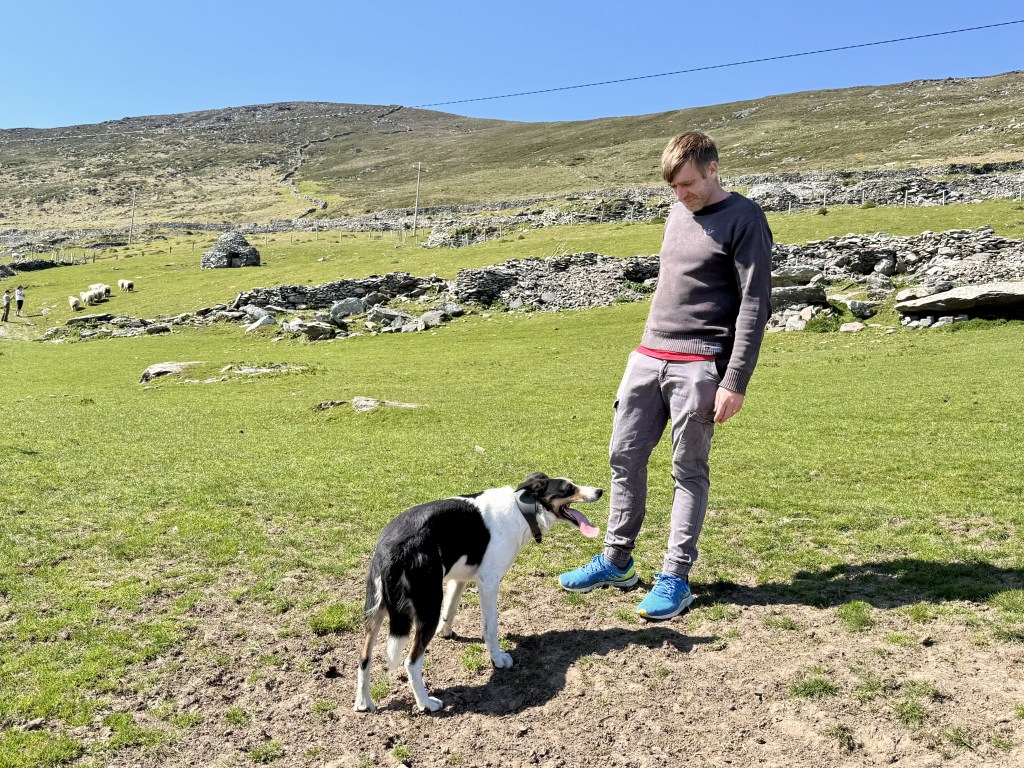
“My people actually built the house,” he explains. His great-grandfather, he says, married into the farm. “This was actually his wife’s farm.”
The original farmhouse remains at the heart of the property, with layers of construction revealing its long life. O’Huallachain points out “the difference between the stone and the upgrade,” evidence of the way the home has evolved over time while still retaining its character. More recently, the family completed major renovation work, including the addition of solar power, a practical modern touch in a place otherwise defined by centuries-old tradition.
It is this blend of old and new that gives the farm its special character. The structures are historic, the work is ongoing, and the values remain rooted.
“There’s a lot of … I want to use the word erosion,” O’Huallachain says, reflecting on modern Ireland and how quickly culture can change. “Irish culture changing and everything changes from the generations.” Yet what his family is doing here feels remarkably grounded. “It’s nice to continue the same way as we were always family before.”
That sense of continuity is no accident. It is a real working life, even if tourism has become an increasingly important part of sustaining it.
Like many traditional farmers in Ireland, O’Huallachain is candid about the realities of rural life today. “It’s not possible to actually make a living from it, just sheep farming alone,” he says. Part of the problem is the collapse of the wool industry. “It completely collapsed over the last 50 or 60 years,” he explains, attributing the change in part to the rise of synthetic materials. Wool, once central to rural economies, no longer brings the financial return it once did.
That economic shift has reshaped farm life across Ireland. On the Dingle Peninsula, as elsewhere, many families have had to diversify, and tourism has become one of the most important ways to do that.
O’Huallachain has seen that change firsthand. “I suppose it has gotten busier in the area,” he says. “I think tourism has taken off. In the last 10 or 15 years, the tourism was way more than it used to be.”
The increase is visible across Dingle, now one of Ireland’s best-loved destinations for international visitors, especially from the United States, the UK, Canada, and Australia. People come for the Wild Atlantic Way, for traditional music, for food, for scenery, and increasingly, for authentic rural experiences that let them connect with the land in a hands-on way.
At Hold a Baby Lamb, that connection begins almost immediately.
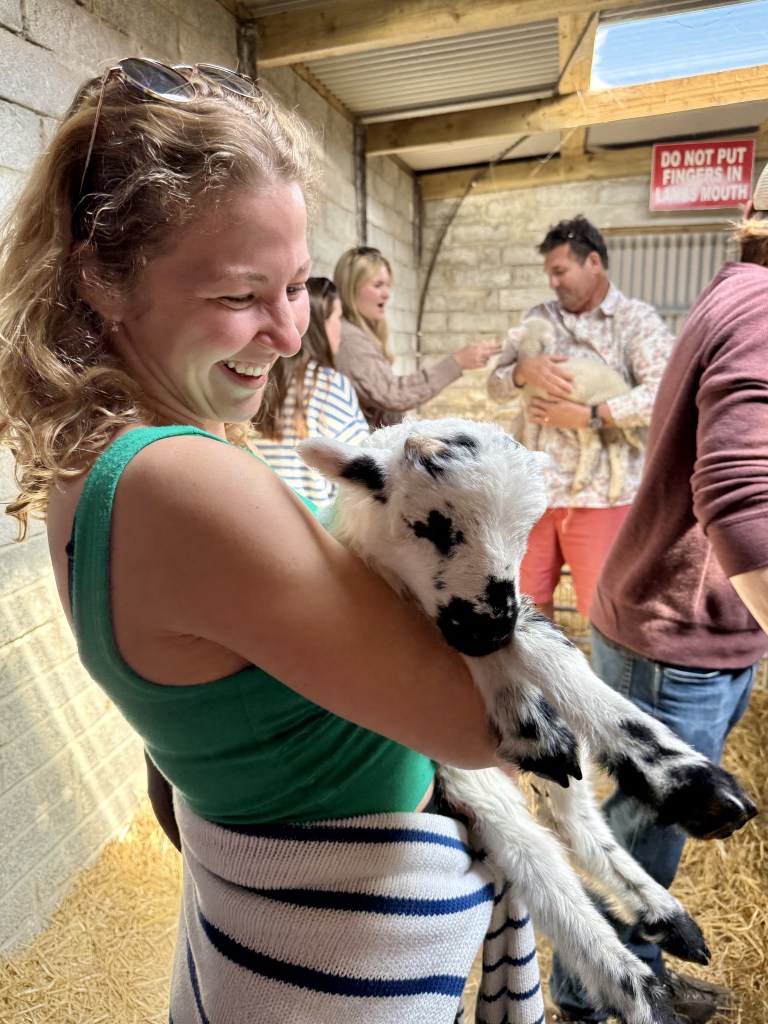
For many visitors, especially those from cities, the simple act of holding a lamb is a revelation. “It’s funny because in Ireland anywhere 100 years ago, everybody was involved with that,” O’Huallachain says, referring to everyday contact with animals. “Almost everybody was involved with animals, you know. So now where people just don’t have any contact with them …” They come seeking the joy of meeting an animal up close, he says.
And that distance from farm life is exactly why the experience resonates. Visitors do not just observe. They interact. They touch wool, cradle a lamb, watch a sheepdog respond to commands, and see how intelligence and instinct work together in the field.
“You see the joy, you see the wonder,” proprietor Aedan O’Huallachain says. “They’re just astounded by it. It’s like, this is a sheep and I’m holding it.”
That sense of wonder extends to the sheepdog demonstrations, which are among the highlights of a visit. Among the visitors the day we were there, everyone shares an obvious affection for the dogs as well as the lambs. “We saw a tremendous show.”
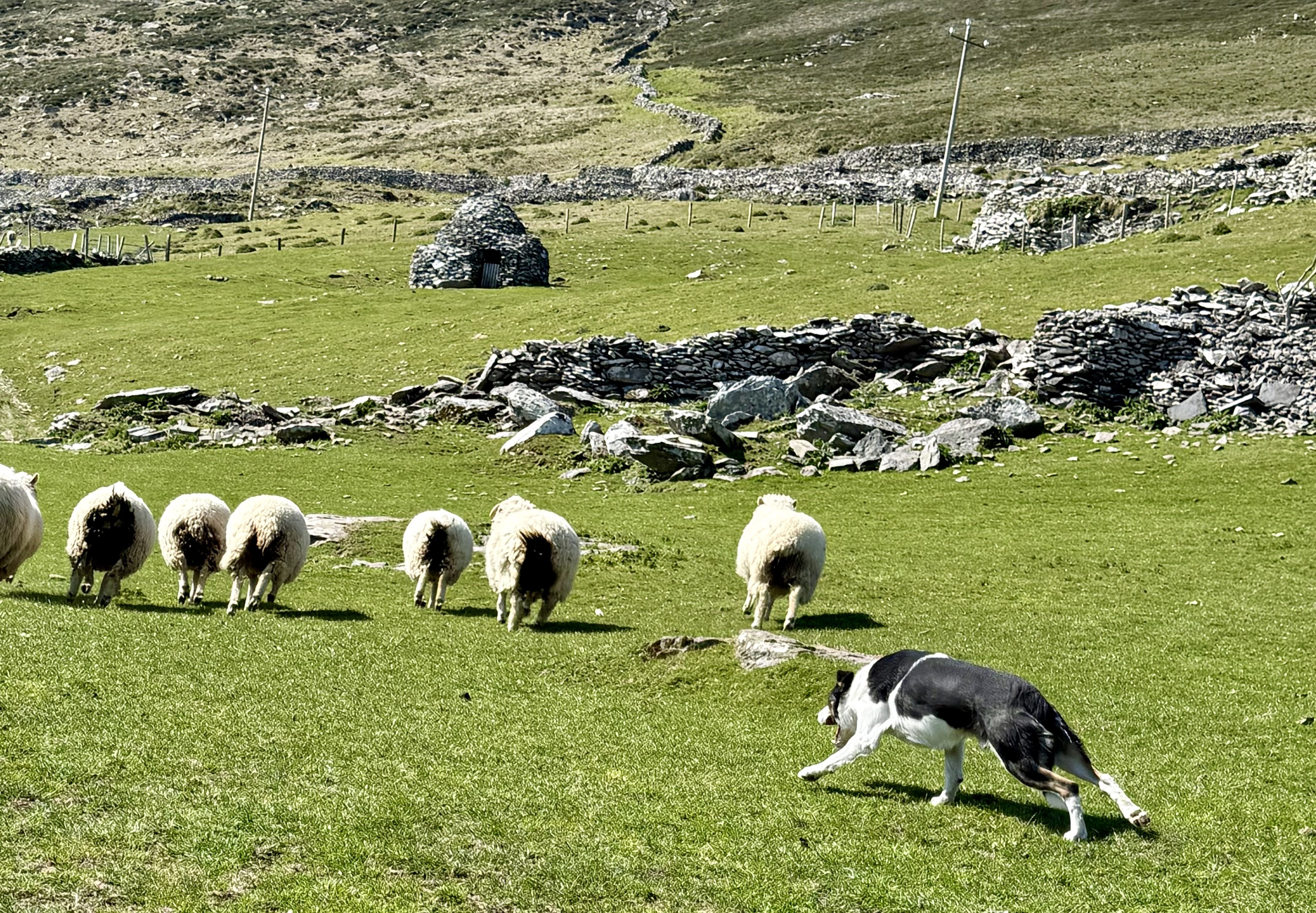
O’Huallachain mentions his determined sidekick Dave, along with other dogs in the family’s working lineup, including up-and-comer Rocky and, of course, single-minded Spot. These are not show animals in a staged sense. They are working dogs, part of a long agricultural tradition in which trained sheepdogs are essential partners on hill farms and open land. Watching them work is to glimpse a skill shaped over generations, both canine and human.
O’Huallachain’s family has been involved in these demonstrations for years. “My uncle also does the dog demonstrations,” he says, noting that farming and presentation are very much shared family endeavors. His father helps too, and the business has even drawn outside interest: one apprentice currently learning with him is Hungarian, a sign that traditional rural skills still carry appeal across borders.
O’Huallachain did not always imagine himself staying.
“I actually wanted to see a bit of the world … and I did for a few years,” he says, explaining that he worked as a ship’s officer before returning home. That detail adds another layer to the story: Like so many people from rural communities, he left, saw another life, and came back.
The return matters. So does the decision to continue.
His family’s story, like the story of so many Irish families, is shaped by migration as well as rootedness. He speaks of relatives who went to America. “He was one of eight,” he says of an earlier generation. “Six more went to America.” Others remained. The family still has connections across the Atlantic, and O’Huallachain himself has traveled back and forth to the United States many times.
That pattern—some leaving, some staying, all connected—is deeply woven into Irish history, especially in the 19th and early 20th centuries, when emigration transformed rural communities. On the Dingle Peninsula, where land was precious and livelihoods uncertain, those departures were especially significant.
And yet places like this endured. The wider area around the farm is one of the most historically rich landscapes in Ireland. The Dingle Peninsula contains one of the highest concentrations of archaeological sites in the country, from ring forts and standing stones to early monastic remains. Among its most distinctive structures are the famous beehive huts, dry-stone clocháns, some of which survive from the early medieval period, though similar building traditions may be even older.
O’Huallachain notes that visitors “would always come and see the beehive huts,” underscoring how central these ancient structures are to the identity of the place. There is restoration work under way on some of the huts, supported by the government, helping preserve an extraordinary physical link to the past.
That preservation effort feels fitting. What O’Huallachain and his family offer is not just an activity but a form of stewardship. They are, in a real sense, in “the historic preservation business” as much as the service business.
The beauty of the farm lies in this layering: the lambs and dogs of the present day, the old farmhouse built by earlier generations, and beyond them the stone remnants of a much older Ireland. The appeal of Hold a Baby Lamb is easy to understand. It is heartwarming, photogenic, family-friendly, and deeply local. But what stays with visitors is not just the novelty of cuddling a lamb.
It is the feeling of stepping, however briefly, into a way of life that still carries meaning. And requires skill. Contact with the rhythms of a place where culture has been shaped by land and labor over centuries.
For O’Huallachain, that may be the most important part of the experience. He wants people to leave with a sense of connection—to understand, perhaps, that what seems quaint or picturesque was once ordinary life, and that preserving even part of that inheritance matters.
And for travelers heading to Dingle, it makes an already remarkable destination richer still.
Come for the scenery, the sea, the music, and the food. Come for the beaches and the pubs and the wild Atlantic light. But make time, too, for the farm tucked into this historic hillside, where a baby lamb in your arms can become a surprisingly powerful link to Ireland’s past and present.
 RELATED ☘️