By BRIAN HANCOCK
Special to RELATED ☘️
It’s not often you see the wind speed pegged at 60 knots. The tiny anemometer only went up to 60 and the dial was shaking, wanting to show us the real wind speed, which was closer to 80 knots.
It’s also not often that any sailor would think it was a good idea to go sailing when the forecast was for “boat sinking” weather, but we went anyway. I was just a punk looking for adventure and the idea of sailing in one of the most prestigious yacht races in the world was just what I wanted to do, weather be damned. I didn’t know at the time that I would be reported dead, while at the same time finding my way along Ireland’s stunningly beautiful south coast.

Let me explain. The Fastnet Race is a must-do on the world sailing circuit. The race starts off the Royal Yacht Squadron in Cowes on the Isle of Wight. Right there, that should tell you something. That’s where the most famous yacht race in the world, the first America’s Cup took place back in 1851 and started the longest sporting win in history. The New York Yacht Club, who won that first race, fended off challengers for 132 years. I was a pink-behind-the-ears South African in awe of the history of the place and just wanting to have fun. And have fun we did; until we didn’t.
The Fastnet Race starts from Cowes with the only mark of the course being the Fastnet Rock off the southern coast of Ireland. It’s 600 miles of ripping tides, tricky wind patterns, sometimes boredom and sometimes terror. In 1979, it was mostly terror.
We could sense the wind picking up late in the afternoon of our second day at sea. We were past the Isles of Scilly and well out into the Irish Sea. Just as the sun was setting, a small trimaran buzzed us. They were sailing a cheap boat and were giving our million-dollar yacht a good run for its money. The crew were two couples, suntanned, beautiful and laughing; they didn’t survive the night.
By midnight, when I was due to go on watch, the boat was slamming into stripmall-sized waves. I could hear the wind howling through the rigging. I knew we were getting closer to Fastnet Rock. When I went on deck, the anemometer was pegged, and the wind was enough to rip the pants off anyone trying to pee overboard. Ahead, the lighthouse looked like a beacon of warmth. It wasn’t. It was just a turning mark in a boat race, and we were obliged to give it a wide berth.
It was not long after when we started to sink.
Our boat, Battlecry, was a new boat built in Finland by some of the best boatbuilders in the world. It was starting to fall apart. The ring frames, the rib cages of all boats, were coming apart, and water, that sneaky mistress, was coming in faster than we could pump it out. We were definitely sinking.
Our skipper made a good decision. We would turn away from the wind, ease the strain on the boat, and head for Cork where the Royal Cork Yacht Club awaited. I had no clue. I was just a young foredeck hand doing as I was told. When we finally got closer to the coast of Ireland, the enormity of what had happened overnight started to dawn on us. Every boat that could possibly help was helping. They were going out into the thick of things to rescue those still alive and to try and retrieve the bodies of those who didn’t make it. It was harrowing for all.
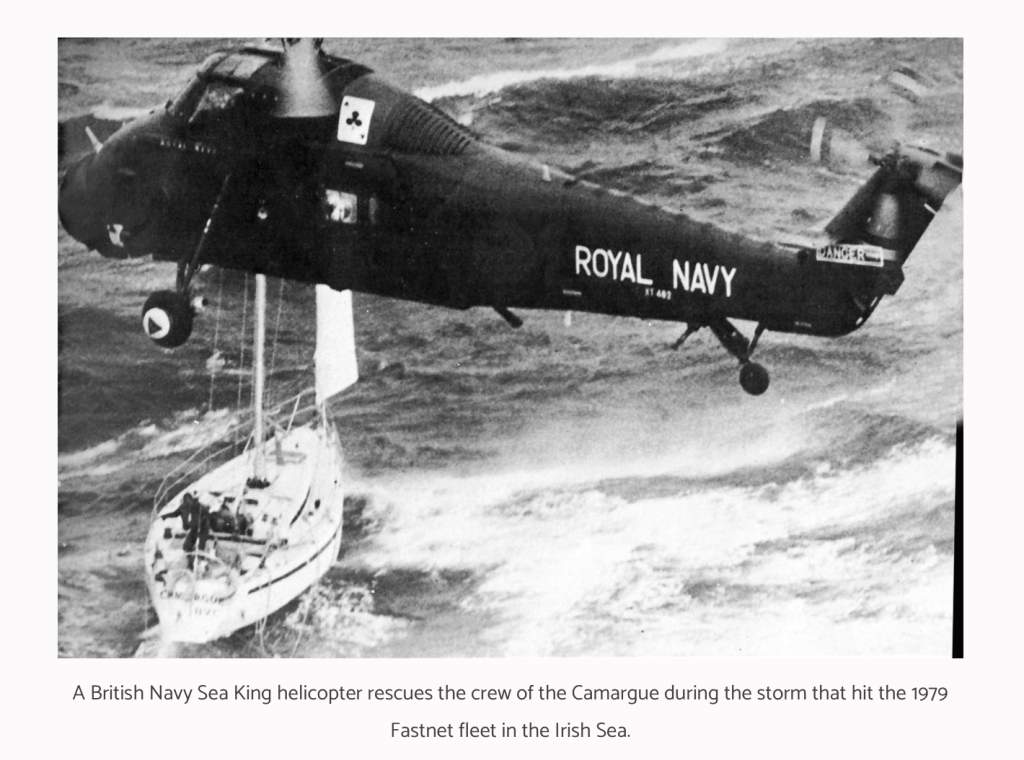
The storm that hit the fleet had started as a low-pressure system out over the Atlantic and went on a march toward Ireland and a fleet of sailors dulled into thinking that everything would be okay. Wind was just wind after all, but when the storm hit the shallow waters of the Irish Sea, things changed. The waves got tripped up and they started to get steep and nasty, and that was when boats started to go down. It was a night of pure terror as 19 people died and many more were injured as their boats sank and they resorted to their flimsy shell of a life raft until help came in the form of a helicopter with a man dangling a few feet above the water, offering hope. Many were rescued that night. Some weren’t.
We docked at the Royal Cork, wet, wild eyed, and still not sure what had just happened. The yacht club welcomed us in, and I tasted my very first pint of a hand-poured Guiness. It went down “singing hymns” as my late father liked to say. Speaking of my Dad, he woke up that same morning to the headlines in our local newspaper in South Africa that read, “Local Boy Missing, Presumed Dead.” Right below the headline was a photo of me that had been lifted from our high school yearbook.
Meanwhile, I was ordering my third pint.
I had no idea. In those days, it was all done in pencil in a foolscap book, no computers and despite my dad’s best efforts, the race officials had no clue where I was. I was at the Royal Cork Yacht Club pub, chugging my fifth pint of the gooey goodness.
The experts from Finland flew in and it was deemed that Battlecry would need a month or so to fix, so I took off on a holiday. I set off to the west, toward Rosscarbery, looking for druids. It didn’t take long to get picked up, and the nice driver knew of a place: Drombeg Stone Circle. Now let me just say that I was young and dumb at the time, but I knew enough about Celtic history to know that the Stone Circle was a special place. A few years later, I visited Stonehenge, but it didn’t hold the same magic for me as much as Drombeg did. It might have been because my new friend dropped me off at Prison Cove. If I remember correctly, the man offered me a bed for the night, but I wanted to sleep on the cliffs overlooking the cove and the Atlantic. Did I mention that I was young and dumb? It poured with rain that night, and I had to walk 5 miles to get back to the nearest main road to hitch another ride.
I had very little money, so I slept rough for two weeks, stopping only when I saw a pub where I could find a pie and a pint. I saved my money by sleeping rough in order to afford more than a few pints for breakfast and some more for lunch.
I made it all the way around the west country and up to Galway before completely running out of beer money when, by sheer luck, I got a good ride back to Cork. The skipper of Battlecry, a Kiwi, told me that the boat needed a couple more months’ work, but that he had organised a ride for me back to England. It was on a small boat called Sophie B. The Irish Sea was much kinder on that crossing, and they dropped me off in Plymouth. I took the train to Southampton, where I knew a girl. That was when I thought to call my Dad to tell him about how awesome Ireland was. I think that my step-mother might have had to steady him when he picked up the phone and heard his presumed-dead-son’s voice.
I tried to stay in touch with my Dad more often after that. We agreed to meet up in Rome a few months later. Italy was great, but I will never forget the kindness of the people of Ireland. They sure treated me as if I were alive and one can really feel alive when you are a baby-faced 21 year old being fueled by Guinness and the good clean air blowing in from the Atlantic, the same winds that had stolen 19 lives that late summer night.
The next Fastnet Race goes off July 24, 2027.
Irish by Ancestry Member Brian Hancock is in the rare club of sailors who have logged over a quarter-million offshore miles, most of them competing in major offshore races while delivering boats in between. These include participating in three Whitbread Round-the-World Races. In ’81 he sailed aboard the American yacht Alaska Eagle, in ’85 with Simon le Bon (he of Duran Duran fame) on Drum, and part way aboard the first, and by happenstance, last Soviet Union entry, Fazisi in ’89.
In the late ‘70s he competed in (and was shipwrecked) in the disastrous ’79 Fastnet Race where 21 people died but undaunted signed up a week later (without pay or prospects) to race from England to Australia in the Parmelia race, an event that celebrated the 150th anniversary of the discovery of Western Australia.
Racing sailboats didn’t pay much back in the ’80s and ’90s, so Brian supplemented his income by writing and has written for every major sailing magazine in the world. He has also written two memoirs, three novels, a book of short stories, a book of poetry, 50 children’s stories and the most definitive book on sails and the art of sailmaking.
Brian lives in Marblehead, Massachusetts, United States, with his two sons, his wife, her two sons, a cat named Fat Cat, and two chickens, Betty and Emma. He recently became a Grandparent.
 RELATED ☘️