We asked you, the Irish by Ancestry community, to share stories using the theme The Irish Thread in Your Life for this month’s Ancestor Memoir Contest. We received some beautiful shares. Thank you to all who participated, we appreciate your creativity and sharing. Keep writing! Your family stories will outlive you, your descendants will have to do less research, and your ancestors will be proud. (And please note: No AI-generated submissions will be published.)
Our winner this month is Sophie Hugo. Congratulations, Sophie! She is the winner of this month’s Irish by Ancestry prize pack. Here is her story.
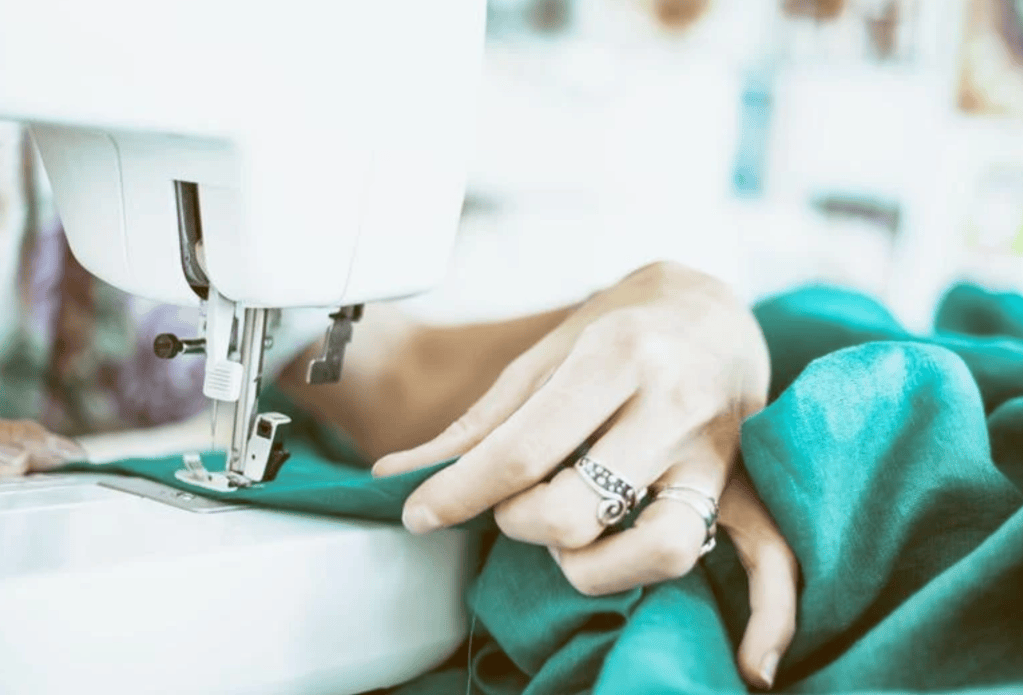
The Irish Thread Through Generations
By SOPHIE HUGO
In our family, history lives in our hands. It began in the quiet certainty of women who could turn a flat piece of cloth into something useful, beautiful, and lasting. If I am asked where the Irish thread in my life takes me, I honestly say: It begins with a literal needle.
The first keeper of that thread, as it has come down to me, was my great-great aunt Treasa.
I know her only through fragments. She was born in the west of Ireland in the late 19th century, in a place my grandmother always called “the stony ground,” where the fields were small and the wind seemed to come at the house from every direction at once. She never married, though nobody in the family told us the story as a sad one. Instead, they said Treasa was capable—her name itself meant “strengthened”—and in that single word, they placed all the admiration due a woman who knew how to make herself necessary.
Treasa sewed for neighbors and family. She altered wedding dresses so they might fit a sister after first serving a cousin. Unmarried women in that time were mocked, but she turned her husbandless state into service. In winter, she sat close to the smoky hearth, mending shirts by lamplight. In spring, she cut down old skirts for growing girls. In summer, she stitched christening gowns so simple yet fine, my grandmother said, that even the priest noticed. Cloth was precious then, and nothing was wasted.
My grandmother Nora inherited both Treasa’s sewing basket and, I think, her way of looking at the world. Nora’s mother, Gertrude, came to America as a girl, crossing with her parents and two younger sisters in the early years of the twentieth century. Their small farm had been so divided through the generations, plots hardly yielded enough to keep them fed. Like so many Irish families, they carried little that could be weighed at customs and much that could not: prayers, stories, and the practical arts that kept a household together. Among those arts was sewing.
My grandmother did not speak grandly of being Irish. She lived it. In her small house, with its crucifix over the kitchen door and lace curtains, sewing was part economy, part artistry, and part devotion. After surviving the Great Depression, she made church clothes for her children, turning collars carefully so they would sit flat, picking buttons from worn-out garments and saving them in a tin. She taught that a seam must be straight, not because anyone would inspect it, but because good work was worth the effort.
As a child, I sat beside her and watched. The manual treadle sewing machine was a marvel, alive under her foot. Her hands moved with assurance—freckled, rough, but never idle. She would let me sort her spools by color and hand me scraps I imagined into doll clothes. She did not lavish praise, but when my clumsy stitches held two pieces of cloth together, she nodded and said, “That’ll do. Now do it better.” It was a very Irish kind of encouragement: unsentimental but affectionate enough, and entirely confident that improvement was possible.
My mother, Kathleen, received the craft in a different America than Nora had entered. By the time I was growing up, sewing was no longer a necessity. Ready-made clothes filled the shops. Fabric itself had changed, more synthetic, more affordable, less appreciated. Yet my mother kept sewing because it bound her to those who had done so before her. She had learned embroidery from her mother and aunts, and they made the most extraordinary tablecloths: poinsettias for Christmas, flowers for Easter. And how they kept them so white, I still can’t figure out.
My earliest memory of mother’s machine is the sound of it after supper, steady as breathing. She sewed Halloween and school play costumes, curtains, aprons. We could have bought them, though not without sacrifice. I remember the smell of steam from the iron, the clipped threads clinging to the carpet, and the seriousness with which she approached the task. We are stitched into a line of women who knew how to make something worthy with their own hands.
When my turn came, my mother resisted teaching. Why spend hours making what could be purchased in minutes? Why struggle with a seam ripper and pattern tissue? She openly feared for my fingers around the needle of an electric machine. Yet when I bought my first home, I felt drawn to making my own curtains. As I manipulated the simple lined rectangles of blue and white toile, I recognized the wisdom hidden in the work. Sewing slows the eye and steadies the concentration. It teaches that mistakes need not be discarded; they can be unpicked, pressed, and done again (which I’ve had to do many a time). These are life lessons, and perhaps distinctly immigrant ones as well, lessons in making, mending, saving, adapting, and carrying forward.
When my daughter was four, I gave her a small tin of buttons, much like the one my grandmother had kept. She spilled them across the table as if they were treasure, which of course they were. Together we began with the simplest things: threading a needle, tying a knot, pushing through and pulling back. Her first stitches were wild and wandering. She frowned at them, and I heard my grandmother in my own voice when I said, gently, “That’ll do. Now do it better.”
We have sewn little things together: pillows for her bed, a costume cape, a patch over the knee of jeans she refused to give up. A few years ago, I made my great nephews and nieces Christmas quilts. As I worked, I thought about Treasa in the west of Ireland, about Nora at her treadle machine, about Kathleen at the kitchen table after dark. My daughter, grown now, sews with me, making treasured baby blankets for friends as their babies come along.
That is how the Irish thread endures in us. A hand learns from another hand. A needle rising and falling, connecting true thread. What was once necessity becomes a gift. Across oceans, generations, and changing times, the thread has not broken. I hold it now, and as my daughter bends over her stitches, tongue caught in concentration, I see that she holds it too.
***
Here we have an entry from our favorite bard, Eric Cronin. Here is his story of coming full circle with his Irish family thread. Great job, as always, Eric. Thank you for sharing the gift of your words with us.
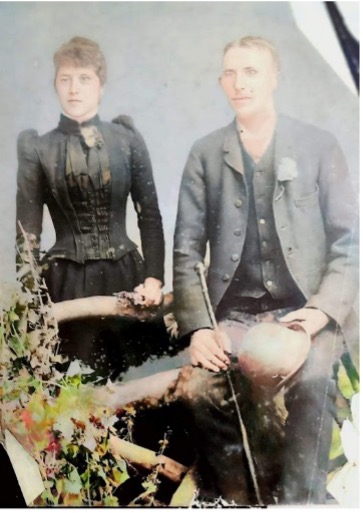
Following in footsteps of your Irish father: A journey with consequences
By ERIC CRONIN
We are all born naked and innocent. Only the parents and the cradle in which you are placed determine, to a large extent, who you become and your entire being and actions for as long as you live—not always, but usually.
I was lucky; I was the son of a Flemish mother and a father who was born in Ireland and spent a considerable part of his youth there. Ireland and our Irish heritage are something we were spoon-fed, from childhood until the passing of both parents. Not that we dance around the table at home every day, adorned with Irish flags or other symbols, with big words or tough pronouncements—far from it. But simply by being the son of a father who possessed the skill to pass on his “Irishness” in his own way, because he could not do otherwise and probably wished it that way.
Consciously or unconsciously, and from a very young age, you realized that you were “different”: not better or worse, but not an ordinary Flemish child, like the others. To them, you were Irish, even if your mother was Flemish.
I was 62 when I visited my father’s native country for the first time. To put this in context: At the initiative of our children, my brothers and I retraced a journey that every grandchild undertook with their father in the year they turned 16. We followed, as it were, back in time in his footsteps, to his youth in his homeland.
This trip was the beginning, the start of a turning point in my life. It is not the memories of those wonderful and special days together with my brothers and fellow travelers that are and will remain dear to me for the rest of my life. Yet, the effect these days had on me is something I could never have predicted.
It began the very moment I took my first step on Irish soil. I felt like I was coming home after all those years. I felt that a part of me belonged here. Strangely enough, my brothers had the same feeling; we didn’t speak a word, yet our glances told enough. We had only one major goal during the trip: to visit our family home.
We found it. It was uninhabited, yet we were satisfied that we had found it. Once again, not a word was spoken. Sometimes words are not necessary; looks speak all the more. The goal had been achieved.
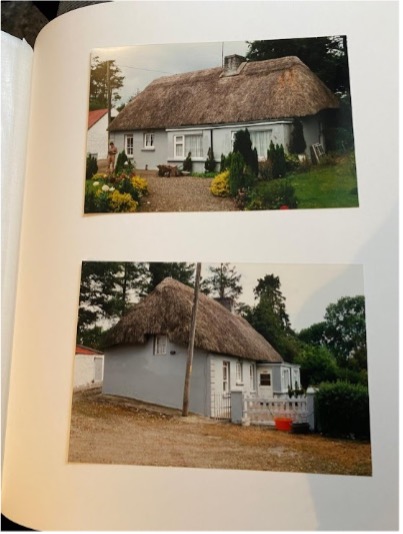
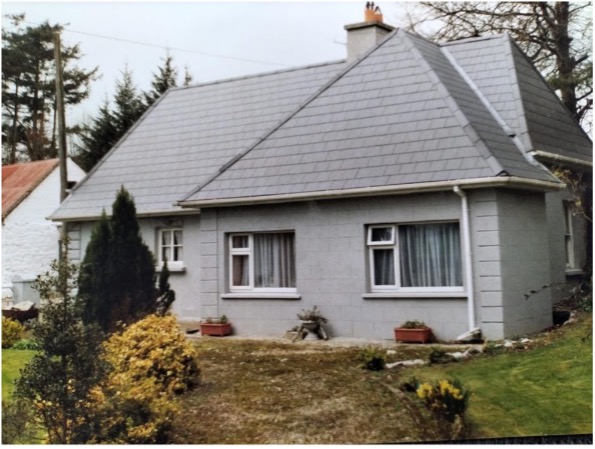
Afterward, we continued the journey in Father’s footsteps. We enjoyed ourselves, experienced life, and learned. We were able to close a circle that we had subconsciously never been able to close; the missing link had been found and visited.
Once back home, I noticed that Ireland had changed me; the small inner fire that had always burned inside me had been ignited; there was no stopping it. I was determined to search for more information about our Irish heritage.
Quite soon, I received a photo of our great-grandparents’ gravestone, which was an important step. I was also in possession of Father’s Ireland map and found a huge number of things I had never read. How stupid can a person be? I found photos, letters, and all sorts of things that are now priceless to me, not in money, but in emotion.
A second trip was quickly planned; we would visit the cemetery where the headstone has stood for years, and bring back something of Father and reunite it at the family stone, to bring Father back home a little bit.
Beforehand, I went looking for authorities to ask if we were allowed to place something at the headstone. After all, you don’t want to trample on laws or customs. You have to follow the rules and, above all, respect them.
By chance, I found a Facebook group of volunteers involved in the maintenance and restoration of this cemetery, the Old Cemetery of Kilcrumper. I posted my question, and within moments I received a response I had never dared to dream of.
“I am your distant cousin! My grandmother was Mary Cronin of Ballyhindon, Fermoy, your dad’s cousin. In fact, I met your father on a few occasions when he came to visit my grandparents!”
This left me speechless for a moment. I also received a response from the brother. Emails and messages were exchanged, and a meeting was arranged.
Our journey was richer in goals: We were allowed to meet our Irish family, visit the ancestral home, and ask questions that would give us answers. How lucky can one be?
I don’t need to tell you, dear reader, that this trip was one of the highlights of my life.
We visited the family, and very quickly you felt a connection, a bond, a shared sense between us; you felt like you belonged and that the joy of meeting was mutual.
The visit to the old house was like stepping through a time capsule; time had stood still in and around the home. It was uninhabited, but all the furnishings were present, as if the last resident had been wandering around there yesterday. I looked and enjoyed it.
We placed a memorial to Father at the family gravestone. He has, as it were, come home a little. Being able and allowed to realize this makes me intensely happy.
I know my Irish relatives and keep in touch, and at this moment I can go back generations with names, places, and dates. What was once unknown territory to me is now familiar ground. I feel more complete, more at ease, and have found my roots, and that gives me a deep and better feeling.
I conclude with cherished words from Eoin Brown; reading this does something to a person:
To finish, it is a rare thing to have people enter your home as strangers and to leave as dear family and friends.
This was my experience last Sunday and one that I will treasure.
***
And one last entry, a new voice of heartfelt stories that bind our families and preserve our memories. Wonderful effort put in here by Claire Campbell. Keep writing, Claire!
Crazy Nanna and the Irish Thread in my Life
By CLAIRE CAMPBELL
My parents were part of the first wave of families to leave Boston for the South Shore of Massachusetts, when my mother was pregnant with me, her seventh of what would be 15 children. My father grew up in Roxbury; my mother, Barbara, or “Ma” as we called her, grew up in Dorchester, the middle child of five girls, with an alcoholic father, William Cody, aka “Wild Bill,” whose parents hailed from Kilkenny, and a stern mother, Mary (Powers) Cody.
My mother’s maternal grandmother, Julia (Sullivan) Powers, who had immigrated here from Killorglin, Co. Kerry, lived with them, and she was a great source of amusement for Ma and her sisters during the peak of the Great Depression. When reminiscing, they called her “Crazy Nanna.”
While my father crooned “Molly Malone” in his deeply haunting, low baritone voice to the baby in “the magic crib”—the source for our naturally curly hair, according to our family legend—Ma would tell us tales about her grandmother, “Crazy Nanna,” as bedtime stories.
For the youngest ones, these stories were new, and they listened in disbelief; the older siblings had heard them many times before but still laughed with delight. Our favorite story was the one about Crazy Nanna shedding her housecoat, running out of the triple-decker, and dancing naked in the Dorchester street while Ma and her sisters giggled on the stoop, and their mother, mortified, ran out to bring her back inside.
There was a mission oak rocking chair that originally belonged to my great-grandmother which sat collecting dust in our basement. My grandmother had given it to my mother, and she loved that chair. I asked Ma why she didn’t bring it up into the house, and my father snorted, “With babies crawling around? Their fingers will get crushed!” I once asked my mother if I could have it when she died. “Put your name on it,” she stoically replied.
As my grandfather aged, he needed more care than my grandmother could provide, so Ma and her sisters took turns assisting her. Ma didn’t drive, so she took the bus to Boston. I would accompany her, although I didn’t really want to. My grandmother was very strict, and my grandfather’s behavior sometimes frightened me. He always called me Barbara, as if he were talking to my mother. Once, I walked in the living room, and he shouted at me, “Barbara, you promised you would never cut your long, beautiful hair,” waving his cane in the air.
“Bill, that is Claire,” my grandmother shouted, and he crumbled in his chair in confusion.
One time, he sat at the kitchen table crying repeatedly, “Mary, I didn’t mean to kill her; it was an accident,” and my grandmother reassured him, “I know Bill; I know.” On the walk to the bus stop, my mother explained that he used to drive a Hood Milk delivery truck and once during a rainstorm, he hit a young girl crossing the street, and she had died.
One day, in high school, my name was announced over the PA system to report to the office: “There’s a family emergency; you need to go home.” When I walked out of school, I saw my family’s station wagon. I knew something was really wrong if Dad was home from work early. I got in the car, and he said, “Your grandfather died; your mother needs to go to Boston. I have to drive her in town, so you need to watch your brothers and sisters.”
I felt sympathy for my mother, but I was mostly irritated that I had to babysit my younger siblings. I also felt relieved I didn’t have to accompany her and be with her, her sisters, and her mother at this difficult time. I tried hard to think of one good memory of my grandfather, and it came to me: him, after Thanksgiving dinner, drinking beer and shooting whiskey, in the living room of my Southie cousins, as he stood by their Player piano crooning “Danny Boy,” with the family crowded in the living room singing along.
Years later, after my father’s death, my mother had to sell the family home and move in with my sister Laura and her family, because she couldn’t live alone anymore. Ma lived with them for several years in an in-law apartment, until she was no longer capable of being “on her own”; then, Laura moved her two oldest sons into the apartment and my mother into their bedroom. My mother’s dementia increased over the years. She would do things like start to do the dishes, then walk away leaving the faucet on and the plug in the drain and flood the kitchen. One night, making tea, she turned the flame of the burner under the kettle off but not the gas completely and almost killed the entire family while they slept.
I regularly visited Ma at my sister’s, but she never remembered me. She called me by another relative’s name or got irritated trying to remember who I was. She did remember me one day but then got mad that I hadn’t come to see her “for years” when my last visit was only two weeks before. One day, Laura found her in the pantry, naked, muttering “I can’t find him,” meaning my father, because she thought he “just disappeared one day.” As she walked their grandmother to her room, wrapped in a tablecloth from the pantry drawer, Laura said to her three teenaged children: “This will be a story to tell your children one day.” Ma died two years ago.
I recently moved closer to my daughter and her family. It is nice having them close by “just in case,” and I get to spend a lot of time with my grandchildren, Kaylee and Aidan. I often sit with them in my great-grandmother’s rocking chair, singing or reading to them, trying to create good memories for stories they can tell their children one day.
Do you have an ancestral memoir you want to share? You could be our next winner! The September theme is The Ancestors Return. We invite you to consider how an ancestor of yours still “visits” through habit, repeated story, a face, phrase, song, or family tradition. Be as creative as you like with this one. We are aiming for a record number of submissions for the October issue, RELATED’s one-year anniversary! Please send your 1000-words-or-less submission to stories@byancestry.com with the subject line ANCESTOR MEMOIR.
 RELATED ☘️
1 thought on “Ancestor Memoir Contest Winners”