By SHELAGH BRALEY STARR
RELATED☘️ Staff
Few school systems in any country ask students to engage with subjects as emotionally charged as An Gorta Mór (the Great Hunger), the 1916 Rising, the Troubles, and the long chronicles of Irish emigration. But in Ireland, these tough topics are central to how the country understands itself. Grappling with its history of loss and movement is as essential as math and literature.
Children in Irish schools begin encountering the past from primary school onward, usually through a mix of local history, storytelling, commemorations, and age-appropriate source material.
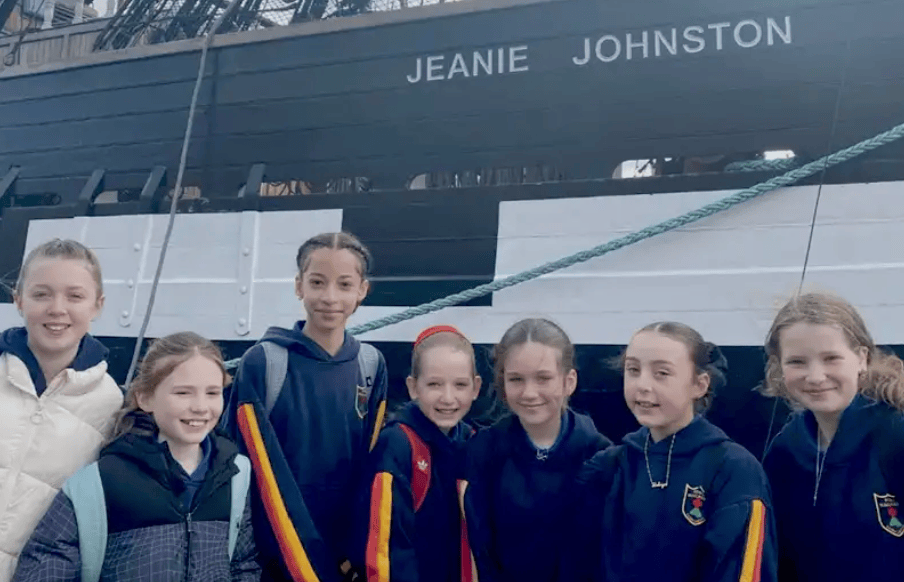
EPIC the Irish Emigration Museum in Dublin sees local students arriving to learn their history just as they do visitors from abroad. The topics are indeed heavy, said Nathan Mannion, head of exhibitions and programmes, but there are ways to teach such things that foster empathy and global citizenship.
“We try to concentrate on as much factual information as possible,” Mannion said, addressing such questions as, “ ‘how long did it go on, what was the impact, where is the connection to emigration, how did that come to be, and how is that period remembered?’ ”
Mannion said EPIC programming complements what the students learn in class, bringing the subject matter even closer without overwhelming them.
“What we try to do is not just look at (the famine) as a distant event, but ask, ‘What is it like to be hungry, why was this allowed to be happen? Have you ever been hungry?’ It’s sensory. There are people going through this today, so it’s historic but also present. The students develop empathy here, so around the world, they’re aware of it.”
EPIC brings emigration to life with interactive exhibits that put them—literally—in the shoes of the children who boarded ships for other worlds. They choose what to put in their suitcases. Make survival biscuits. Even cardboard shoes. Below, courtesy of EPIC, you’ll see a piece of curriculum the students review.
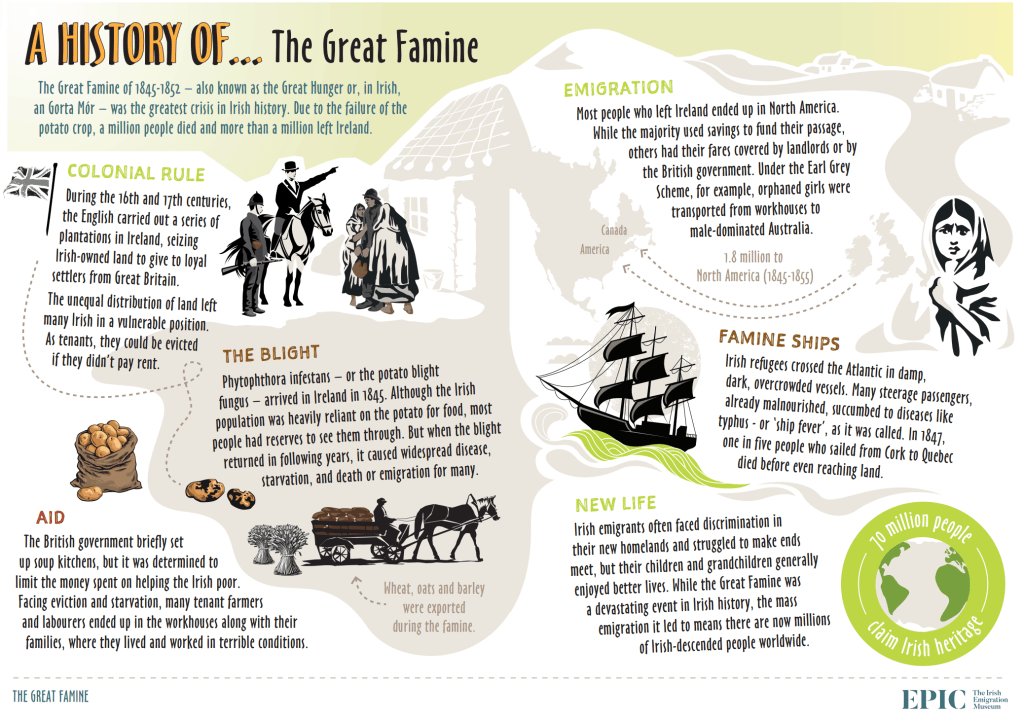
“We encourage students to reflect on: What would you bring with you if you had to go, if you were displaced? A cherished family memento, food, warm clothing? They left with the very little that they did have,” Mannion said.
“We also have journals, diaries of what it was like, copies of firsthand letters and eyewitness accounts of being evicted, to give that sense of hunger, death. We try not to just lean into the real hardship that everyone experienced but focus also on what were their lives like afterward,” Mannion said.
By secondary school, these subjects become more structured and analytical. The history curriculum in the Republic of Ireland includes significant attention to political change, colonial rule, nationalism, partition, and conflict. Students preparing for the Junior Cycle and Leaving Certificate are expected to know what happened and also assess evidence, compare interpretations, and understand cause and consequence. In Northern Ireland, where the legacy of the Troubles remains especially fresh, teaching can be more sensitive still, often shaped by the type of school, the local community, and efforts to promote balanced understanding.
The Great Hunger is typically taught as both a human catastrophe and a political controversy. Students learn about potato blight, dependence on a single crop, landlordism, poverty, evictions, workhouses, and mass death. But they also examine British government policy and ask difficult questions about responsibility. Was the disaster simply a natural event made worse by ideology or was it an avoidable tragedy intensified by apathy? Teachers draw on textbook accounts, census records, sketches of starving families, extracts from newspapers, official reports, and eyewitness testimony.
“We always get a few questions around, why was food being exported then? We respond, it’s quite simple, food was being exported because there was a belief in the Laissez Faire capitalism, a belief that if it doesn’t work, it should collapse, don’t get involved, no matter what happens. If it needs support, it’s not sustainable.”
One fact Mannion said students find quite surprising is that the blight didn’t originate in Ireland. “It came from New England and hit all over Europe,” though no other land lost as much due to it. For comparison, according to research published by the National Library of Medicine, by 1851, France had lost around 10,000 to the blight, Prussia’s losses were estimated at 42,000, and Belgium lost 50,000—less impact because they had other food sources on which to rely. Ireland suffered a million dead from disease and starvation, with another 1-2 million leaving for other countries. That resulted in a one-third of its population gone.
“Ireland is unique in that sense,” Mannion said, “that it is the only place that has a lower population than we did. We are still living in the aftermath all these years.”
The best teaching helps students understand why the past remains controversial in Ireland. History in Ireland has to be handled with care, but also with historical accuracy and enough distance so students can learn facts. They need the freedom ask hard questions and the time to develop critical thinking. In that balancing act, history education in Ireland determines what the country remembers, how it presents globally, and how the next generation will build a different future.
“The biggest compliment we get is, ‘I can’t wait to bring back my parents.’ When that happens, we’ve empowered them to be the new resident expert on the famine, they’re almost a tour guide themselves,” Mannion said. “That’s successful learning.”
Visit the EPIC museum when you’re in Dublin, at the chq Building, Custom House Quay. Visit their website to learn more HERE.

